Posted in Non-Fiction, Teen, Young Adult/New Adult

Two YA nonfiction titles for the weird fact fans in your life

Next up, with the new school year upon us, I look for nonfiction that will inform and entertain. Sometimes, I find nonfiction that is just so out there, I have to suggest them because they’re freaky, fun, and will give readers who equate nonfiction with boring a nudge and a wink, and maybe – just maybe – make a nonfiction reader out of one or three.

History’s Weirdest Deaths, by James Proud, (June 2019, Portable Press), $12.99, ISBN: 978-1-68412-757-3

Ages 15+

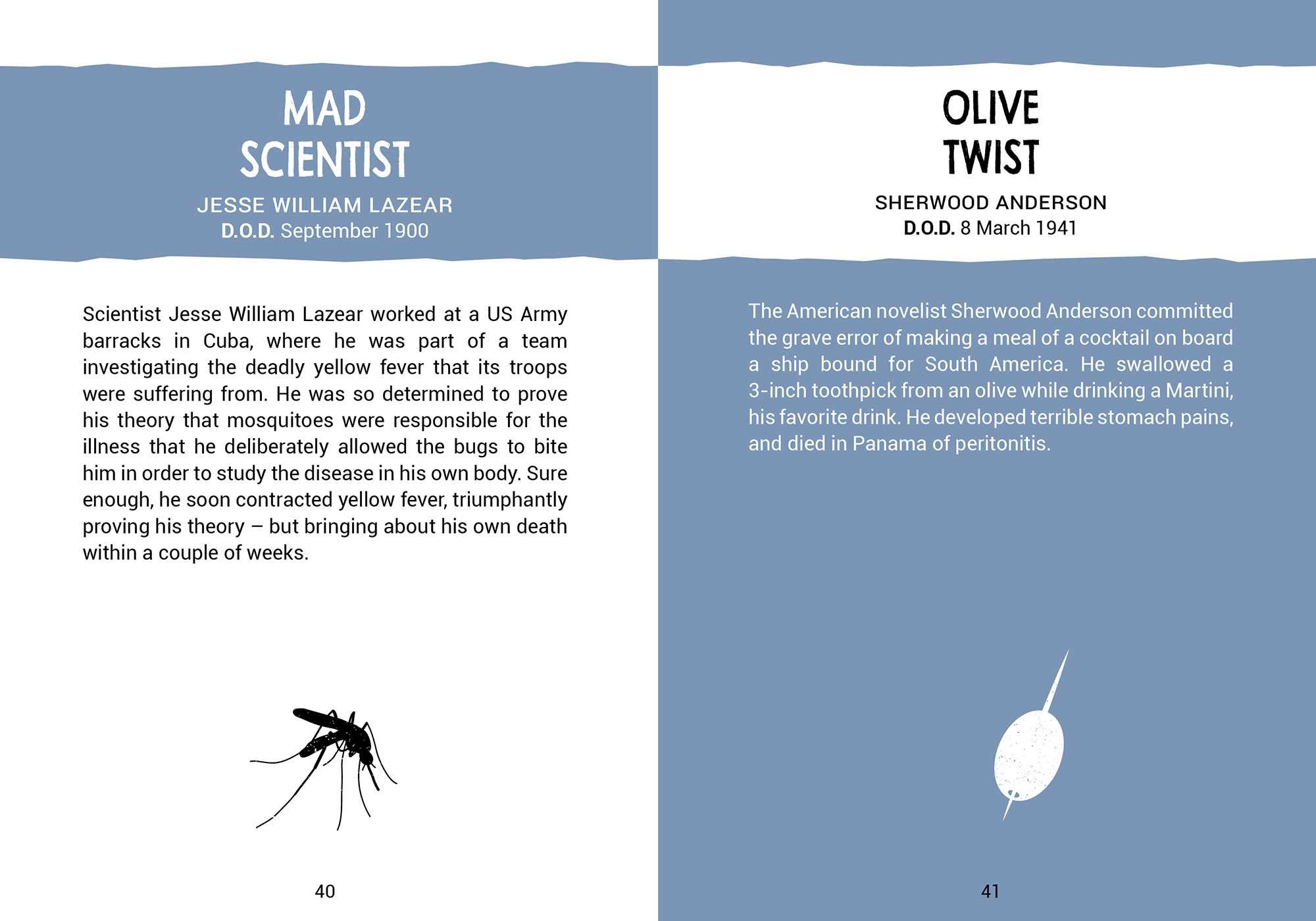
The title tells you all you need to know here: it’s a collection of stories and facts about freaky deaths throughout history. There are famous last words, unsettling statistics about Japanese pufferfish consumption, an unbelievable number of stories about people who went over Niagara Falls in a barrel, and unusual methods of execution. Each page has something new and bizarre to be discovered, like the story of 13-year-old William Snyder, who died in 1854 after “being swung around by the heels by a circus clown”. Or Joao Maria de Souza, who was crushed in 2013 when a cow wandered onto his roof and crashed through his ceiling, crushing him. There are also famous firsts: first death by robot, first death by auto accident, first spectator to die after being hit by a baseball during a game, and the first – and only known – jockey to win a race after dying. Illustrations add to the tongue-in-cheek morbid humor.
Strange Hollywood: Amazing and Intriguing Stories from Tinseltown and Beyond, by the Editors of Portable Press, (May 2019, Portable Press), $15.99, ISBN: 978-1-68412-677-4

Ages 15+

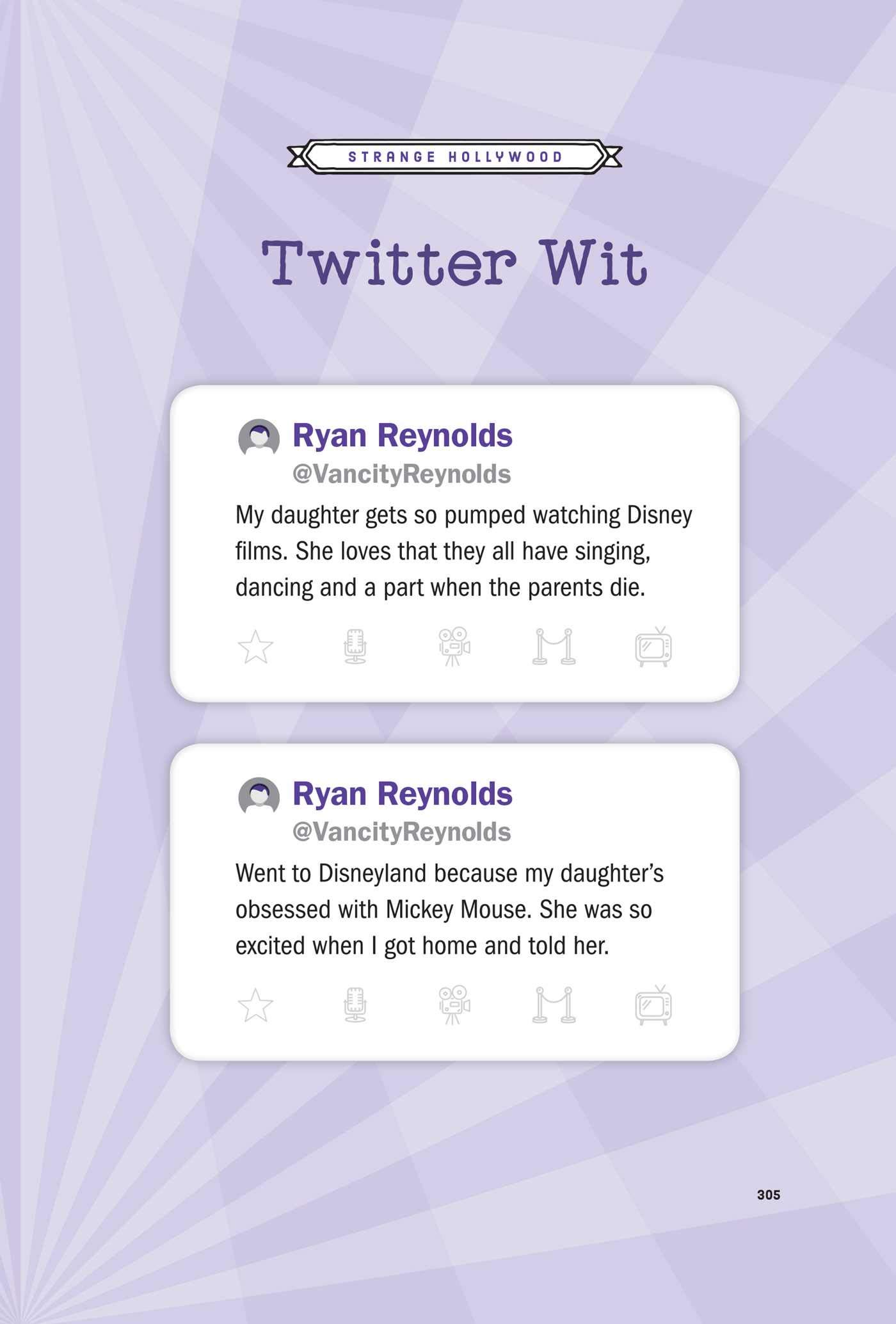
This is the latest in Portable’s Strange series and is loaded with stories about Hollywood, with a big emphasis on Hollywood’s Golden Age: stories about Rudolph Valentino, Charlie Chaplin, Judy Garland, Elvis, and Audrey Hepburn get a lot of page space; teens may not know the names, but the stories are a hook. There are quotes, Tweets, and facts in here, too, making this an easily readable book with tidbits to make readers laugh or wince. The recent Twitter feud between Armie Hammer and Jeffrey Dean Morgan is in here, and there are highlights called, “Putting the REAL in Reality TV” that squeal on the dubious verity of some of the more popular shows out there. Crazy lawsuits get touched on, too, like Hormel Foods, makers of canned meat Spam, suing Jim Henson Productions over naming a villainous Muppet Treasure Island character Spa’am. It’s morbid in some spots, head-shaking and wincing in others. An additional grab if you have nonfiction readers who love the gossip rags. Illustrated in two-color throughout.

 

Posted in Middle Grade, Non-Fiction, Non-fiction, Teen, Tween Reads

Monstrous brings the science of monsters to you

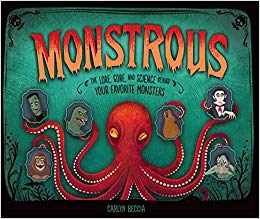
Monstrous: The Lore, Gore, and Science Behind Your Favorite Monsters, by Carlyn Beccia, (Sept. 2019, Carolrhoda Books), $19.99, ISBN: 978-1-5124-4916-7

Ages 10+

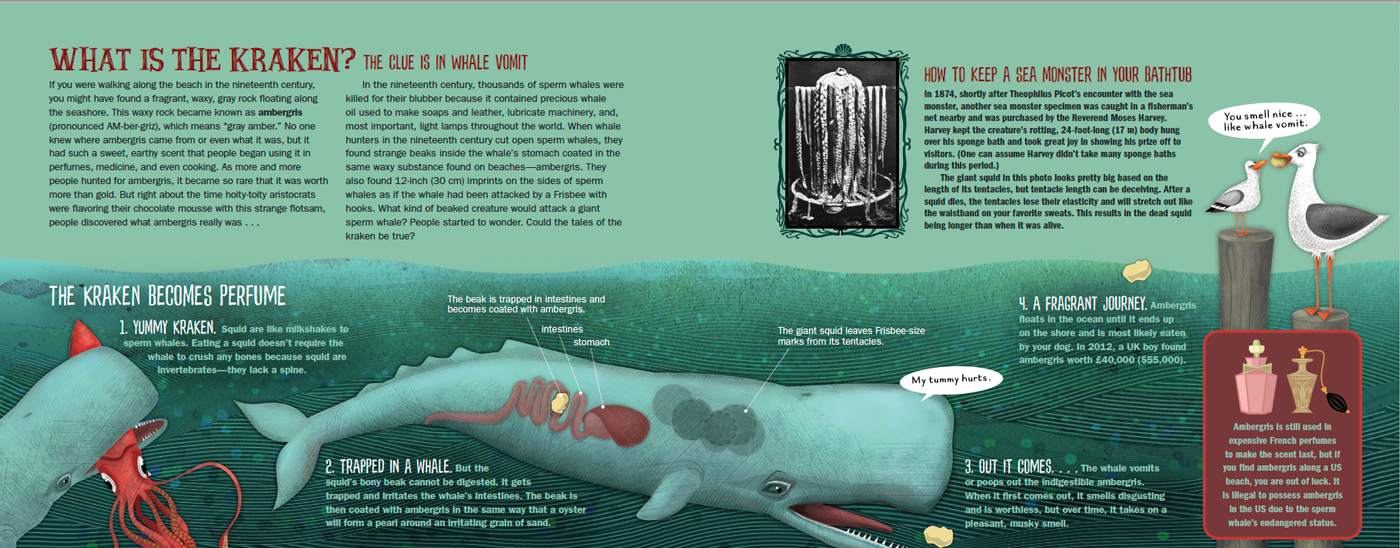
Okay, this is one of the best nonfiction reads I’ve read this summer. Eight movie monsters come together with witty writing, solid science and history, pop culture and myth, and amazing artwork to bring readers the “Science of the Monstrous”. Talk about electricity with Frankenstein’s Monster; whether or not science can make us immortal with Dracula (also, a spirited discussion on sparkly vampires); look at the zombie brain and pack a zombie preparedness kit while reading about zombie viruses; learn about math and whether or not you’re stronger than a dung beetle with King Kong; learn how to avoid – or, failing that, survive – a werewolf attack and read about the science behind the legend of werewolves; check out the ocean zones to figure out where the kraken dwells (and learn whether or not you’re about to be eaten by a giant octopus); talk evolution with Bigfoot while you scan a map of the US to see where your best chance of spotting him is; and, last but NEVER least, find out what kind of dinosaur Godzilla, King of All Monsters, is (hint: the awesome kind).

That’s the short of it. There is so much great stuff in here, I’d be here all day long if I tried to gush about how much I loved this book. I chuckled and snickered out loud behind the reference desk reading it, which brought some of my Library Kids over (the section on Why You Should Never Stress Your Mom Out made them laugh, which garnered a librarian look over the glasses from me). Everything in here is just pure gold, from the timelines like “The Monstrous History of Electricity”, where you learn that Thomas Edison used electricity on dolls to experiment with recorded sound (SO CREEPY), and a real list of radioactive creatures, like the wolves of Chernobyl and the cows of Fukushima. Carlyn Beccia’s writing is informative and whip-crack smart and funny – if I had a book like Monstrous available to me when I was in the middle grades, I’d probably be making freaky dolls talk to people in a lab today. Instead, I’ll figure out how to hold a program to let my Library Kids do it.

My Library Kids love the grossest history and science stuff out there, which I challenge myself to find on a regular basis; one of their favorites is Carlyn Beccia’s They Lost Their Heads!, along with Georgia Bragg’s How They Croaked and How They Choked, so I predict this book will disappear shortly after I say, “Hey, guys! Look what I’ve—“.

Long story short, Monstrous is a guaranteed win for your science collections, your STEM collections, and for your horror/monster/burgeoning goth fans. Check out author Carlyn Beccia’s webpage for more about her books, her art, and her social media links. Monstrous has a starred review from Kirkus.

Posted in Teen, Young Adult/New Adult

Dear Haiti, Love Alaine is the YA you need to read this Fall

Dear Haiti, Love Alaine, by Maika Moulite & Maritza Moulite, (Sept. 2019, Harlequin TEEN), $18.99, ISBN: 9781335777096

Ages 13+

Alaine is a smart, witty, outspoken 17-year-old Haitian-American teen living in Miami with her father. Her mother, a high-profile cable news journalist, has an on-air meltdown that puts Alaine in the crosshairs of the mean girls at school; she retaliates with a school project that goes sideways. Her psychiatrist father intervenes and comes up with an appropriate “punishment” for Alaine: she must spend two months volunteering with her Tati Estelle’s startup fundraising app in Haiti. Alaine’s mother is already there, spending time pulling herself together after events leading up to the on-air breakdown. As Alaine spends more time in Haiti, the burgeoning journalism student discovers her love for Haiti and its history, and stumbles onto family secrets and a situation with her aunt’s organization that’s sending up red flags.

Told through e-mails, postcards, journal entries, and in Alaine’s voice, Dear Haiti, Love Alaine is an unputdownable look at Haiti, its history, and its people, all wreathed in magical realism tied into the heart of the country. Alaine’s voice is strong and clear; she’s dealing with a seemingly nonstop onslaught of feelings and stressors and works through them all as they come. She desperately wants to improve the relationship between herself and her high-powered, emotionally distant mother, but sometimes, she isn’t even sure where to begin. She’s as confused by her aunt as she adores her. And does she dare explore a relationship with the fellow intern in her aunt’s Patron Pal startup? (Hint: Uh, YEAH.) There’s never a lull in the storytelling here, which will endear readers to Alaine and her family, and inspire an interest in learning more about Haiti’s rich, yet troubled, history.

If this is the debut for sisters Maika Moulike and Maritza Moulike, I can’t wait to see what’s next. Dear Haiti, Love Alaine has starred reviews from Publisher’s Weekly and Booklist. The book is out today – check out an excerpt on Bustle.com, and then hit your library or local bookstore to pick up a copy.

Posted in Fantasy, Fiction, Middle Grade, Teen, Tween Reads

Folk and Fairy Tales from Across the Pond: Between Worlds

Between Worlds: Folktales of Britain and Ireland, by Kevin Crossley-Holland/Illustrated by Frances Castle, (Oct. 2019, Candlewick Press), $17.99, ISBN: 9781536209419

Ages 10+

Forty-eight folk and fairy tales from Britain and Ireland; some you’ve heard before, most will be new to you. The tales are organized by Magic and Wonder; Adventures and Legends; Power, Passion, and Love; Wits, Tricks, and Laughter; and Ghosts. This is a wonderful tome for your fantasy and fairy/folk tale collections; especially, if, like me, you love having a collection of tales from all over the world. Some are short enough to read aloud, others are longer and invite readers to sit down, have a nice cup of hot chocolate, and imagine a storyteller leading you back through time for  stories about fairy rings, boggarts, and changelings. Frances Castle’s stark black-and-white illustrations set a mood for each story and each section. An afterword on “Why Everyone Needs to Be Able to Tell a Story” is told as a final folktale, infusing the entire volume with a bit of magic. Comprehensive source notes identify each story’s source(s) and original titles, if any.

A definite add to your folk and fairy tale shelves, and a gorgeous gift for readers. Keep a copy at your Reference desk, too, if you have it in the budget.


Posted in Fiction, Middle Grade, Middle School, Realistic Fiction, Teen, Tween Reads

Middle School #MeToo: Maybe He Just Likes You

Maybe He Just Likes You, by7 Barbara Dee, (Oct. 2019, Aladdin), $17.99, ISBN: 9781534450158

Ages 9-13

It all starts with an unwanted hug that takes seventh-grader Mila by surprise, on the school playground, when the basketball boys decide to join in on a friend’s birthday celebration. It keeps going: unwanted hugs, comments, even touches; barely disguised chuckles and cheers among the basketball boys. Mila knows it’s wrong. She feels uncomfortable, she feels it in her skin, but her friends think she’s being dramatic. The teacher she tries to talk to brushes it off. And it keeps going, because she doesn’t want to mention it to her mom: she’s got enough problems, raising two kids on her own and having a lousy time at work. When Mila steps into a karate class, though, and makes an unexpected friend, she starts to recover her confidence and realizes that she owns her own power, and if no one will help her, she’s going to take matters into her own hands.

Maybe He Just Likes You. Who hasn’t heard this phrase, growing up? It’s been the excuse, as old as time, for behaviors from hair-pulling to unwanted brushes across parts of our bodies; smirks and hapless shrugs with half-chuckled, half-muttered, “Sorrrrrry” responses. It’s been the excuse, putting it on young girls and women to endure the snickers and comments as we walk down the halls of school, play outside, walk into the workplace. Barbara Dee’s book introduces us to Mila, a seventh grader who finds herself the object of a group’s attention; their power play. She asks for help, and gets brushed off. Her friend, Zara, seems almost jealous of the attention she’s getting, not understanding that attention like this is unwanted, unasked for. She’s gaslighted by her tormentors, who tell her to “lighten up”; that she blows things out of proportion; that she can’t take a joke. Just as Mila begins to withdraw into herself, she starts taking a free karate class, and discovers a classmate who notices that something’s been going on, and encourages Mila to stand up for herself. Karate practice, plus this new, unexpected friendship, gives Mila clarity and the ability to bring attention to the behavior, and discovers that she is not the only one the boys have targeted.

Mila is a strong, smart character in whom readers may see themselves. Barbara Dee creates a painfully real story with Maybe He Just Likes You; a story that has taken decades to come to light, but isn’t backing down anymore. Mila’s first person narration makes it much easier to envision ourselves in Mila’s shoes, and Barbara Dee’s strong, clear voice makes Mila’s creeping discomfort and anger palpable, causing us to curl our fingers and grit our teeth. I wanted to cheer for her, I wanted to scream for her, I wanted to yell and demand that her educators take notice of what was going on – and wanted to sink into my seat with relief when someone finally does.

Sexual harassment has spent too long feeding on our silence. With the #MeToo movement, and now, a #MeTooK12 movement, kids are learning about respect, consent, and boundaries. Let’s support them. I hope that Maybe He Just Likes You will come with an educator guide with sexual harassment resources and lesson plans for K-12 educators. I have found some on the Web: Institute for Humane Education; Equal Rights Advocates; Harvard University’s “Making Caring Common” Project; and Stop Sexual Assault in Schools.

This is a middle school/upper middle grade novel, and needs to be read by adults, teens, and tweens. Booktalk and display with books like Jennifer Mathieu’s Moxie, Laurie Halse Anderson’s Speak, and Saints and Misfits by S.K. Ali. There are more and more books available for YA on this topic; I’m glad that middle grade/middle school is getting their moment, too. School Library Journal has a great article from 2018, “Beyond “No Means No”: Resources on Consent“, and a Teen Librarian Toolbox article from 2014 spotlights two works by Jacqueline Woodson that can fall into either middle grade/middle school or YA. Author Barbara Dee writes about her inspiration in this Nerdy Book Club post.

Maybe He Just Likes You has a starred review from Publishers Weekly. Barbara Dee’s author webpage contains information about her books, school visits, and an FAQ.

Posted in Fiction, Realistic Fiction, Teen, Young Adult/New Adult

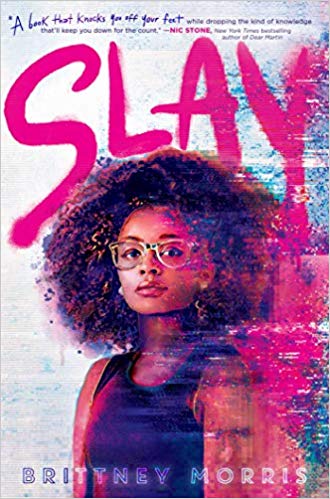
Get ready to SLAY!

Slay, by Brittney Morris, (Sept. 2019, Simon Pulse), $18.99, ISBN: 978-1534445420

Ages 12+

This is one of the most buzzed-about YA books of the year, and with excellent reason. Slay is phenomenal.

Keira Johnson is a 17-year-old high school senior, math tutor, and one of a small handful of students of color at her high school, Jefferson Academy. Keira is at her happiest, though, when she steps into her character, Emerald, in the VR game she created: Slay. Slay is at once a competitive game and celebration of black culture, with hundreds of thousands of players. Slay lets black players inhabit a world where they don’t need to be a spokesperson for their race; they don’t need to code-switch to move in a white world; they can be, together, while competing in arenas and using cards that praise and elevate notable black men and women throughout history, and touchstones – both weighty and humorous – without having to explain or defend their meaning. Keira can’t let anyone know she’s the one behind Slay, though – her boyfriend, Malcolm, thinks video games are a way to keep young black men and women distracted and off balance, and she worries that her parents wouldn’t approve. But when a Slay-er is murdered over a Slay coin dispute, Keira finds her game the target of the media, who wants to call out the game and its creator as racist, and a dangerous troll, who threatens to take Keira to court for discrimination.

Slay is just brilliant writing. Gamers will love it for the gameplay and the fast-paced gaming action. The writing is sharp, with witty moments and thought-provoking ideas, including how a game can unite a community on a worldwide basis. Told mostly through Keira’s point of view, chapters also switch up to introduce readers to people affected by Slay, including a professor in his 30s and a closeted player living in potentially unsafe circumstances. There’s a strong thread of white deafness here, too – how white friends can ask things like, “Should I get dreadlocks?”, or provoke their “black friend” into speaking for the POC community to get the “different” point of view. Keira and her sister, Steph, come from a solid family, and Keira’s boyfriend, Malcolm, who wants black men and women to rise up together, but whose more radical worldview conflicts with many of Keira’s ideals.

Breathtaking characters that live off the page and in the imagination, fast-paced dialogue and a plot that just won’t quit make Slay required reading for upper tweens, teens, and adults alike. Give Slay all the awards, please.

Slay isn’t out until September, but you can catch an excerpt here at EW’s website. Bustle has a great piece on Slay and another excerpt, if you’re dying for more. Publisher’s Weekly has an article about Black Panther‘s influence on author Brittney Morris, which comes through in a big way through the pages of Slay, and the Slay website has sample cards from the game that you’ll love.


Posted in Fantasy, Graphic Novels, Non-Fiction, Teen, Tween Reads, Young Adult/New Adult

July graphic novels: A Hawking bio and a witchy middle grade noir

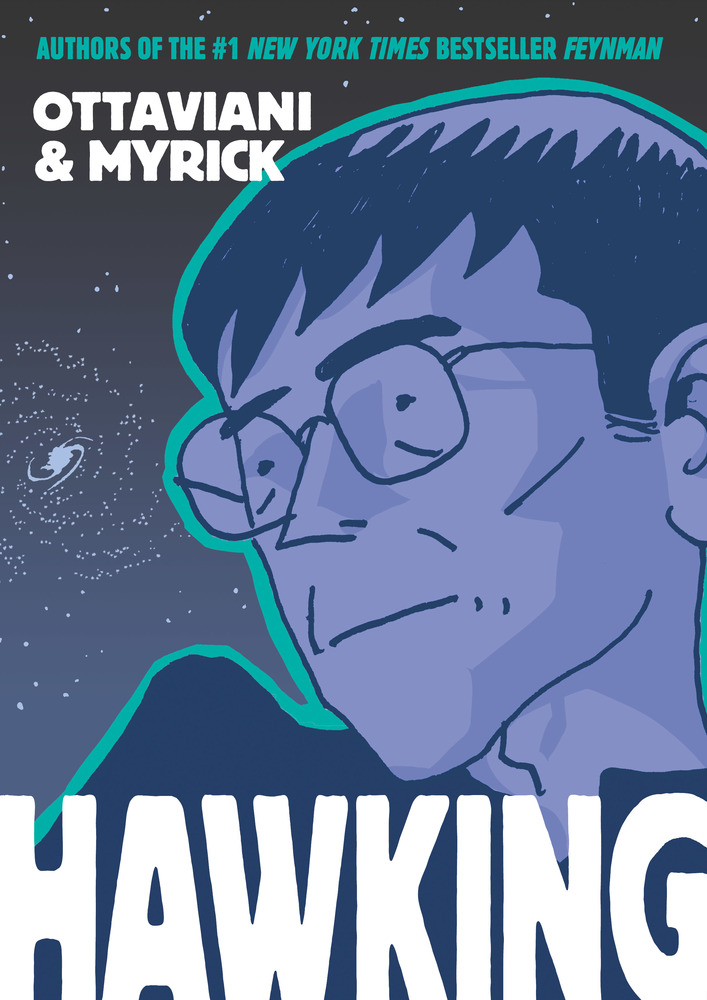
Hawking, by Jim Ottaviani/Illustrated by Leland Myrick, (July 2019, First Second), $29.99, ISBN: 9781626720251

Ages 12+

If your science and biography sections don’t have an Ottaviani/Myrick section yet, you may want to get to work on that. This is the second collaboration the two have worked on; the first being Feynman, a graphic biography on physicist and Nobel laureate Richard Feynman.

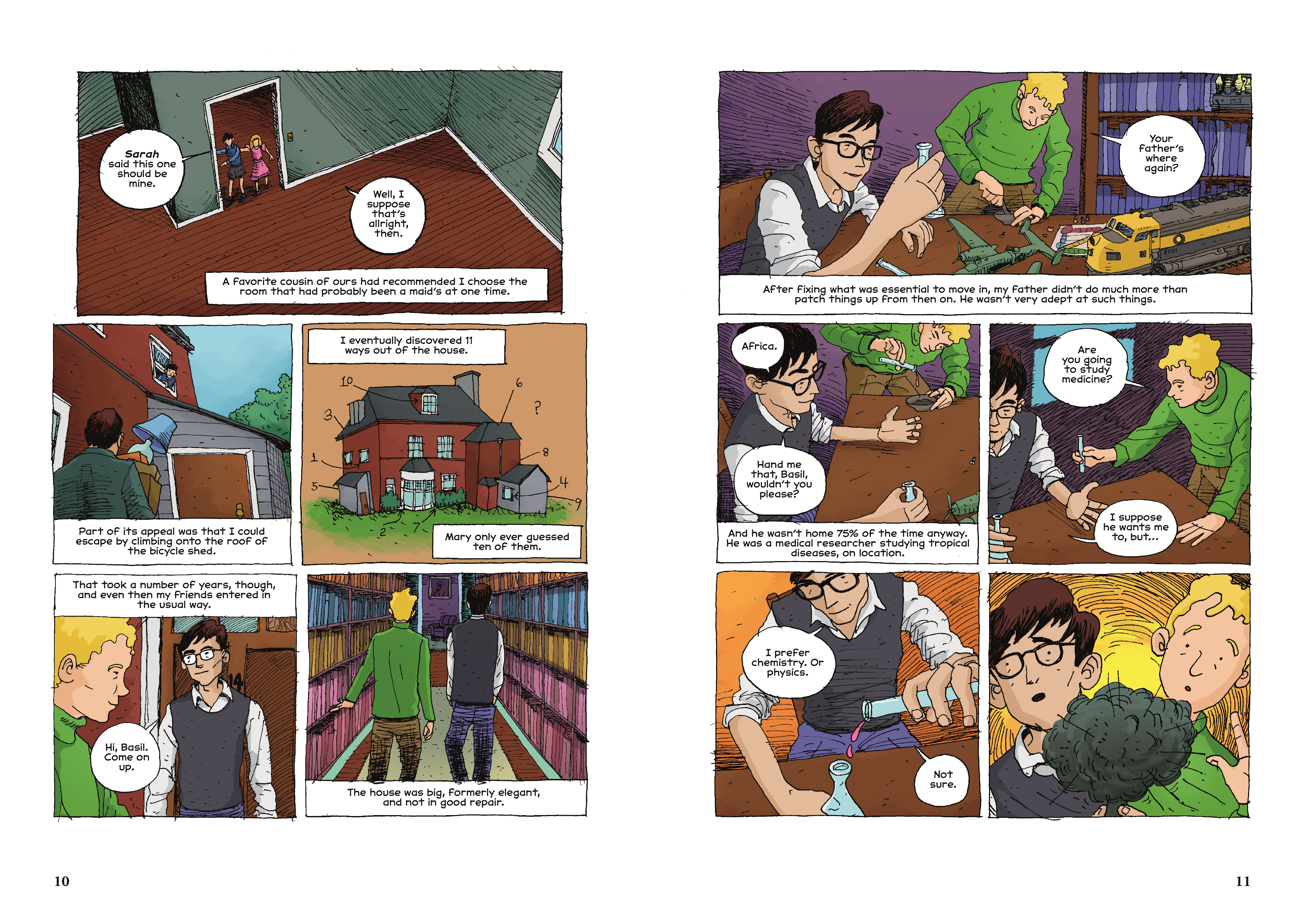
Hawking is in parts biography and science comic for teens and adults, moving easily back and forth between Stephen Hawking’s life story and explanations of physics, black holes, and the universe at large. The story begins with Hawking’s birth, 300 days to the day after Galileo’s death, wanders through his early adolescence as a teen who speaks “Hawkingese” and appears socially awkward; his marriage to Jane Hawking and his diagnosis with motor neurone disease, also known as ALS; his research and ultimate pop culture fame, and his later years, second marriage, and the degenerative path of his disease. First and foremost, this is a story about science; there are pages devoted to discussions between defining voices, including Newton, Faraday, and Einstein, about cosmology, light, and gravity. Jim Ottaviani captures Hawking’s voice – the graphic novel is narrated by a fictional Hawking – and shows up a glimpse of the man behind the legend. Award-winning illustrator Leland Myrick‘s artwork is unfussy, providing scientific sketches as easily as he captures Stephen Hawking’s wry smirk and his ability to disappear into a cloud of physics, even in a crowded room. The end of Hawking’s story will catch readers right in the feelings – I choked up a bit. An author’s note discusses how graphic novels are a good medium for narrative nonfiction, and I couldn’t agree more. Jim Ottaviani is an New York Times-bestselling author whose graphic biographies also include The Imitation Game (Alan Turing) and Primates (Jane Goodall, Dian Fossey, and Biruté Galdikas), so the man knows how to plot out a graphic biography. There is a nice list of references that will give interested readers even more material to look through.

I love graphic novel bios – they’re a great way to get tweens, teens, and adults interested in reading biographies, and the graphic medium allows for great explanations of topics that may be difficult in solid print (like physics!). If you have readers who have aged up from Science Comics, hand them Hawking. A definite must-add to your (growing!) graphic novel biographies.


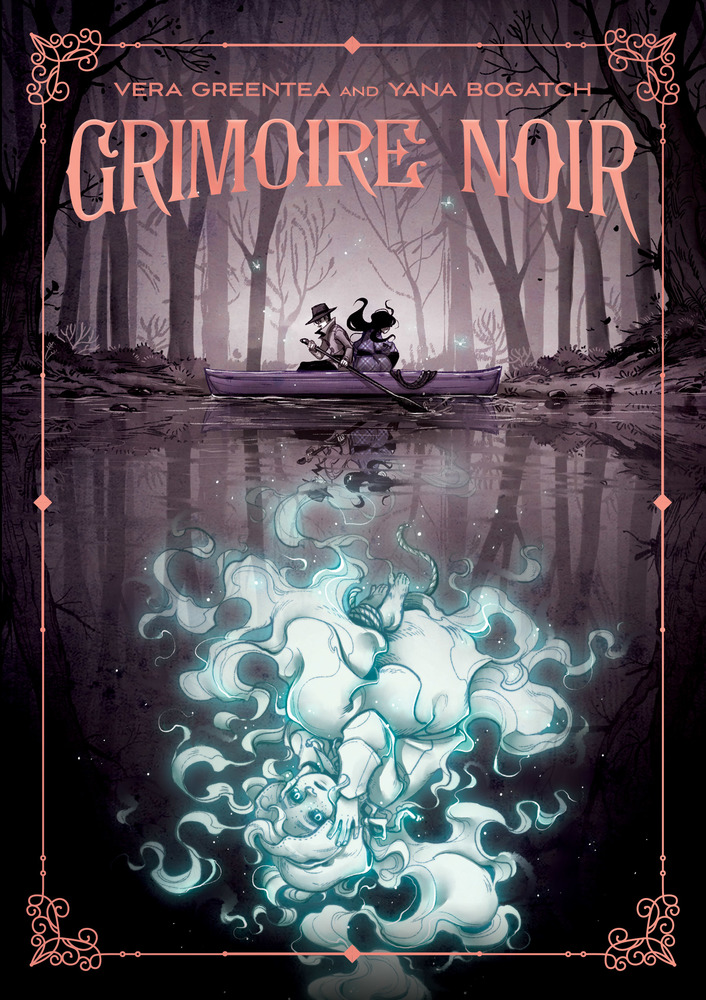
Grimoire Noir, by Vera Greentea/Illustrated by Yana Bogatch, (July 2019, First Second), $17.99, ISBN: 9781626725980

Ages 12+

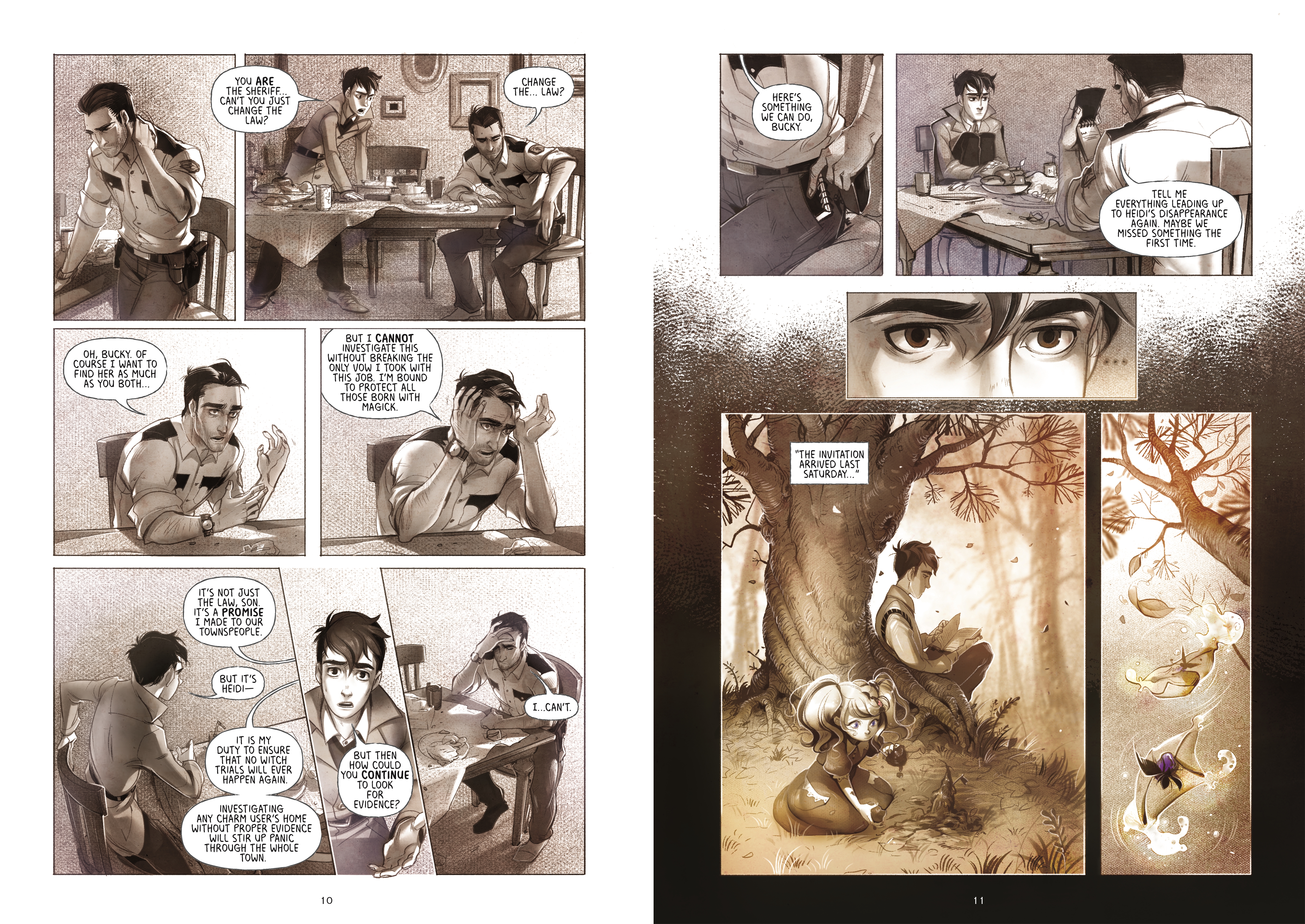
This beautifully illustrated graphic novel has a few plots going on at once: set in a town called Blackwell, where all the girls are witches, a teen named Bucky yearns for power of his own – despite the fact that no witch can leave the town. Ever. Bucky’s younger sister, Heidi, is kidnapped, and Bucky joins forces with his estranged friend, a teen girl named Chamomile, to look for her. Within this main story are threads of other plots; the hostility Chamomile’s father, Blackwell’s deputy, has toward Bucky (who also happens to be the sheriff’s son); a coven of Mean Girls/The Craft witches called The Crows, who want to set plans in motion that will set them free to leave Blackwell, and a ghost of the very first witch, a child named Griselda, whose death at the hands of witch hunters set the curse on Blackwell’s daughters into motion.

The storyline has moments where the storyline becomes confusing to follow, but has some touching relationship bits that I’d like to have seen more about. The relationship between Chamomile and her father runs deep, and we only get a surface glimpse, for instance. Will we get more Blackwell stories from Vera Greentea and Yana Bogatch? We can sure hope so; I think there’s a lot more to tell in a town with a history like theirs. Tween and young teens will enjoy this human, paranormal tale with a twist.


Posted in Fantasy, Science Fiction, Teen, Young Adult/New Adult

LOKI YA IS HERE!

Loki: Where Mischief Lies, by Mackenzi Lee, (Sept. 2019, Disney Book Group), $17.99, ISBN: 9781368022262

Ages 12+

Disclaimer: I am a rabid Marvel and Loki fangirl. When I heard that Loki was getting his own YA novel, I shrieked just a little bit, and camped out on NetGalley and Edelweiss until the DRC gloriously appeared. In short, I’ve been really, really, flipping excited for this book! So let’s get the show on the road.

Loki is Thor’s younger brother, and still hoping that his father, Odin, will see that he’s just as capable of heroism – and possibly, the throne of Asgard – as his older, golden brother. He and his best friend, the sorceress-in-training Amora, find themselves in deep trouble when they accidentally destroy a powerful artifact. Amora takes the blame for Loki and finds herself banished to Earth; essentially a death sentence for a magical being, because her powers will wither and die slowly. Fast forward some years later, and Loki is sent to Earth to investigate a series of murders in Victorian London. He joins forces with a watchdog organization that believes otherworldly magic is involved in the murders. Dare Loki hope that Amora is still alive and in London? And if she is… is she connected to the murders? Our (well, my) favorite son of Asgard is at a crossroads in this first adventure.

I thoroughly enjoyed Where Mischief Lies. Mackenzi Lee has given us a delightful mix of Marvel/Tom Hiddleston Loki with a sprinkling of gender-fluid Norse myth Loki. He prefers high-heeled boots, sees Midgardian (Earth) society and its concern with binary sexuality and relationships ridiculous, and he’s got a wonderfully snarky way of interacting with people, especially those he sees as below him, which is… basically, everyone. He is also a vulnerable, often fragile, young man coming into his powers and frustrated by the lack of attention from his father, who prizes only traditional masculinity and strength rather than magic and wisdom. You can see Loki’s trajectory from this story to Earth’s favorite villain in years to come.

The writing is page-turning, with witty dialogue, a creepy whodunit, and slow-burn heartache throughout. My head spun a little bit as I tried to connect the dots from myth Loki to present-day Loki (What about Sigyn? His monstrous children? That whole situation with the cave and the venom?), but Mackenzi Lee deftly maneuvers around these questions with an interesting explanation that works for me.

I’m a fan of Mackenzi Lee’s God of Mischief. I’m looking forward to seeing who else she takes on in the Marvel Universe. A solid must-add to collections.

Posted in Fiction, Graphic Novels, Historical Fiction, Middle Grade, Teen, Tween Reads

Queen of the Sea: Re-imagined History

Queen of the Sea, by Dylan Meconis, (June 2019, Candlewick Press), $24.99, ISBN: 9781536204988

Ages 10-14

Inspired by Queen Elizabeth’s exile when her sister Mary I ascended the throne, Queen of the Sea begins with the banishment of Queen Eleanor, a young monarch of an embattled kingdom, to an island where nuns live, pray, garden, and sew. Margaret is a young girl who has spent her entire life on the island in the care of the nuns and finds herself drawn to Eleanor. Margaret learns about the island and the reasons behind her presence there, and quietly begins planning with Eleanor and a mysterious man who washes up on the island one stormy night.

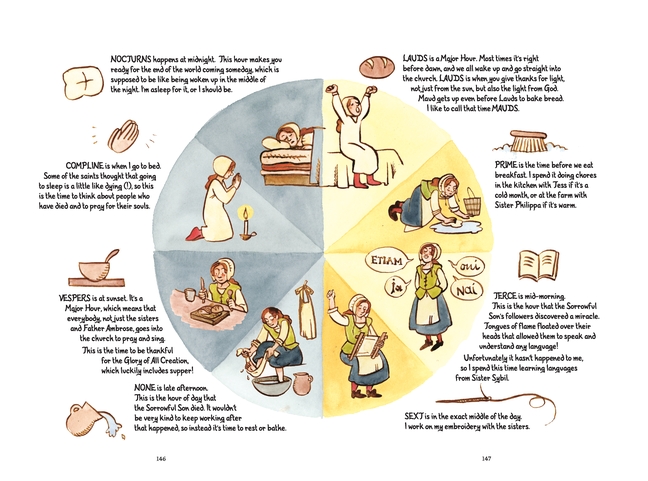
Queen of the Sea is gorgeously created historical fiction with fully realized characters and a solidly constructed plot filled with intrigue; revelations; world-building, even light romance. Dylan Meconis’ pen, ink, and gouache artwork will appeal to Raina Telgemeier and Victoria Jamieson fans; the characters are softly realistic with period costuming and soothing earth and sea colors. I particularly love the back-and-forth between present moment storytelling and Margaret’s narration of history and myth, rendered to appear as stone or stained glass. The character growth is a joy to witness: Eleanor, from a taciturn exile to an embattled young woman embracing her feelings, and Margaret, a naïve child to a young woman coming into herself and her own intelligence make this a wonderful read. An author’s note discusses Elizabeth I’s inspiration of Eleanor. Graphic novel gold.

Queen of the Sea has starred reviews from Kirkus, Publisher’s Weekly, Booklist, and School Library Journal. You can read an excerpt at Candlewick’s website.

Posted in Historical Fiction, Teen, Tween Reads

The Good Son tells a tale in miniature

The Good Son: A Story from the First World War Told in Miniature, by Pierre-Jacques Ober/Illustrated by Jules Ober & Felicity Coonan, (May 2019, Candlewick Studio), $22, ISBN: 9781536204827

Ages 10-14

“About one hundred years ago, the whole world went to war. The war was supposed to last months. It lasted years.” This story about Pierre, a World War I French soldier, is told with spare narrative and is illustrated using antique military miniatures, photographed to create stunning moments.

Pierre is a young French soldier who quietly left his regiment for two days to celebrate Christmas with his mother. Upon his return, he is imprisoned for desertion and awaits execution. As he waits, he looks back on his life as a soldier: his choice to sign up, his dreams of glory, and the horrific truth of the battlefield. He remembers sharing coffee with German soldiers who were tired of fighting, and of spending what would be his final Christmas with his mother. His friend, Gilbert, comes by to bring him food and wine, and makes a promise to carry Pierre’s letter to his mother.

The Good Son is not a picture book for young children; it’s for middle schoolers and up. The use of miniatures brings home the scale of war: seeing the lines and lines of soldiers going into battle looks impressive, but turned becomes chilling when you understand that young men, not toys, headed to battle. There are beautiful and horrifying shots of battlefield explosions and war machines; pensive portraits by firelight as Pierre waits for word from the colonel. The text is heart aching, as we read about a young man’s struggle to understand how to be a good son and a good soldier. An author’s note and a note on the photography process provide a deeper look into the creation of the book and offers some further insight into Pierre’s story.

Beautifully written and photographed, this is a story that will provoke thought and discussion. A good book group choice.