Posted in Preschool Reads

Book Review: Diary of a Worm, by Doreen Cronin/illus. by Harry Bliss (Joanna Cotler Books, 2003)

diary of a worm

Recommended for ages 2-6

A young worm journals his daily life, writing about his friends, his family, and the pluses and minuses of being a worm.  His observations are often very funny, as when he talks about spending the day above ground with his family after a rainstorm, and then notes, “Hopscotch is a very dangerous game”, with illustrations from a worm’s point of view. The story includes facts about earthworm behavior that gives young audiences a fun lesson in science: earthworms dig tunnels that help the earth breathe; worms cannot walk upside down, and worms have no teeth being just a few fun factoids to take away.

The artwork adds to the appeal of the book. Mr. Bliss uses watercolor and ink illustrations to bring Worm, his family and friends to life; while not overly anthropomorphizing them, he does infuse them with personality. The worm’s-eye view of the world provides a different point of view that young audiences will appreciate, and could lead to a good post-storytime discussion of how things look different from a worm’s point view as opposed to a human’s. The text looks almost like a printed font, and the entries are dated, like a real diary would be. The endpapers are set up like a scrapbook or diary, with photos of Worm’s friends, family, and accomplishments – report cards, a web made for him by his friend, Spider, a comic strip – “taped” to the pages.

The “Ðiary Of” series includes Diary of a Fly; Diary of a Spider; and Diary of a Worm.

A Wiggling Worms/Garden read-aloud would be a fun idea for the Spring. Diary of a Worm may be a tricky read-aloud if done conventionally, as there is a lot of activity within each page. Bringing in puppets may be a fun way to accomplish a fun read-aloud, with assistants or another librarian acting out with puppets of worms, spiders, and flies, while the librarian narrates the journal entries. Amazon offers a Diary of a Worm & Friends Finger Puppet Playset that would connect the puppet show to the book even further. An after-story discussion about worms would involve children, inviting them to share what they have learned about worms after reading the book. A fun craft would let children make worms out of modeling clay, which they could take home. Scholastic has a Diary of a Worm DVD that may be fun viewing for younger audiences.

Diary of a Worm has received numerous awards and accolades since its publication, including designation as a School Library Journal Best Book for Children (2003).
Posted in Preschool Reads

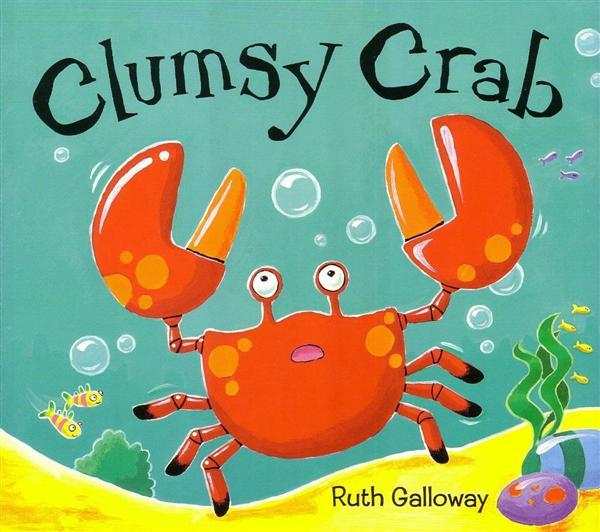
Book Review: Clumsy Crab, by Ruth Galloway (Tiger Tales, 2007)

clumsy-crabRecommended for ages 3-6

Nipper the Crab’s claws always seem to get in his way, until one day, when he discovers how helpful they can be. Clumsy Crab is a very good story about accepting yourself that should resonate with preschoolers. Nipper the Crab hates his claws because they always seem to get in his way; one day, though, playing hide and seek with his friends, he discovers that having claws to snip, snap and clip, clap can come in handy when he is the only one that can rescue a friend. All of the sea creatures are friendly and helpful to Nipper; there is no bullying, only encouraging. The cartoon artwork is bright and the sea creatures have expressive, happy faces. The endpapers offer an underwater welcome, with Nipper and some sea life friends greeting readers. The text is rounded, almost cartoonish to match the illustrations, with larger, bolded words for emphasis.

The book’s use of alliteration and onomatopoeia makes this a good storytime selection that will keep readers interested. Storytime Katie’s blog offers songs and fingerplays for a Sea Creatures read-aloud; if possible, stock the storytime area with plastic and plush sea life toys to allow for playtime after the read-aloud. Enchanted Learning offers ocean life printables for a coloring craft. The Raffi CD, Baby Beluga, is a fun music choice to for children to listen to while playing and coloring.

Posted in Preschool Reads

Book Review: Grandparents are the Greatest Because… by Adele Aron Greenspun & Joan Schwartz (Dutton, 2003)

grandparents are the greatestRecommended for ages 4+

A photo album of grandparents and grandchildren provides readers with many reasons as to why grandparents are the best. The book features actual, hand-tinted photographs of grandparents and grandchildren in coordinating pastel frames. The phrase, “Grandparents are the greatest because” runs throughout the book, with reasons why – “They cheer you up with smooches/and big warm squeezes… elephants don’t scare them,/and neither do dinosaurs with big, sharp teeth” – running along the bottom of the photos. Embedded in the illustrated frames are quotes from either the adult or the child featured in the photo. The photos are affectionate (a grandmother hugging her grandson at what looks like a family wedding) and inspiring (a grandfather shows his grandson his army uniform as his grandson wears his hat). The endpapers feature different ways of saying grandmother and grandfather in different languages and different nicknames for them, like “Mamaw” and “Papaw”. Children will enjoy these loving photographs of grandparents and this celebration of grandparents and grandchildren alike.

This would be a great addition to a read-aloud on families, specifically grandparents. National Grandparents Day is September 8; this may be a good reason to get grandparents into the library with their grandchildren. The Perry Public Library has a Grandparents Day storytime theme that includes songs and rhymes, and the children can get up and dance with their grandparents at the conclusion, perhaps doing the Hokey Pokey or Ring Around the Rosie.

Posted in Preschool Reads

Book Review: Dinosaur Train, by John Steven Gurney (HarperCollins, 2002)

dinosaur trainRecommended for ages 3-6

A young boy loves dinosaurs and trains. One night, a dinosaur train shows up and takes him on a ride.

Dinosaurs and trains are both very popular themes for young readers – there’s a PBS show called Dinosaur Train, unrelated to this book – and putting the two together in a Polar Express-type of situation is a great idea. Jesse is a young boy who loves dinosaurs and trains. He draws them, he plays with them, he thinks about them constantly. When he gets ready for bed one Thursday night, he hears a loud noise, and his house begins to shake – a train full of dinosaurs has pulled up outside his window, and he’s been invited along for a ride! He hops on for a brief adventure. The artwork, done in oils and finished in Photoshop, detailed and bright, standing out against the plain backgrounds. The dinosaurs all have pleasant faces and are wearing people-like clothes – engineer’s overalls and caps, a ticket taker with a change belt, and jeans and dresses. Jesse is dwarfed by the huge dinosaurs, but there is never a moment where we worry for his safety.


dinosaur train_2

Dinosaurs and trains could be a fun storytime idea to explore further, with this book linking the two concepts. There are many train-related and dinosaur-related songs and fingerplays available; Everything Preschool has themes devoted to both.  It may be fun to stock the play area with toy trains and dinosaurs, and allow for a dinosaur train playtime after the story, or even arrange for a viewing of the PBS show.

Posted in Preschool Reads

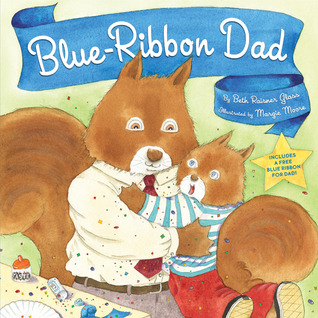
Book Review: Blue Ribbon Dad, by Beth Raisner Glass/Illus. by Margie Moore (Abrams Books for Young Readers, 2011)

blue ribbon dadRecommended for ages 2-6

The book, a love letter to dads, shows a young squirrel counting down the hours until his father gets home from work. As he works on a craft project to have ready for his father’s arrival, he thinks of all the things his dad does with him: he wakes him up in the morning, packs his lunch and brings him to school, and watches his swimming lessons. When Dad comes home, his son presents him with a blue ribbon, for being a Number 1 Dad. The story, told in rhyme, will appeal to young readers and audiences. The illustrations are made with black pen and watercolors on cold press paper and provide soft images with enough definition that the characters stand out against their backgrounds. The faces on the family members are gentle and expressive. The endpapers feature all of the craft supplies used to make the blue ribbon plus the clock, an important part of the story as the squirrel son counts each hour down until his father comes home. The book comes with a detachable blue ribbon that should probably be removed before putting circulating, rather than invite theft and damage to the book.

This would be a good addition to a Father’s Day read-aloud. The blue ribbon is an easily made storytime craft. The Perry Public Library has a Daddy storytime theme that includes songs and rhymes that would enhance any read-aloud.

Posted in Preschool Reads, Uncategorized

Book Review: Rain Romp, by Jane Kurtz/Illus. by Diana Wolcott (Greenwillow Books, 2002)

RainRompRecommended for ages 3-6

Preschoolers often deal with moods that they don’t know how to control; many will associate with this young girl who wakes up in a bad mood on a rainy day. Her parents try to boost her mood, but she wants none of it, until she decides to stomp her bad mood away in the rain. Her parents join her, and the bad mood goes away. The watercolor and gouache art is perfect to convey the both the weather and the girl’s moods, going from angry and gray, like the rain, to happy and content, as the sun peeks through the clouds. The text curves around the art and gets larger for emphasis when the girl vents her anger.  As she and her family hug, mood lifted, the text curves underneath them, allowing the reader to join in the hug.

This would be a good addition to a read-aloud on moods. There could be a discussion on what preschoolers do when they are angry, or sad, or happy. If they feel sad or mad, what makes them feel better? A good storytime craft would allow the children to draw a picture of how they deal with a bad mood, and they could receive a smiley face handstamp at the end of the storytime.

Posted in Preschool Reads

Book Review: Roar! A Noisy Counting Book, by Pamela Edwards Duncan/Illus. by Henry Cole (HarperCollins, 2000)

roarRecommended for ages 2-5

A little lion cub wants to play, but his roar scares other animals away, from one red monkey to eight brown gazelles – but then, he discovers nine other lion cubs.

This counting book has a story attached to it, and is good for older audiences who are about to enter Kindergarten and could use a brush-up on their counting and colors. A little lion cub wanders away from his pride, looking for some fun, and encounters different animals across the African savanna – from one red monkey to eight brown gazelles – who all run from his roar. He finally comes across a group of nine little yellow lion cubs, just like him, who aren’t afraid of him. The cartoon illustrations, done in acrylics and colored pencil, bring the savannah and the animals to life, from a group of lions lying lazily in the sun to a stampede of animals running from the group of little lions, to the little lion cub, curled up with his mother, asleep as the sun sets on the savanna. The animals’ facial expressions convey fear on the parts of the animals the lion confronts, confusion, frustration and despair, as the little lion searches for a new friend and finds none, and finally, happiness when he meets friends just like him. The book provides a fun lesson in numbers and colors in rhyme.

This would be a great opportunity to use a flannel board to depict the animals that the little yellow lion cub encounters on his trip across the savanna. Getting stuffed animals for each of the groups of animals depicted into the story area would allow for a fun playtime before or after the story. This could be part of a jungle animal read-aloud, with hand stamps of an animal for children to have as a memento of their storytime.

Roar! was a Buckaroo Book Award Nominee (Wyoming, 2003).

Posted in Preschool Reads

Book Review: Food Fight, by Carol Diggory Shields/Illus. by Doreen Gay-Kassel (Handprint Books, 2002)

food fightRecommended for ages 3-8

Late at night, when we are fast asleep, who knows what goes on in our refrigerators? In Food Fight, it’s the cat who bears witness to this story about what happens when the food in a kitchen decides to throw a late-night party. The story, told in rhyme, escalates when tuna fish tells the garlic, “You stink”, angering the chili pepper, and the rumble is on. The artwork, done in modeling clay, brings life to the food, creating a wide variety of facial expressions and movements. The multicolored text, in different sized, exaggerated font, swirls and flows around the artwork and stands out against the brightly colored backgrounds, adding more fun to the book and for the reader. The endpapers offer a cursory look into the refrigerator, showing assorted groceries on shelves.

This would be part of a fun, food-related read-aloud for preschoolers and kindergarteners. It could fit in with other fun food books, like Dr. Seuss’ Green Eggs and Ham, and can also lead to a discussion about healthy eating. Putting out plastic food for children to play with will provide a fun playtime, as will singing songs like “On Top of Spaghetti”.

Food Fight has received numerous awards and accolades, including designation as an ALA Notable Children’s Book (2012), Colorado: Children’s Book Award Nominees (2013), Horn Book Fanfare (2011), Indies Choice Book Award for Picture Book (2012), Irma S. & James H. Black Picture Book Honor (2012), NY Times Best Illustrated Books (2011), NY Times Notable Children’s Books (2011), Publisher’s Weekly Best Children’s Books (2011), Texas: 2×2 Reading List (2012), Theodore Seuss Geisel Honor (2012), Virginia: Readers’ Choice Award Nominees (2013).

Posted in Preschool Reads

Book Review: I Want My Hat Back, by Jon Klassen (Candlewick Press, 2011)

i want my hat backRecommended for ages 4-8

Bear has lost his favorite hat and searches the forest, politely asking different animals he encounters if they have seen it. Just as he begins to despair ever seeing his hat again, Deer comes by and jolts his memory – he HAS seen his hat. The resolution is understated and sly, and adults will pick up on it right away; perhaps even before the children do. The book has won awards and accolades, including the Theodore Seuss Geisel Honor, but caregivers have voiced concerns over the implied ending being potentially disturbing or inappropriate for young children.

The Chinese ink illustrations are understated, as are the sandy hued backgrounds. Red is used to set off the color of Bear’s hat, and a change in emotion both in text and background. The endpapers set the mood for the story, with illustrations of the Bear and the animals featured in the story set on a dark brown background.

The book allows for a fun (and no doubt entertaining) discussion about the book’s ending. There are I Want My Hat Back-related activities on Candlewick’s website, including a printable world-building activity and a shape-identifying activity. There is also a Make Your Own Hat activity sheet that allows attendees to decorate, cut and tape together their own hat. For a bear-related read-aloud, decorate the reading area with toy bears of all sorts and encourage playtime afterwards.

Among the award and honors I Want My Hat Back has received are designation as an ALA Notable Children’s Books (2012), Colorado: Children’s Book Award Nominees (2013), Horn Book Fanfare (2011), Indies Choice Book Award for Picture Book (2012), Irma S. & James H. Black Picture Book Honor (2012), NY Times Best Illustrated Books (2011), NY Times Notable Children’s Books (2011), Publisher’s Weekly Best Children’s Books (2011), Texas: 2×2 Reading List (2012), Theodore Seuss Geisel Honor (2012), and Virginia: Readers’ Choice Award Nominees (2013).

Posted in Preschool Reads

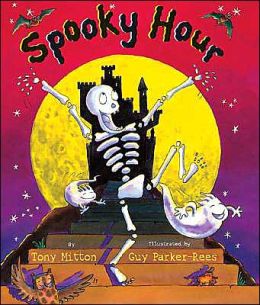
Book Review: The Spooky Hour, by Tony Mitton/illus. by Guy Parker-Rees (Orchard Books, 2004)

spooky hourRecommended for ages 3-7

Spooky Hour is a counting story – counting down, rather than a counting up – about a dog and a cat who witness spooky creatures on their way to a party at the strike of twelve. The dog and cat follow the creatures: eleven witches, ten ghosts, nine skeletons, and more, all the way to the spooky castle doors, where Mitch and Titch, the witchy twins, are waiting to welcome them to the big, spooky party, where they feast on one gigantic pumpkin pie. The cartoon illustrations are fun, even silly, but never scary, and younger audiences will enjoy the anticipation of counting down to the party. The full-bleed images have a great deal of action going on in the frames: flying ghosts, a  line of skeletons dancing into a forest, observed by owls, trolls tromping through a forest as the cat and dog hide behind a log. The font is black or yellow – whatever needs to pop on the page’s background – and looks similar to a typewriter font.

The book has interactive elements that make it a good candidate for a Halloween read-aloud. The story itself is written in rhyme, and each creature has a sound attached to its action that audiences can mimic and act out: the witches shriek, the ghosts swirl,whirl, and say, “whoooo”, the skeletons dance and go clickety-clack. Attendees can come in costume and receive a trick or treat bag with some candy and a small toy, and there can be a jack-o-lantern craft for children to color. Time permitting, they can cut out shapes for jack-o-lantern faces and glue them on. Perpetual Preschool has Halloween songs that the children can sing after the story, and there are CDs with Halloween music, like Kids Bop Halloween, which can play during the craft time, and children can receive a Halloween hand stamp before they go home.