Posted in Early Reader, Fiction, Non-Fiction, picture books

Science for Kindergarteners!

I’m always looking for ways to get more science in my kids’ days: my QBH Kids and my own Kindergartener alike. I’ve had some great successes and some that fell a little flat. At my previous library, I had a phenomenal early learning assistant who helped create amazing Science Storytimes, using popular storybooks to demonstrate simple science concepts for little ones: using Ellen Stoll Walsh’s Balancing Act to teach balance, while showing them a simple balance board that kids were invited to place small objects on and discover what balanced, and what tipped the sides.

I also look to fellow librarian and teacher bloggers for hints. Pinterest is a great resources, as is Education.com and Teachers Pay Teachers. Science In Storytime is one of my more recent go-tos, with loads a great book and activity ideas, and The Show Me Librarian has some fantastic programming for Pre-K and elementary programs.

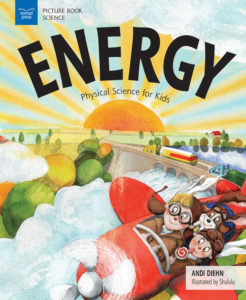
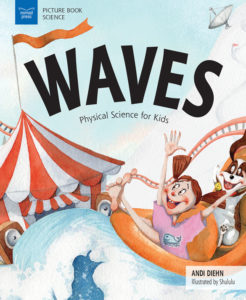
I’ve just received some new books from Nomad Press’ Picture Book Science series, too. These are a lot of fun: color artwork on every page, a fun poem to kick off each book, and my favorite part: an explanation of the scientific term, with all the uses of the term. Take, for instance, the book Waves: it starts off with the simplest interpretation of the word; a way to say hello. The book goes on to include ocean waves in that explanation, then the motion of a wave, and finally, a discussion of waves: energy, light, sound, all using questions to provoke thought, discussion, and understanding. Each book “Try This!” boxes, with simple activities kids can easily do at home or in the classroom (or during Science Storytime). Glossaries are handy to define terms that come up. There are currently four books in the Picture Book Science series: Waves, Forces, Matter, and Energy, all written by Andi Diehn and illustrated by Shululu; at $9.95 each, it’s a good and reasonable investment for our home, school, and public shelves. (Waves: 978-1-61930-635-6; Forces: 978-1-61930-638-7; Matter: 978-1-61930-644-8; Energy: 978-1-61930-641-7)


Rosen Classroom has a new series of easy readers called Computer Science for the Real World. They’re not attempting to teach Python or Scratch to the little ones (yet): these readers break the concepts needed to study computer science down for beginning readers. The three readers I received use everyday concepts – morning routines, alphabetizing books, building a birdhouse – to introduce activities that will help learn computer science; in this case, repetition and doing things step by step.

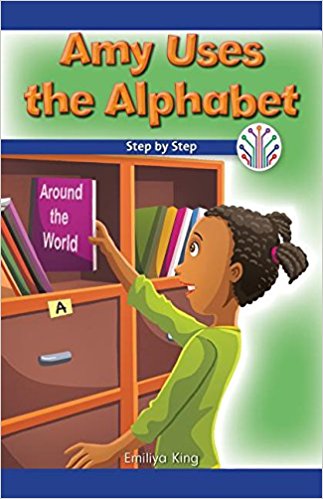
 

The books are leveled and contain instructional guides with include new vocabulary words, background knowledge for the specified concept, and text-dependent questions. There are independent and class activities to help kids learn through experience, and are available in English and Spanish. I really like these readers; there aren’t that many “just right books” (as my son’s school calls them) explaining science like this, and I’d love to have them in my library, but this is more of a Central library purchase, at least in my system, because you’re going to want to buy these by the collection; you can certainly buy them as single books, but having a whole set will better benefit your readers. The pricing is pretty reasonable, so I’ll be slipping this into an interoffice envelope bound for my collection development department tomorrow morning.
Posted in Intermediate, Non-Fiction, picture books

Black History Month: Trailblazer – The Story of Ballerina Raven Wilkinson

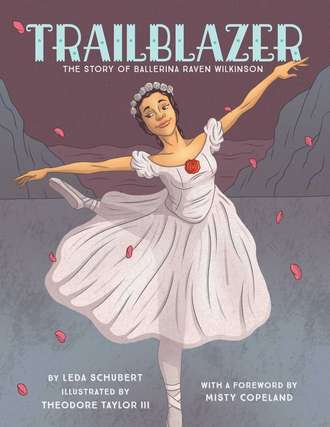
Trailblazer – The Story of Ballerina Raven Wilkinson, by Leda Schubert/Illustrated by Theodore Taylor III, (Jan. 2018, little bee books), $17.99, ISBN: 9781499805925

Recommended for ages 6-9

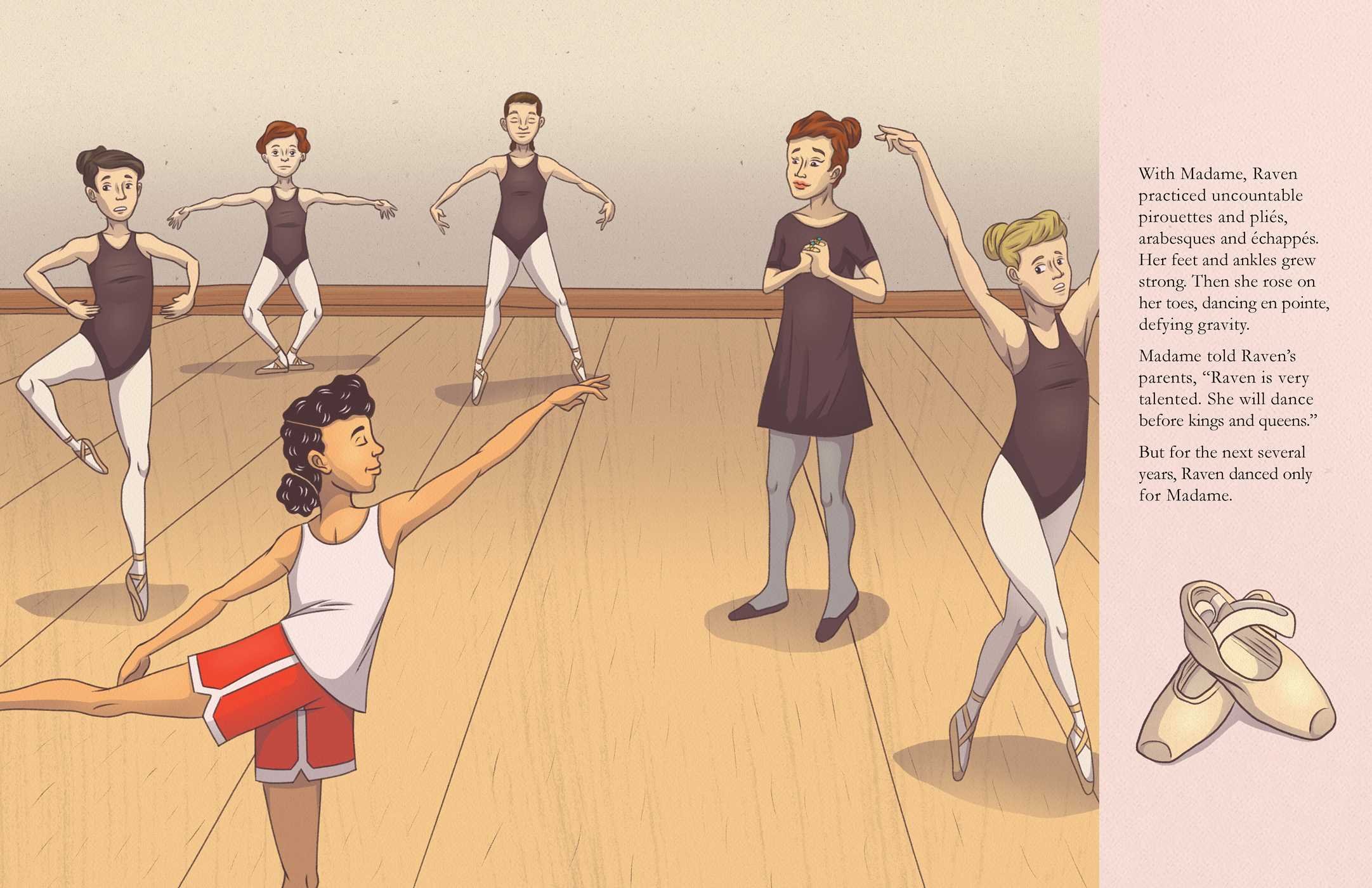
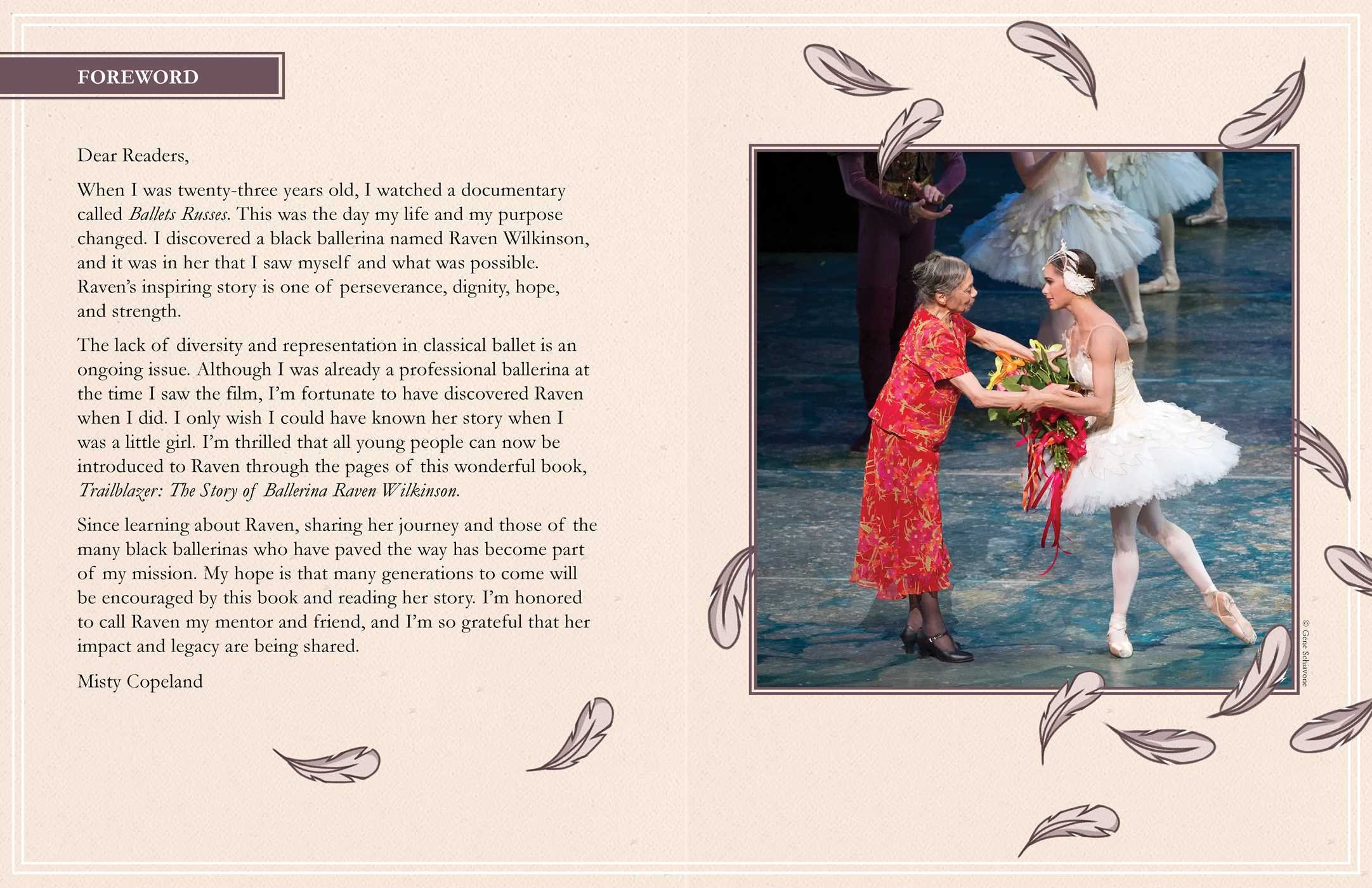
Born in New York City in 1935, Raven Wilkinson was a little girl who fell in love with ballet and grew up to become the first African American ballerina to tour with a major American touring troupe. She faced racism at every turn; she auditioned three times for the Ballet Russe de Monte Carlo before they finally accepted her into the touring company. When they toured the American South in the 1950s, she faced adversity from hotels who wouldn’t allow her to stay, fearing repercussions from the Ku Klux Klan; ignorance in the form of racists running onto the stage to protest the “nigra in the company”; and dining in hotels where families left their Klan sheets in a pile in the back while they ate dinner together. She persisted, even when she was passed over time and again for the starring role in Swan Lake, finally achieving the spot in 1967 with the Dutch National Ballet of Holland. She later joined the New York City Opera, dancing until she was 50. She’s inspired countless dancers, including Misty Copeland, who became the first African American principal dancer with the American Ballet Theater in 2015 AND danced in Swan Lake. Copeland has said of Raven Wilkinson, “She was a mentor in my life before I met her.”

This is a lovely look at Raven Wilkinson’s life and career, especially relevant in our racially charged society – the more things change, the more things stay the same, it would sadly seem. When Raven eats dinner in a hotel surrounded by families who leave their Klan sheets strewn across seats while they eat, it’s horrifying because it normalizes hate. The indignity of Raven Wilkinson having to endure this indignity is like a gut punch to an older reader, and we need to use that nausea, that anger, that outright disgust, as a teaching opportunity to de-normalize this for younger readers. The illustrations are soft, almost comic book-like, while retaining a realistic quality, that will appeal to younger readers.

This is a beautifully illustrated picture book biography of an African American pioneer few people may be familiar with. Let’s change that. If you ask kids to name African American role models, you’ll likely hear the big names, but let’s make MORE big names. Let’s put books like Trailblazer in our displays, showing kids that there are pioneers everywhere. Neil Degrasse Tyson, Mae Jemison, and Katherine Johnson? Heck yes, get them in front of kids. STEM and the sciences are important. And let’s show them Trailblazer and Firebird; Radiant Child and When Marian Sang, DJ Kool Herc and the Creation of Hip Hop and Muddy to remind readers everywhere that there are pioneers in the arts, too. Children need to see inspiration everywhere, and that there are advocates in every walk of life.

This 2015 video features Raven Wilkinson and Misty Copeland when Dance/USA, the national association for professional dance, recognized Raven Wilkinson, the 2015 Dance/USA Trustees Awardee, at the Dance/USA Annual Conference in Miami on June 17, 2015.

Leda Schubert’s most recent picture book biography, Listen, was about singer and activist Pete Seeger. Her website offers more information about her books, including downloadable activity guides and discussion questions. Illustrator Theodore Taylor III is a Coretta Scott King John Steptoe New Talent Award Winner. See more of his artwork and learn about his other books at his website.

Posted in picture books, Preschool Reads

Explore the Starry Skies!

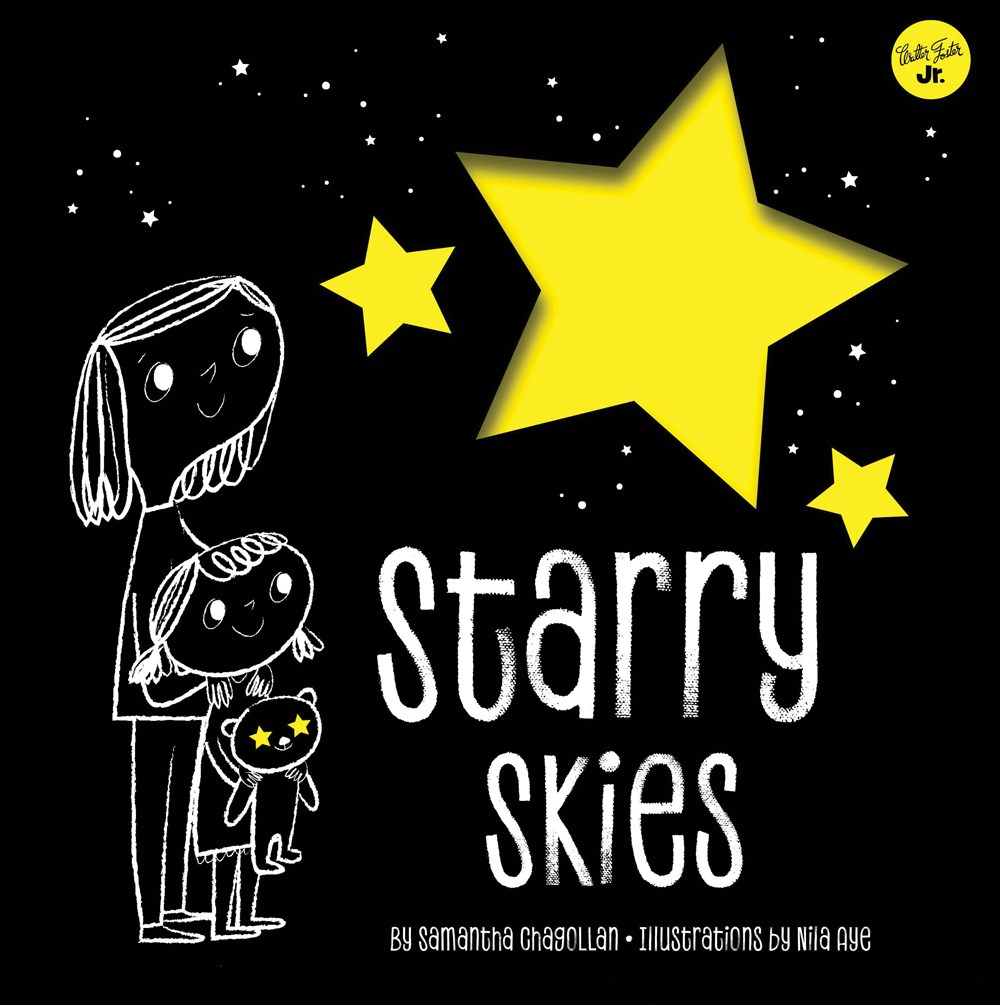
Starry Skies: Learn About the Constellations Above Us, by Samantha Chagollan/Illustrated by Nila Aye, (April 2018, Walter Foster Jr.), $16.95, ISBN: 9781633225091

Recommended for readers 4-6

I remember my first book on constellations. It’s still around today: Find the Constellations, by H.A. Rey (the Curious George author!); and it endures because it’s diligently updated (5 updates, including a 2017 version) and because constellations are fascinating. They’re pictures in the sky; they’re maps in the sky; they’re stories, waiting to be revealed. Starry Skies is a great companion – an introduction to constellations for the preschool set – to the well-loved Rey book.

Beginning with the sentence, “Every night, the sky is filled with stars that tell a thousand stories,” Starry Skies launches into spreads features a different individual starring in his or her own story: a boy battles a dragon (Draco); a cat sees herself as Leo, the lion; a girl gets ready to fly on Pegasus. Each spread features a black sky, dotted with stars, and a white line drawings of the dreamers and their constellations. It’s a preschool-friendly entry to stargazing, astronomy, and mythology. Readers enjoy 14 constellations in all, plus a star map of the for the Spring/Summer and Fall/Winter seasons.


Posted in Middle School, picture books, Preschool Reads

Just Like Brothers teaches valuable lessons

Just Like Brothers, by Elizabeth Baguley/Illustrated by Aurélie Blanz, (March 2018, Barefoot Books), $16.99, ISBN: 9781782853459

Recommended for ages 3-7

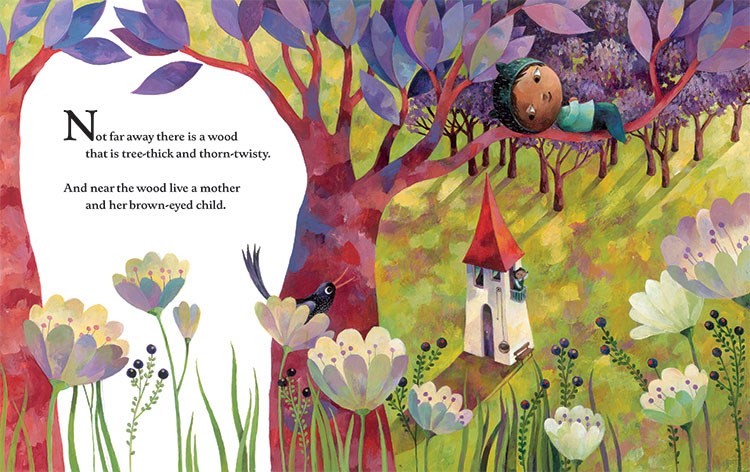
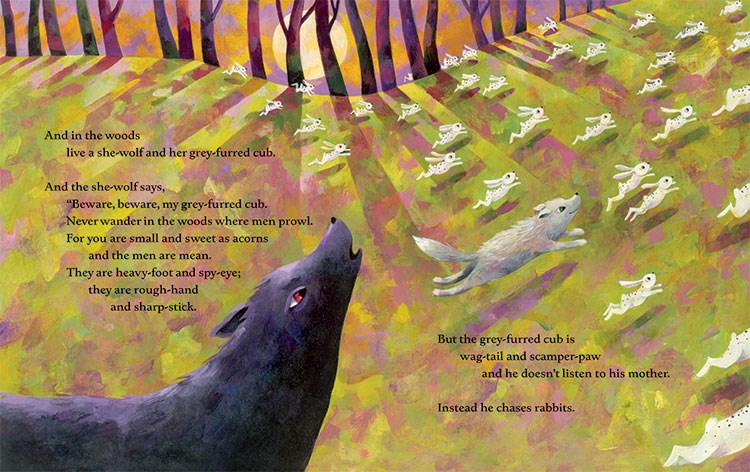
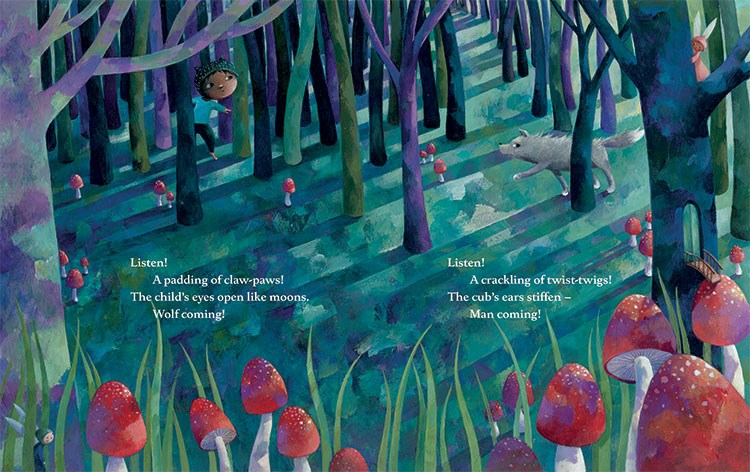
A young boy and a young wolf cub are each warned by their mothers. The boy’s mother warns of the wolves; the wolf’s mother, of men. The children listen, then go off and play, as children do. When each gets lost in the forest and come upon the other, their first reaction is fear; eventually, though, they discover that their similarities far outweigh their differences. And their mothers discover that they have a lot to learn from their children.

Told like a modern-day fable, Just Like Brothers teaches readers about the problems formed by prejudice and baseless judgement; it also teaches the value of empathy and trust. The innocence of children, both here and in real life, has no place for prejudice; it’s passed on at an early age. It’s a call to us as caregivers to be careful not to let our own fears make us irrational in what we teach our kids. It’s the start of a conversation, with lyrical descriptions like, “rough-hand and sharp stick” to describe humans, and “wag-tail and scamper-paw” to describe the playful cub. This makes for a good read-aloud and discussion about friendship and trust.

Posted in Fiction, Intermediate, picture books, Realistic Fiction

Black History Month: As Fast as Words Could Fly

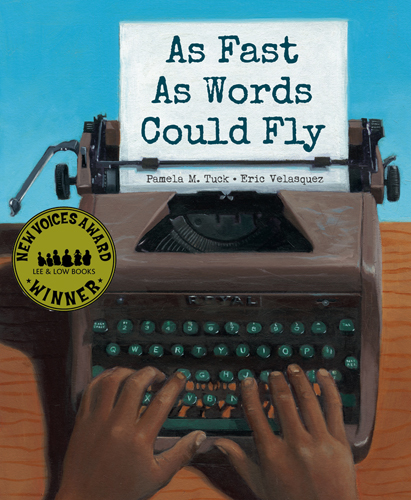
As Fast As Words Could Fly, by Pamela M. Tuck/Illustrated by Eric Velasquez, (Apr. 2013, Lee and Low), $18.95, ISBN: 9781600603488

Recommended for readers 6-10

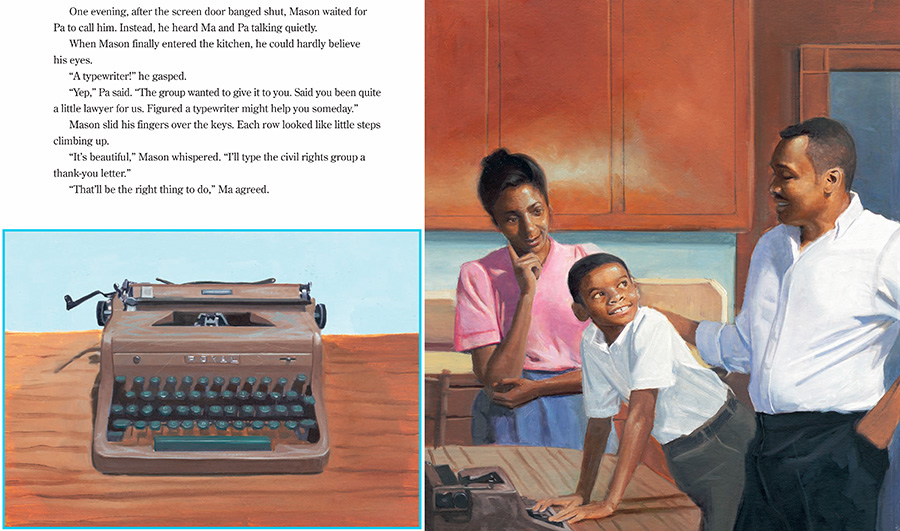
I had to start my Black History Month reviews off with this gorgeous book by Pamela M. Tuck. As Fast As Words Could Fly is inspired by Ms. Tuck’s father, who – along with his brothers – integrated a North Carolina school, and by her grandfather, who was active in the Civil Rights movement. Mason Steele is a 14 year-old who helps his father’s civil rights group by writing letters for them, shining light on injustices. Mason’s father brings home a manual typewriter, transforming Mason’s life and letting his words fly across the pages. At the same time as Mason receives his typewriter, his father tells him and his brothers that they will integrate the local high school rather than continue busing to one twelve miles away. Integration is tough on Mason and his brothers: buses drive right by them and teachers and students alike make it known that the boys aren’t welcome there, but Mason endures and uses his typewriter to increase his skill and earn some money. He also uses his typewriter to make a change: he defies racism to keep his job at the local library and to represent his school in a typing contest. For Mason, the words on the paper speak loud and clear.

This was Pam Tuck’s first published story, which won the Lee & Low New Voices Winner. I was lucky enough to see her speak about her experience, and her family’s experience, at KidLitCon back in November, and I got my own copy of As Fast As Words Could Fly signed for my kiddo. Pam’s voice comes through so clearly in her story; I can hear her, even now, telling me about her grandfather and father’s story. I mentioned that I was a fan of her illustrator, Eric Velasquez, and she sat with me; as we went through the book together, she pointed out her favorite pieces of artwork. I mentioned that I loved Mr. Velasquez’s books, Grandma’s Records and Grandma’s Gift, and his talent for creating warm, loving family artwork, and she told me that the spread where Mason’s father tells his boys that they are going to a new school was perfectly recreated: she pointed out areas of her grandparents’ kitchen that she remembered, and said that Pa’s posture and hands were spot-on; the artist had given life to her grandfather.

As Fast As Words Could Fly is a strong story about a family during the Civil Rights movement, and it’s the story of a young man who was determined to make a change on his own terms. I love this story, and would love to see it on more bookshelves. Find a teacher’s guide and interviews on the Lee & Low website, and learn more about Pamela Tuck here. See more of award-winning illustrator Eric Velasquez’s artwork at his website.

Posted in picture books, Preschool Reads

Paw Patrol: Rescue Time!

I just received a copy of a gadgety book for review: Paw Patrol’s Rescue Time!

Paw Patrol: Rescue Time!, by Cara Stevens, (Oct. 2017, Nickelodeon),
$18.99, ISBN: 978-0-7944-3867-8

Recommended for readers 3-8

This is a large-size picture book, great for lap reading; it also comes with a wrist projector that projects 10 images directly onto a wall, with a little twisty-turn at the bottom to move kids through the pictures. It’s like a ViewMaster (look it up, kids) watch, and my kindergartner immediately seized it and went to work. It works easily enough; just make sure your kiddos have the patience to let you show them how it works, especially the focus dial; I had to wrestle my son to show him how to work it, but it was all good after that.

There are two Paw Patrol stories in this 30-page book: one is a Tooth Fairy story, where Alex loses a lost tooth, and the Paw Patrol has to find it so he won’t miss out on the Tooth Fairy’s visit. The other story has the team searching for a flock of Symphony Songbirds that’s gone missing, leaving their eggs uncovered in their nests! All the favorite characters are here, including that wacky mayor and her pet chicken, Chickaletta – we watch a lot of Paw Patrol in my home, okay? – which will make fans of the Nick show very happy. Numbers throughout the book signal when to advance the projector.

This is a fun gift book – the Tooth Fairy storyline makes it a fun choice to slide under pillows for that first lost tooth, if you want to go big – and the little projector is battery-powered, so you can replace the batteries and keep the fun going. I’d split reading up, because it is wordy, and younger kids aren’t going to sit still for the entire book; read one story at a time, even a few pages at a time, if they start getting antsy. Let me run through the images on the projector and tell them to make up their own adventure; let them talk you through it. No job too big, no pup too small!

Posted in picture books

Welcome to Seed School!

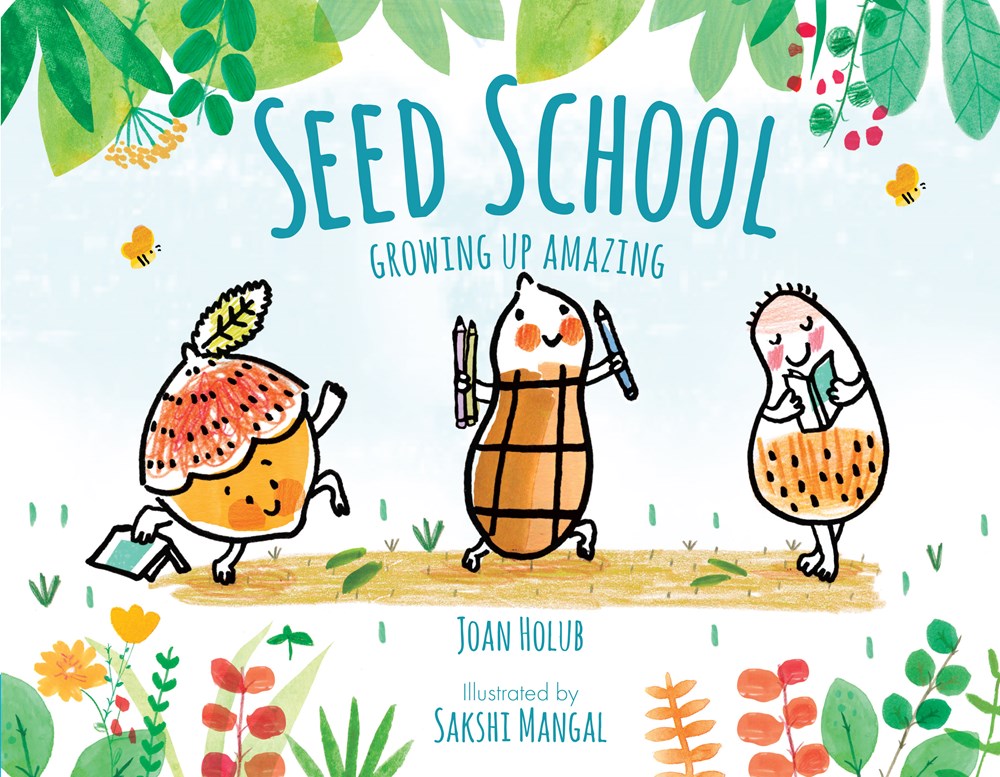
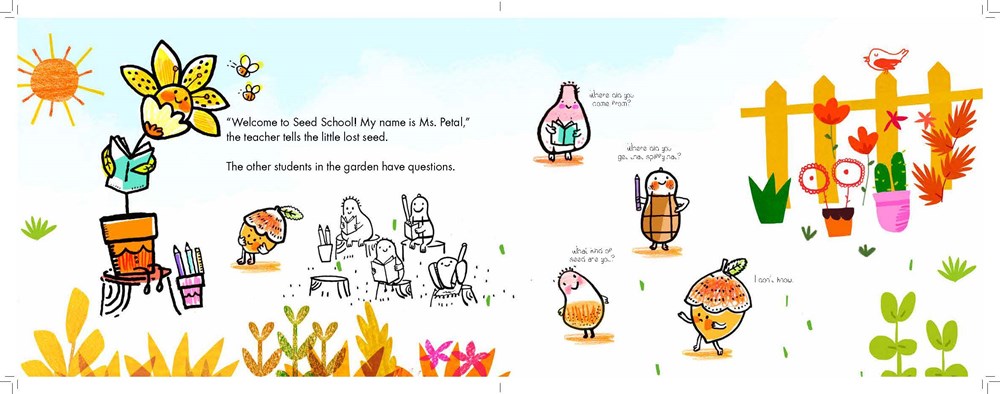
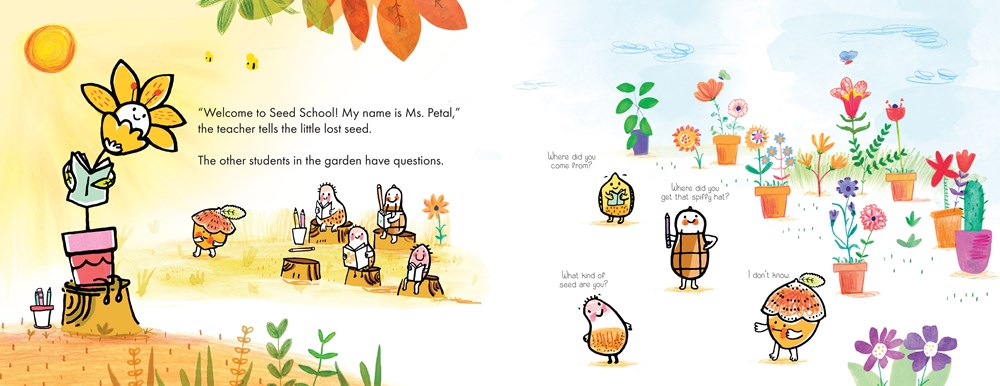
Seed School: Growing Up Amazing, by Joan Holub/Illustrated by Sakshi Mangal, (Feb. 2018, Seagrass Press), $16.99, ISBN: 9781633223745

Recommended for readers 5-8

An acorn gets blown from his tree and lands in the middle of Seed School, meeting seeds that will grow up to be sunflowers, vegetables, even weeds. The acorn is a kind of cool new kid with a funny cap, and doesn’t know what it’ll be when it grows up, but has some ideas as the seeds all learn what goes into growing from seed to plant: what to do during the different seasons (love those long winter naps), the important stuff they’ll need to grow (soil, sun, water, and air), and visit the Leaf Librarian to learn about photosynthesis. They even learn a cute song about growing. When it’s graduation time, the seeds all travel – by bird, squirrel, or wind – to get ready to grow. It may take the lost little seed with the cool hat to figure out what he’s going to be, but it’ll be worth the wait.

I love just about everything Joan Holub writes, from her board books to her middle grade novels, and my library kids do, too. Her Mini-Myths series (with Leslie Patricelli) is aces with my toddlers (and was with my own toddler), and I can’t keep her series novels, like the Grimm-tastic Girls, Goddess Girls, and Heroes in Training on my shelves. A picture book about seeds growing into flowers, that’s kind of like Science Comics for early readers is going to fly! Putting nonfiction text into a cute, storytelling format guarantees that kids will learn and enjoy. Sakshi Mangal’s illustrations are just too adorable, with bold, black outlines, adorable little faces, and brightly colored nature against a stark white page. I would hang art from this book all over my nonfiction area, and I’m incorporating this book into a Science Storytime on seeds and gardens in the spring.

Seed School is a fun add to picture book collections, and can be a fun read-aloud or a one-on-one. Pair it with Eric Carle’s The Tiny Seed or Eve Bunting’s Flower Garden, or Lois Ehlert’s Planting a Rainbow and Growing Vegetable Soup. Get out some flower coloring sheets, and you’re set!