Posted in picture books, Preschool Reads

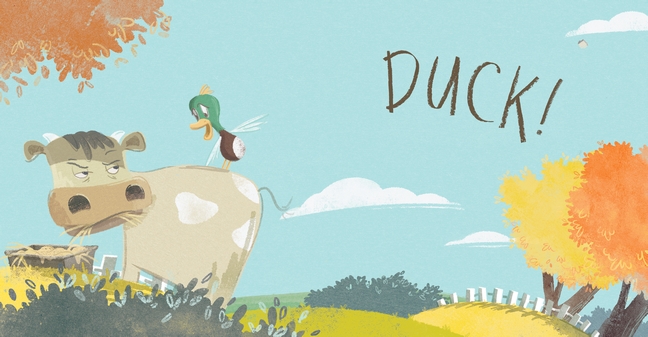
But what if the sky really *was* falling? DUCK!

Duck!, by Meg McKinlay/Illustrated by Nathaniel Eckstrom, (Aug. 2019, Candlewick), $15.99, ISBN: 9781536204223

Ages 3-7

It’s a quiet afternoon at the farm when a duck comes running, panicked, yelling, “DUCK!” The horse, cow, pig, and sheep each correct him, reminding him that he is the duck, and they have far lovelier qualities (like a fine pink snout or a fine pair of cloven hooves). The duck remains insistent, until the animals are tired of him and lecture him. At that point, Duck tells them to run… just in time for a house to come crashing down on the group. A newspaper headline strewn about the downed house notes that there are tornadoes in Kansas… and there’s a street sign in the debris that says, “Kansas”.

Duck! is a fun spin on the classic Chicken Little tale, with a cumulative spin added. Each animal that corrects Duck adds his own name and qualities onto the growing list of animals Duck is trying to warn. The artwork is wonderfully subtle here – alert readers will get the idea that something’s up when they see something in the sky, right next to a cloud… is that a house? As the spreads progress, the house gets closer, the sky gets darker, and leaves and household objects start entering the pages. The entire book is a sight gag and a play on words, and I love reading this to the kids. My son likes reading Duck’s parts, and I take the other animals.

The illustrations are done in pencil, acrylic, and digital and are colorful and are full-bleed, taking up each spread with something to see. The sky starts out as a light blue and darkens as the story moves forward; the characters’ faces are comical enough to mimic while telling the story for maximum laughs. Don’t miss this one.

Originally published in Australia in 2018, you can find free, downloadable activities and discussion questions at author Meg McKinlay’s website.

Posted in picture books, Preschool Reads

Bear and Spider return in Bear Out There

Bear Out There, by Jacob Grant, (June 2019, Bloomsbury Children’s Books), $17.99, ISBN: 978-1-68119-745-6

Ages 3-6

Bear and Spider’s newest adventure – the follow-up to 2018’s Bear’s Scare – sends the two friends on an outdoor hunt for Spider’s kite. Bear is just not an outdoorsy bear. Why bother? Everything he needs is inside! But Spider really wants to fly his new kite, so Bear relents and goes out for a little while. Spider’s kite gets pulled away by the wind, and Bear reluctantly offers to help him find the kite, but he complains the whole time, not noticing the nature all around him; focusing only on what he perceives as noise and weeds. When the rain comes, Bear is even more miserable, until he realizes that he hasn’t been a very supportive friend. He offers to help Spider keep looking, and sure enough, the rain stops and they locate Spider’s kite. The two friends end the day with a sweet compromise: they sit outdoors, having tea, and flying kites together.

As in his earlier story, Bear has a bad habit of not seeing what’s in front of him. His perception is skewed; something the art lets us readers in on as an inside joke. What he sees as “filthy ground, itchy plants, and pesky bugs”, we see as a sedate forest spread; what he sees as “yucky weeds”, we see as flowers that a turtle enjoys smelling; what he calls “noisy twitter” is the hooting of baby owls. Spider is there to be our “can you believe this guy?” foil, descending from his thread, wide-eyed and staring off the page, directly at us. At a rushing waterfall amidst gentle, rolling hills and butterflies, Bear’s exclamation of “such an unpleasant forest” is met with Spider, legs thrown up in the air in frustration. When Bear realizes he’s been selfish, letting his pessimism get in the way of helping his friend, things lighten up – literally; the rain stops falling and the kite is located. It’s all about perception, and friendship is all about compromise.

This one is a sweet follow-up, and reminds me of Arnold Lobel’s classic friends, Frog & Toad. Visit Jacob Grant’s website for more of his artwork and information about his books.

Posted in picture books, Preschool Reads

Back to School stories: Pirates Don’t Go to Kindergarten!

Hi all! I’m getting caught up on the avalanche of books in my home, so bear with me if I’m a little behind on my Back to School posting. NYC public school kids are back to school today – GOOD LUCK, EVERYONE! – and I’ve been getting my kiddos ready to start their school years off right. (So. Many. Supplies.) Anyway, with that, let’s talk starting Kindergarten with Lisa Robinson and Eda Kaban!

Pirates Don’t Go to Kindergarten, by Lisa Robinson/Illustrated by Eda Kaban,
(Aug. 2019, Two Lions), $17.99, ISBN: 9781542092753
Ages 4-6

Yeeeargh! It’s the first day of Kindergarten, but Pirate Emma has decided that she’s not leaving her preschool Captain, Cap’n Chu, and her crew! Cap’n Chu brings her over to the Kindergarten classroom – a spaceship! – but Pirate Emma isn’t having it. She runs back to Cap’n Chu’s room and refuses to leave, even going so far as to start a mutiny, and threatening Cap’n Chu with walking the plank! Thankfully, the Cap’n is a good and understanding Cap’n, who’s likely been through this before. She consoles Emma and convinces her that, while it’s time to join her new crew, she can always visit the pirate waters of preschool. From there, Emma’s ready: she joins the Kindergarten class as Space Pirate Emma.

This is a story that gets it. The transition from Pre-K to Kindergarten can be tough for kids, and Emma embodies those feelings of fear and defiance. She bellows things like, “Pirates don’t go to Kindergarten!”; “Pirates don’t take naps!”, and “Pirates don’t follow rules!” as she pushes back against having to join her new class, and it takes the combination of the very patient Ms. Hayes, the Kindergarten teacher, and the very understanding Ms. Chu, to help Emma work through her worries and resistance, leading her to make the decision to join her new Kindergarten crew.

Having been one of those moms, reading Pirates Don’t Go to Kindergarten was a relief: authors and illustrators who get it! They’re speaking to my now-second grader, who used to wake up morning after morning with one ailment or other that would render him unable to go to Kindergarten (and he, too, had a VERY understanding teacher, thank goodness). They’re speaking to me, letting me know that this is okay. I’m not the first parent, nor will I be the last, who will have a pirate that defies Kindergarten, or first grade, or maybe things on a smaller level, like going to the bathroom in school, or eating school lunch. This is all part of growing up, and growing up can be scary and hard. Having books like this can make it easier on all of us: kids, parents, caregivers, and educators alike.

The digital illustrations are colorful and lend themselves to exciting classrooms, where teachers create atmospheres for their students: Cap’n Chu created a pirate setting for her Pre-K class; Ms. Hayes has a spaceship-themed classroom for her Kindergarteners. (Psst… these teachers exist, I know a bunch of them!) The illustrations are enticing, giving kids (and worried caregivers) a glimpse into how fun a classroom can be. There are also tons of craft project ideas here: pirate hats and paper swords, anyone? Space helmets and stars?

Pirates Don’t Go to Kindergarten is aces for me. I’ll be reading this to my son’s former Kindergarten teacher’s class, to let those kids know that pirates certainly DO go to Kindergarten, and it’s pretty darned cool.

Posted in picture books

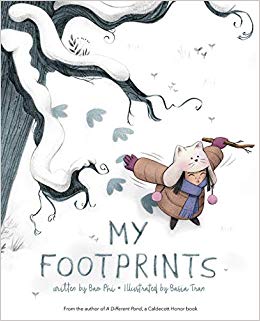
My Footprints addresses family, bullying, and imagination

My Footprints, by Bao Phi/Illustrated by Basia Tran, (Sept. 2019. Capstone), $19.99, ISBN: 9781684460007

Ages 5-8

Thuy is a biracial child with two moms who feels “double different”. Walking home one winter afternoon, she tries to ignore the bullies who go at her, but she’s frustrated – and then she sees a bird, which takes her away from the bullies and into the air, soaring like the bird; from there, she wonders about taking on characteristics of other animals: sprinting like a deer; roaring like a bear; anything that can help her channel her frustration. She arrives home to her moms, Momma Ngoc and Momma Arti, and talks with them as the three walk together, creating all sorts of footprints: a phoenix, a Sarabha from Hindu mythology, even a new creature that leaves heart-shaped footprints in the snow, as Thuy walks between her mothers.

This is a quietly captivating book about imagination and family; about taking power away from bullies by talking things out with family, and gaining strength from coming together. Using mythological animals like a phoenix, which rises from its ashes, and a Sarabha, a powerful beast with the ability to leap great distances, is a nod to both Thuy’s and her mothers’ Asian and Southeast Asian backgrounds. These animals also let readers follow Thuy further into an imaginary world where she – and we – can channel the strength of these creatures into ourselves when faced with adversity.

Beautifully told, beautifully illustrated, My Footprints is a solid addition to picture book collections.

Posted in picture books, Preschool Reads

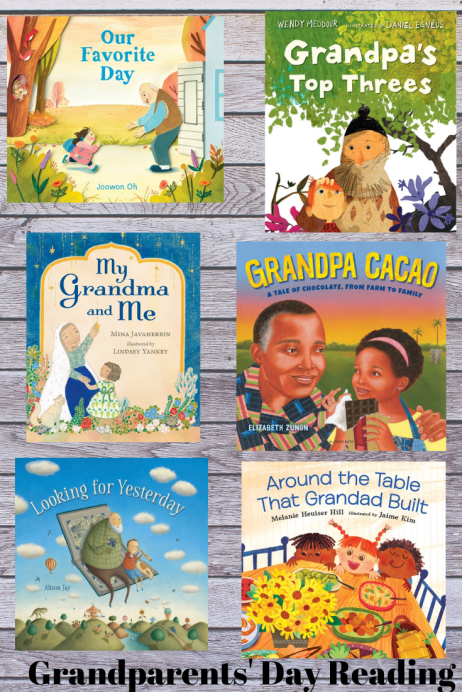
This Grandparents Day, let your kids read the stories to their grands

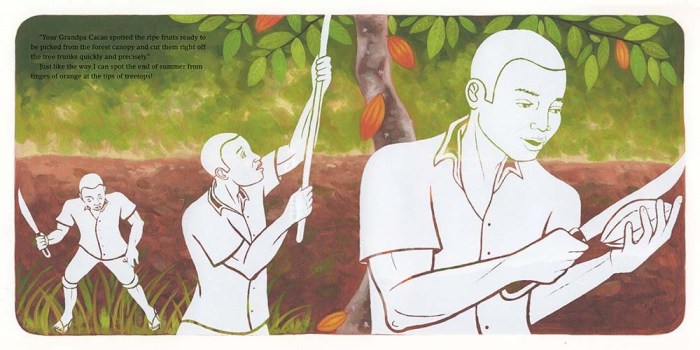
Grandpa Cacao: A Tale of Chocolate, from Farm to Family, by Elizabeth Zunon,
(May 2019, Bloomsbury USA), $17.99, ISBN:  978-1-68119-640-4
Ages 5-9

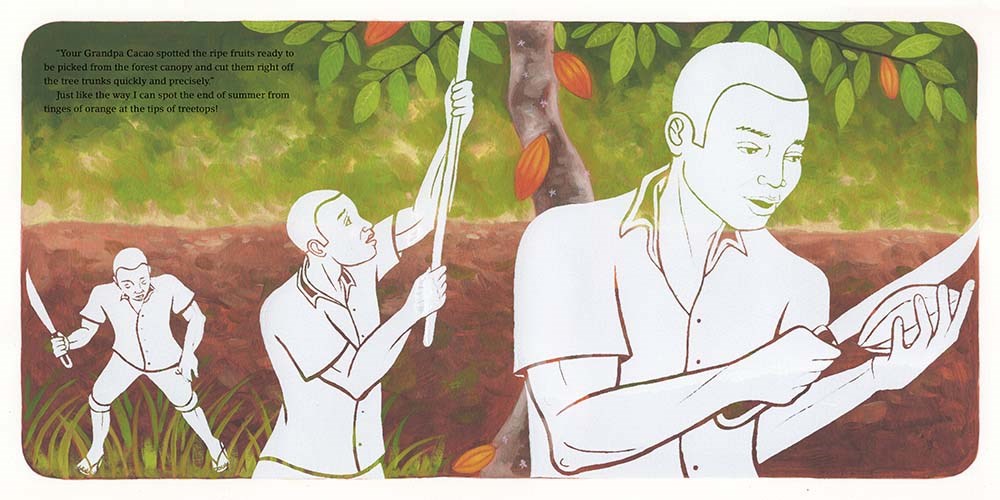
A girl and her father bake a cake and reminisce about “Grandpa Cacao” – her father’s father – and his life working on a cacao farm on the African Ivory Coast. Lush images come to life through Elizabeth Zunon’s oil paint, collage and screenprint artwork; there’s gorgeous texture and movement across the landscape, and Grandpa Cacao appears as a pale image, illustrating his existence as a “mythical figure” in the girl’s imagination. Inspired by the author’s own “Grandpa Cacao”, this is a heartwarming link across generations and celebrating the joy of creating together and uniting families. Back matter includes author’s notes and maps on the realities of the cacao trade, the sobering perseverance of child labor, and fair trade. There are notes on the science and history of chocolate, and a cake recipe to try with the kids.

Grandparents Day Idea: Talk to kids about their grandparents’ stories. Where are their grandparents from? Do they have memories of growing up to share? Does the family have any special recipes that have been handed down through generations?
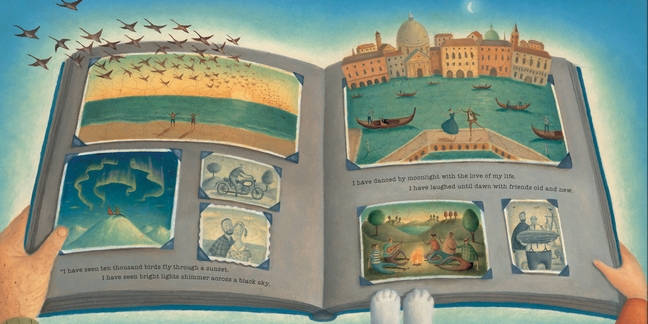
 

Looking for Yesterday, by Alison Jay, (Aug. 2019, Candlewick Press),
$16.99, ISBN: 9781536204216
Ages 4-7

A young boy tries to use science to figure out how to travel back in time, so he can relive the great day he had the day before. When he asks his grandfather for advice, he learns that memories are great, but it’s exciting to look forward to the possibilities of adventure in the here and now. Alison Jay gives her character a wonderfully childlike reasoning process – yesterday was so great, let’s try to get back there and live it again! – and has him go through the motions of working on the science to make it happen; her crackled oil artwork giving a vintage-looking life to the story. As the boy calculates going faster than light speed, we see his mind at work: he’s flying around the world, wearing a cape; using a time machine that looks like a giant unicycle; configuring a garbage can into a rocket. The boy’s grandfather walks him through a photo album as he recounts the past, drawing the boy into his adventures as the two fly on a scrapbook to see mountain tops, whales, and hot air balloons. The grandfather-grandson relationship is warm and loving, communicated with warm colors and body language. A great book to encourage kids to seize the day.

Grandparents Day Idea: Get out the photo albums and show kids your adventures! Show them your childhoods, talk to them about playing with your friends; going to school; exciting and ordinary things you did as a child. See how things are different, and how things are the same.
 

My Grandma and Me, by Mina Javaherbin, (Aug. 2019, Candlewick Press),
$16.99, ISBN: 9780763694944
Ages 4-8

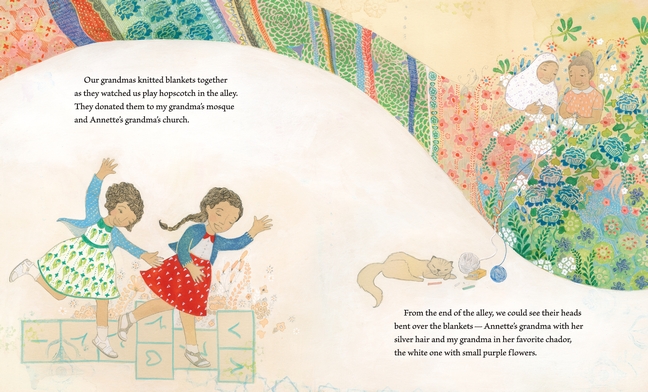
This autobiographical story of a the author as a young girl and her grandmother, living in pre-revolutionary Iran, brought me to tears with it beautiful storytelling. The opening line – “In this big universe full of many moons, I have traveled and seen many wonders, but I have never loved anything or anyone the way I love my grandma” – poetically brings to life that everlasting love between grandparents and their grandchildren. Mira Javaherbin invites us to glimpse into her life as we see her lay across her grandmother during morning prayer; send down baskets to buy bread from the boy on his bicycle, bread piled high in a basket; waiting for her grandmother to break fast during Ramadan, so she can eat with her; hiding under a table strewn with her grandmother’s chadors, as she “helps” her make news ones. Lindsey Yankey’s mixed media illustrations create a cozy, welcoming space for us to spend time reading Mina’s story. Mina’s best friend and her grandmother are Christian; Mina and her grandmother are Muslim. The two girls play together while their grandmothers craft and enjoy each other’s company; each goes to their own house of worship and prays for the other. It’s a quietly strong celebration of two cultures, two faiths, living and playing together. With starred reviews from Kirkus and School Library Journal, this loving look at the relationship between grandmother and granddaughter is a perfect gift book and storytime book.

Grandparents Day Idea: Do you have memories of your grandparents that you’d like to share with your kids? Talk to your kids about spending time with your grandparents as a child, or as an adult, if you have stories to tell. Ask them what they like to do when they’re with grandparents. Do they like to play board games together? Do they read together?
Around the Table that Grandad Built, by Melanie Hauser Hill/Illustrated by Jaime Kim, (Sept. 2019, Candlewick),
$16.99, ISBN: 9780763697846
Ages 3-7
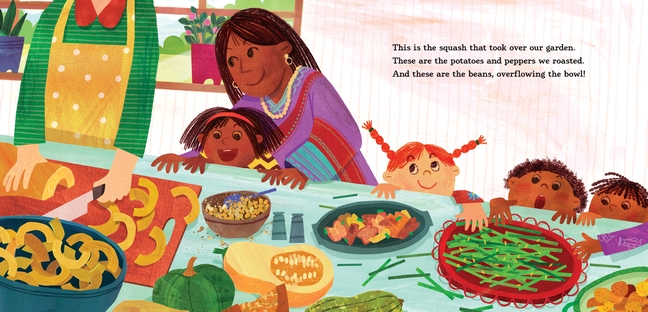
A sweet take on the classic cumulative story, The House that Jack Built, this heartwarming story assembles a multicultural family for a celebration centering around a table that Grandad built. Each part of the celebration is warm, inclusive, and participatory: cousins gather sunflowers; Mom’s sewn napkins that go with the dishes; glasses come from Mom and Dad’s wedding, and flatware comes from Dad’s grandma, all coming together to create a global table where the family enjoys squash, tamales, samosas, and other tasty fare, all prepared by members of the family. It’s a celebration of family steeped in tradition, linked across generations. The acrylic, crayon, and digital artwork adds to the handmade feel of the story and is rendered with bright primary colors, making this an upbeat story that will work for any family gathering. (Definitely keep this one on hand for Thanksgiving.)
Grandparents Day idea: Prepare a favorite dish with your grandkids, or create something with them. If you have little ones, try a no-sew project, or consider a craft that brings your generations together – handprints are always a good choice, and you can easily take some inspiration from the choices out there, while making it your own.
Grandpa’s Top Threes, by Wendy Meddour/Illustrated by Daniel Egnéus, (Sept. 2019, Candlewick),
$16.99, ISBN: 9781536211252
Ages 3-6
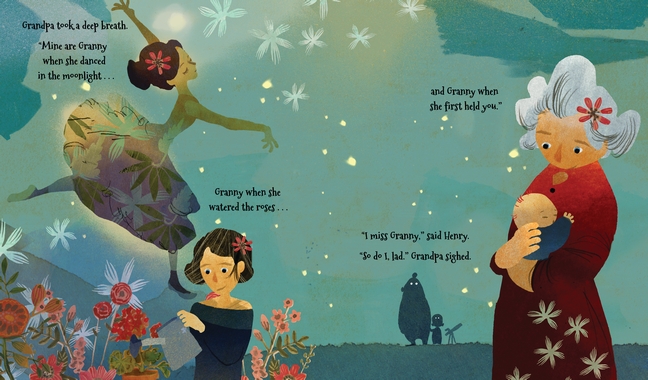
Henry loves to talk to his Grandpa, but Grandpa hasn’t been talking much these days; preferring instead to silently work on his garden. When Henry nudges Grandpa by indulging in his favorite game – Top Threes – Grandpa finally starts talking, giving thoughtful answers that ultimately rebuild the bridge between them. And then we find out what’s really going on: Grandpa is mourning Granny. In a moment that’s at once touching and heartbreaking, Henry asks Grandpa who his three favorite Grannies are, citing his favorites as his two grandmothers, plus the granny from Red Riding Hood. Grandpa recounts his favorite three memories of Granny as his three favorites, including the Granny that first held Baby Henry. The simple, moving prose is eloquent and full of feeling; full of aching and loss, and yet, instilled with deep affection and love for a grandchild and for a spouse. A beautiful, tender story that you may need a tissue or two for, but one not to be missed. Daniel Egnéus’s watercolor illustrations are digitally assembled, giving a mixed media, textured feel to the layers of the story with each turn of the page. Make this one available to kids who have lost a grandparent, and encourage them to talk about their Top Threes.
Grandparents Day idea: Talk about your Top Three moments; Top Three grandmas and grandpas, or Top Three anything.
Our Favorite Day, by JoowonOh, (Sept. 2019, Candlewick Press),
$16.99, ISBN: 978-1-5362-0357-8
Ages 3-6
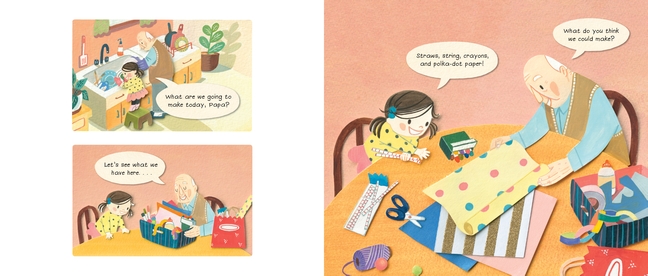
Grandpa has a routine he keeps to: a morning cup of tea, some light housework, and a bus ride into town, where he has lunch at his favorite dumpling shop, but Thursday is the best day of the week for Grandpa and his young granddaughter. It’s their day, and Grandpa is making sure it’s a good one! He chooses some crafting materials at a craft shop on his trip to town, gets two orders of dumplings to go, picks some flowers, and is ready to greet his granddaughter with a hug when she bounds out of the car! Together, the two enjoy their lunch, make a kite, and head out to fly it. With a narrative consisting of both omniscient narration and word-balloons, this adorably illustrated story is a wonderful way to celebrate grandparents and grandkids spending time together, and illustrates how important each is to the other. Grandpa has his own routine, but he lives for those Thursdays; he’s ready and waiting for his best buddy to arrive, and she can’t wait to get there. The affection and time they spend together is heartwarming and shows the mutual benefits of a multigenerational relationship. Joonwon On’s watercolor, gouache, and cut paper artwork creates texture and a scrapbook-like environment to envelop the reader. An absolutely adorable, touching story of grandparents and their grandkids.
Grandparents Day Idea: Craft together! Make a fun project together: it can be a kite, like the story shows, but it can be as easy as coloring together. I used to save a bag of fabric scraps from old clothes; when my Nana came to visit, I’d dump the bag on the table, and we’d make clothes for my dolls together. The craft doesn’t matter; the time you spend together does.
Posted in picture books, Preschool Reads

Bring on the School Stories (and a giveaway!): My Name is Wakawakaloch!

My Name is Wakawakaloch!, by Chana Stiefel/Illustrated by Mary Sullivan, (Aug 2019, Houghton Mifflin Harcourt), $17.99, ISBN: 978-1-328-73209-5

Ages 4-6

Over here in NYC, most kids are going to be starting school next week; many kids across the country are already back in school. It’s the perfect time to introduce some new school stories to the kids!

My Name is Wakawakaloch! takes place in the Stone Age (-ish), and stars a little girl who’s frustrated because her classmates can’t pronounce her name right! She goes home and tells her parents she wants to change her name to a nice, simple name, like Gloop. Her parents send her to the Wise Neanderthal in their village, the Elder Mooch, who tells her that she’s a “forward thinker”, but needs to be a “backwards seer, too”. Wakawakaloch returns home and looks at her home’s cave paintings, and sees that she is named for a line of strong women in her family and is empowered to not only stick with her unique name, but to empower other kids with extraordinary names.

This is an adorable book to start off the school year (or for anytime, really). How many of us have names you don’t see on a mug or a t-shirt? How many of us have growled when our names are mispronounced again and again? (You’d look at my name and think, “That’s so easy, it looks like it sounds!” But no.) In our multicultural society, we – and our kids – meet people with names that will be new to us on a daily basis. Books like My Name is Wakawakaloch! show kids (and adults) that our names are as individual as we are, and that there are positive ways to embrace our names and encourage others to embrace both our names and their names. The cartoony digital artwork has a playful sense of fun, and works with the story to deliver an upbeat story with a positive message.

Display with books like Phoebe Sounds it Out by Julie Zwillich, and Alma and How She Got Her Name by Juana Martinez-Neal.


Want a chance to win your own copy of My Name is Wakawakaloch? Enter this Rafflecopter giveaway! (U.S. addresses only, please!)

Posted in picture books, Preschool Reads

Celebrating Hair with Hannah Lee and Allen Fatimaharan

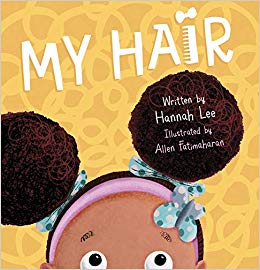
My Hair, by Hannah Lee/Illustrated by Allen Fatimaharan, (Sept. 2019, Faber & Faber), $16.95, ISBN: 9780571346868

Ages 4-7

A little girl has a birthday coming up, and wants a new hairstyle to debut. What should she get? This rhyming story follows a girl of color as she explores different hairstyles, observing friends, family, and the ladies at the salon. She mulls over dreadlocks, fades, braids, close-cropped, and wraps and turbans before finally listening to her mother and going with her natural, beautiful afro.

This acclamation of black hair and culture is such a joy to read. The rhyming text is fun and works beautifully with the images: earth-toned, bold, expressive characters and settings abound, and the personality of the images pops off the page. There are pets throughout the story, many sporting dramatic hairstyles (fur styles?) that match their humans. The young girl uses positive, lively words to run through styles she knows: her mother’s dreadlocks are “dazzling”; her uncle’s waves “swirl all over his head”; her aunt’s close-shaved hair is “like the head of a lioness”, and her grandmother “found one [grey hair] years ago and invited them all to stay”.

A positive, upbeat book about hair and community, and a smart add to your picture book collections.

A side note – if you haven’t had a chance to read or see the animated short for Mathew A. Cherry and Vashti Harrison’s Hair Love yet, please get the book or see the short (it’s running before Angry Birds 2; I hope other kids’ movies pick it up).


Posted in picture books

Folk and Fairy Tales with Mulla Nasruddin: Riding a Donkey Backwards

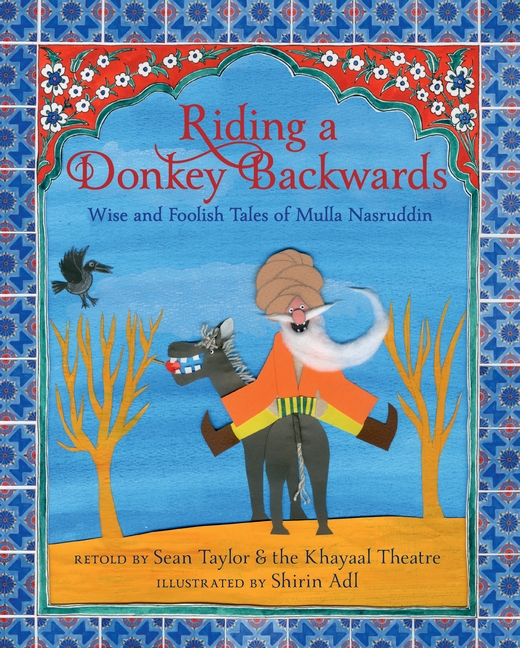
Riding a Donkey Backwards: Wise and Foolish Tales of Mulla Nasruddin, retold by Sean Taylor & the Khayaal Theatre/Illustrated by Shirin Ali, (Aug. 2019, Candlewick Press), $18.99, ISBN: 9781536205077

Ages 4-8

Mulla Nasruddin, the wise fool from Muslim folk tales, is here to entertain and liven up your 398 sections with 21 trickster tales. Every story is amusing; some are laugh-out-loud funny, and all of them will make you think. There are stories like “Whose Move?”, where the Mulla’s home is robbed; the Mulla follows the robber back to his home, gets into his bed, and informs him that his wife and family will join them tomorrow, convinced that he thought the robber was moving the Mulla and his family to the robber’s house. Stories like “Who Owns the Land?”, where the Mulla gives a thoughtful response to a dispute between farmers, will make readers pause and think about the earth and who has rights to it, after all. There’s a little bit of wisdom in each story.

The stories run 1-2 pages, allowing for quick reads during a circle time, story time, or lesson. The mixed media art is wonderful; it’s colorful and has different textures, almost inviting readers to touch the Mulla’s cottony beard or run a finger across a woven rug. An author’s note at the beginning of the book introduces readers to Mulla Nasruddin, and a glossary of Arabic terms helps readers with some new words. A welcome addition to trickster tales on the folktales shelf.

You can find out more about the Khayaal Theatre Company at their website. See more of Shirin Adl’s illustrations at her website. Get a riddle at author Sean Taylor’s website, or visit his blog for older readers.

Posted in picture books

Saying Farewell to Summer Reading with How to Be on The Moon

How to Be on the Moon, by Viviane Schwarz, (June 2019, Candlewick Press), $16.99, ISBN: 9781536205459

Ages 4-7

A little girl and her best crocodile friend decide to go to the moon. They ready their math skills, practice having patience, and pack travel games and sandwiches, then take off for a jaunt on the moon.

This is the second Anna and Crocodile adventure from Viviane Schwarz (the first, How to Find Gold, was published in 2016), and it is a celebration of friendship and imagination. The illustrations are pencil, crayon, and watercolor, giving the scenery different textures; it’s like taking a peek into an imaginary landscape. The moonscape is amazing, and looks like aluminum foil (more on that in a minute) against a colorful rocketship and blue-black spacescape. The book is upbeat, with an overall sense of playful fun, that makes this a book I’ll return to again and again at storytime and science time.

Speaking of science time, I’m finishing up my summer reading programs this week, and will be reading How to Be on the Moon when the kids and I make aluminum foil moons. It’s a simple enough craft that I can open it up to all ages, and I think it will be a fun way to bid summer reading goodbye for another year.

Author/illustrator Viviane Schwarz has fun, free downloadables and activities on her author webpage. Check them out!

I look forward to seeing where Anna and Crocodile go on their next trek!

Posted in picture books, Preschool Reads

Blob Tour Stop: A. Blob on a Bus

Hi, all! Happy to be a stop on this fun book tour about a bully, a blob (one and the same), and a bus. Read on!

A. Blob on a Bus, by L.A. Kefalos/Illustrated by Jeffrey Burns,
(July 2019, Laughing Leopard Press), $9.95, ISBN: 978-1-731251107
Ages 3-6

The second book in the A. Blob series stars A. Blob, who’s just a big, gooey bully. He pulls hair, he oozes all over the place as he shoves his way through the bus, he throws erasers, he’s just awful. One day, a little girl named Alexandra has had enough. She confronts the bully, and the other kids, bolstered by her courage, stand behind her. Faced with a united front, the bully puts itself in their shoes, and stops oozing! What lies beneath the muck that is A. Blob?

The first book, This is A. Blob, took a look at the other side of bullying, introducing us to the big, oozing bully tormenting kids at the school playground, and hints that bullies can be sad and lonely people who have trouble connecting with others. Here, we’ve got another common bully setting – the school bus – and the story of what happens when one person says, “Enough”. With A. Blob’s ooze slithering away, we see that possibly, that ooze is a wall built up to keep others out. The third book promises to reveal all!

The artwork reminds me of Nick Jr.-like characters; a realistic cartoony feel. Characters are diverse, with large, expressive eyes. Blob’s eyes are just as expressive, on eye stalks at the top of his head, letting readers know that there’s more than just what’s on the surface. The A. Blob books are a nice addition to your anti-bullying bookshelf, adding a thoughtful look at a bully’s internal motivation while encouraging kids to stand up for themselves and others. Display and read with Kathryn Otoshi’s books, particularly One.

There are bullying facts and free, downloadable materials guides for both This is A. Blob on A. Blob on a Bus at the Laughing Leopard website.