Posted in Media, TV Shows

Media Review: Jake and the Neverland Pirates (Episodes: The Golden Egg/Huddle Up) (Walt Disney Studios, 2011)

Directed by Kelly Ward. Disney Junior, 22 minutes. Walt Disney Studios. 2011

Recommended for ages 2-5

Jake_and_the_Neverland_Pirates_3489

Jake and the Neverland Pirates is Disney Junior’s answer to Dora the Explorer. Jake (voiced by Colin Ford) and his friends, Izzy (voiced by Madison Pettis) and Cubby (voiced by Jonathan Morgan Heit), are a multicultural group of children playing pirate games along with their parrot friend, Skully (voiced by David Arquette). Disney favorites Captain Hook and his mate, Smee, always seem to find a way to show up and meddle in their fun. Each 11-minute episode involves a quest of some sort, and Jake and his friends interact with the viewer by asking them to help out and solve problems and cheer them on. Each episode’s close rewards the team – and the viewer – for their teamwork by providing them with “pirate doubloons” that goes in the group treasure chest, which the viewers help Jake count. In The Golden Egg, Jake and his friends find a gold-colored egg, and set off to find who it belongs to. Captain Hook (voiced by longtime Captain Hook voice actor Corey Burton) and Smee (voiced by Jeff Bennett) are hot on the team’s trail, thinking the egg is an actual gold egg. Huddle Up finds Jake, Izzy and Cubby playing a game of “pirate football” until Captain Hook steals the ball, believing it has special powers. Jake and his friends set off on a quest to get the ball back from Hook.


The series is highly interactive, and children familiar with Dora will enjoy the familiarity. Like Dora, each episode resembles a video game, with tasks to complete; the team collects gold doubloons that float in the air to put in their treasure chest at the end of each episode. Members of the pirate rock band, Captain Bogg and Salty, end each episode with a pirate song.


Captain Hook and Smee are similar to Dora’s Swiper, the wily fox who tries to swipe Dora’s objects. Jake and his friends go on quests and provide the viewers with prompts to help them along; there are musical interludes throughout each episode, and a celebration at the end. It’s a good introduction to mainstay Disney characters – Peter Pan has appeared in at least one episode – for younger viewers, and Captain Hook and Smee are goofy here, less threatening than they are in the movie Peter Pan. Each episode emphasizes the importance of teamwork. With the Disney name on the cartoon, caregivers know the production values will be high. The animation is computer-generated, with bright colors and fluent action to keep viewers’ attention. The main characters have expressive, happy faces while the antagonists have exaggerated features that make them less menacing, more caricature-like.


Each episode runs roughly 11 minutes, which makes this a good addition to a pirate story time or a teamwork story time. The show is a pleasant way to keep children entertained while reinforcing lessons on preschool basics and teamwork, and the musical ending provides an opportunity to get the kids up and dancing. Learning a pirate jig would be a fun way to conclude a library program showing a Jake and the Neverland Pirates episode. The Jake and the Neverland Pirates section of the Disney website offers free printables that attendees can color and take home, and the Oriental Trading catalog and website has a wealth of pirate supplies that can be bought in bulk for relatively low cost, including fun pirate eye patches to hand out.
 

Posted in Media

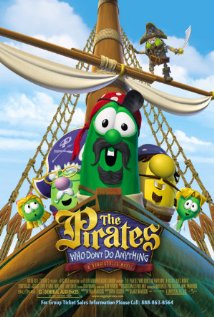
Media Review: The Pirates Who Don’t Do Anything: A Veggie Tales Movie (DVD, Universal Studios, 2008)

Directed by Mike Nawrocki. 85 minutes. DVD. Universal Studios. 2008. $ 9.99 ISBN 000013830397

Recommended for ages 2-8

veggie tales pirates

VeggieTales is an American series of computer animated family movies featuring anthropomorphic vegetables. The stories convey moral themes; many retell Bible  stories. The Pirates Who Don’t Do Anything was the first VeggieTales movie released theatrically through Universal Studios. Taking place between the late 17th century and the present, The Pirates Who Don’t Do Anything follows Veggie characters Elliot, George, and Sedgewick (“played” by popular Veggie characters Larry the Cucumber, Pa Grape, and Mr. Lunt, the Gourd). Working as servers in a pirate-themed restaurant, they wish they could be heroes rather than cabin boys; after they discover a “Helpseeker” sent back in time by Princess Eloise, they are transported back in time, where they become actual heroes and learn that being heroic has nothing to do with how someone looks, but in his or her actions.


The computer animation is well done. The VeggieTales franchise has been around since the 1990s; creators Mike Nawrocki, who voices main characters George, Sedgewick and Bob the Tomato , and Phil Vischer, who voices main character  Elliot – have built a successful book, movie and merchandising business, and reinvest money into it to keep it fresh and well-produced. The animation is rife with bright primary colors, and the Veggies themselves have expressive face with large eyes. The movie stumbles with its dialogue, which, while delivering an honorable message, does so with lackluster dialogue. The pacing is also a problem; the movie tends to drag as characters get caught up in dialogue over action, which may lose young viewers’ attention.   It can also be confusing to those viewers new to VeggieTales that the characters are “acting”, and therefore playing other characters.


The movie’s positive message and popular characters make it a good choice for a movie day or evening at the library.  The tone of the film is relentlessly positive; when the characters are feeling down, they lift one another up and always look for the bright side.  The villains are never truly scary or horrible; they appear goofy more than anything else. A viewing, with a discussion about what makes people heroes, and how actions speak louder than words or appearances, would be a good way to communicate the values demonstrated in the movie. The VeggieTales webpage provides free downloadable printables that viewers can color and take home.


Posted in Media, TV Shows

Media Review: Yo Gabba Gabba: The Dancey Dance Bunch (DVD, Nickelodeon Studios, 2008)

Directed by Scott Schultz and Christian Jacobs. 99 minutes. DVD. Nickelodeon. 2008. $14.98. ISBN 097368925847

Recommended for ages 1-5

yo gabba gabba dancey dance

Yo Gabba Gabba is a fun Nickelodeon series that teaches children social skills. The Dancey Dance Bunch DVD packages four episodes from Yo Gabba Gabba’s first season in 2007: Eat, Dance, Friends and Happy. Each 23-minute episode features human host DJ Lance Rock (Lance Robertson) and his costumed character friends, Muno (voiced by Adam Deibert), Brobee (voiced by Amos Watene), Foofa (Emma Jacobs), Toodee (Charme Morales), and Plex (voiced by Christian Jacobs). The group sings, dances, and plays together while teaching children lessons about friendship, eating healthy, and respecting one another. The show is live-action, with animated sketches and segments featuring real children dancing and playing. Celebrities including Elijah Wood, Mya, and Mark Mothersbaugh teach dance moves and give drawing lessons.  The music, while geared toward a very young audience, is set to pop, rock, and hip-hop beats, and the songs stick with you long after the episodes are over. The sets are simple, almost stripped-down, so the emphasis is on the characters.


Color is an important part of Yo Gabba Gabba. DJ Lance Rock’s costume is bright orange, and the characters are all brightly colored. Children appearing in sketches often wear colorful clothing with Yo Gabba Gabba characters on them, and the backgrounds where the characters sing and dance range from bright green grassy fields to icy blue glaciers to 8-bit computer backgrounds. The characters’ voices are high-pitched like a child’s, but the language never speaks down to the audience; rather, it takes concepts like learning how to lose gracefully and simplifies the concepts through song and conversation to reach their viewers on their level: “We play games to have fun, not to win or lose”.


The episodes in this video can be used to teach toddlers and preschoolers alike about forming good habits early in life. In the episode Eat, for instance, the character Muno has a party in his tummy that carrots and string beans want to be invited to. Space and cleanup permitting, this could be a great idea for a healthy eating workshop, with finger foods like baby carrots, celery sticks, and sliced up fruit for preschoolers to invite to the “parties in their tummies”, while dancing and singing along with the video. It would be a great teaching tool for teachers and librarians alike, particularly with episodes that teach the joy of playing, that it’s more important to enjoy a game rather than worrying about winning or losing, and how to be a good friend.


Posted in Fantasy, Media, Science Fiction

DVD Review: Hellboy: Blood and Iron (Starz Home Entertainment, 2007)

Recommended for ages 12+
For those unfamiliar with the Hellboy comic book and movie series, let me provide a very quick overview: Hellboy is a demon from Hell, brought to earth by Nazi occultists during World War II. He was saved by the Allies and raised as a son by Professor Trevor Bruttenholm, and later went to work for the secret international Bureau of Paranormal Research and Defense (BPRD), founded by Professor Bruttenholm. His two closest friends and partners are Liz Sherman, a human who can create fire with her mind, and Abe Sapien, an amphibious humanoid.

In Blood and Iron, the BPRD is asked to investigate a haunted mansion purchased by a billionaire who wants to make money from it as a tourist attraction. They learn that the mansion is haunted by ghosts, witches, werewolves and hellhounds and that the evil undead Hungarian countess and vampire Erzsebet Ondrushko, who Professor Bruttenholm has tangled with before, is back to cause more trouble. Ondrushko appears to be based on the real-life historical figure Elizabeth Bathory, and Greek mythological figures Hecate, goddess of the crossroads and witchcraft, and harpies are also thrown into the mix.

 
Mike Mignola, Hellboy creator, was one of the screenwriters on Blood and Iron and the cast who plays the characters in the movie voice their characters in this animated film. Fans of the comics and the movies will be happy here; there is plenty of paranormal activity, snappy dialogue and character interaction, and wild fight scenes and gunplay. While some of the imagery may be rough for younger viewers – there’s not direct graphic violence, but there is blood and some implied torture – older ‘tweens and teens have played more violent video games. Parents, watch it first, then use your judgement.
Posted in Media, TV Shows

TV Show Review: Good Luck Charlie (Disney Channel, 2011-Present)

Recommended for ages 9-14

Good Luck Charlie is a Disney Channel show that follows the Duncan family, a family of six. The title refers to the youngest, Charlie (Charlene), and the videos that her family makes for her as a guide to growing up. Every video ends with her oldest sister (and star of the show) Teddy, played by Disney Channel favorite Bridgit Mendler, wishing Charlie “good luck” as she navigates her wacky family.

The show sticks to the Disney formula of having present, loving parents who tend to need more supervision than the children. While lacking much of the smart-alecky backtalk that some of the Nick shows have drawn fire for, the Duncan children, particularly the middle schooler Gabe, have no problem talking to their parents as their peers. Mom Amy may be a nurse, assuming a degree of intelligence, but she craves attention like a child; Dad Bob has his own bug-extermination business but seems to be lucky he can function on his own, as he comes across dim-witted beyond belief.

Each Duncan child is a stereotype: PJ, the oldest son, takes after his father in being slow-witted; high-schooler Teddy is the straight-A, neurotic overachiever; middle-schooler Gabe is the caustic, scheming pre-teen, and toddler Charlie steals the show with a cute word or smile.

The formulaic characters provide a comfortable familiarity to the ‘tweens who watch the show – they know what to expect, they know that they’ll get a laugh, and they know everything is neatly resolved by the end of the episode. The parents manage to be loving and supportive and offer disciplinary action when warranted; for instance, when Teddy is caught in a lie, she is grounded; when Teddy goes through a bad breakup with her boyfriend, her mother is there to hold her and tell her it will be okay. The kids come together and care for one another and their parents and have friends who they surround themselves with. They are good kids, a good family, with their quirks – kind of like most families.

Posted in Media, Video Games

Game Review: Plants vs. Zombies (PopCap Games, 2009)

Recommended for ages 8-up

Plants vs. Zombies is a tower defense game by PopCap Games where the objective is fairly simple – using different plants as defense, keep the zombies out.

With every wave the player successfully fends off, the zombies increase, as do the plants at the player’s disposal. Originally starting with pea shooters and sunflowers, who draw sunlight and allow you to grow more plants, the game also provides such defensive fauna as cherry bombs, walnuts, and exploding potatoes. The zombies start out in the classic shambling style and whispering “Braaiins”, but get craftier – some ride zambonis, some dance, Saturday Night Fever-like, onto the scene, and some drop from the sky. They will eat through the plants if they make it through the wave of attacks, and if they eat their way through, lawnmowers stand by as a last line of defense. Increasing levels take the battle from the front lawn to the backyard (setting up defense by the pool) and the roof. A neighbor,  “Crazy Dave”, appears periodically to give the player a chance to purchase additional bonuses.

The game is available for limited play on PopCap’s site; it is also available as a download for Apple iPod and iPad systems, Android, Nintendo DSi, PlayStation 3, XBox, and the multiplayer platform Steam. PC and Mac users can also buy a copy for their computer. There is a Plants vs. Zombies wikia where players can read about walkthroughs, cheats, and new releases.

The game is shoot-’em-up fun without any horrific or realistic violence. Zombie’s heads pop off, but this is no George Romero film. The flowers are cute animated characters, and the zombies are ugly-cute more than horrific. If the zombies make it into the house, there are crunching sounds and red letters appear on the screen saying, “The zombies ate your brains!” but that is the extent of the horror in this game. The game helps kids plan strategies, figuring out how much they want to spend on their flowers, placement to best fend off their zombies, and when to spend funds with “Crazy Dave”.

The game is the fastest-selling PopCap video game and has been nominated for Interactive Achievement Awards from the Academy of Interactive Arts & Sciences (“Casual Game of the Year” and “Outstanding Achievement in Game Design”). The game has also received nominations in “Best Game Design”, “Innovation”, and “Best Download Game” for the Game Developers Choice Awards. (Wikipedia)

Posted in Media, Video Games

Game Review: Minecraft

Recommended for ages 9+

Minecraft is a sandbox game – a game with no objective other than to have fun (and survive) – where players create their own worlds by mining and digging resources for themselves. With both multiplayer and single player options, Minecrafters can play with other friends or on their own.

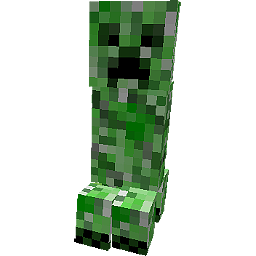
Players have limited time to get their resources and initial shelters built; monsters called Creepers (right) come out at “night” and damage property and individuals alike. Other monsters, including spiders, skeletons and zombies cause varying degrees of damage to property and/or players.

Players can modify their game by downloading modifications (mods for short) that provide them with extra weapons, unlimited resources, surface textures and additional characters. Some mods are not comptabile with others, but there are lists that keep players informed about these incompatibilities.

Minecraft is a great game for kids. It affords them the creativity to build worlds to their liking and gives them the tools to continue creating, expanding and altering their worlds. By playing alone, they can interact with other Minecrafters, or by playing by themselves, they can avoid any potential problems with “friends” who think destroying other people’s worlds is fun. It is a game of imagination and creation that continues to grow and expand, bringing new ideas and capabilities to kids. With an “old school” 8-bit appearance, there are no sleek graphics or mind-blowing special effects, and yet the game is very popular because of the ability to develop and adjust entire landscapes and stretch their creative  muscles.

There is a wealth of information available for anyone interested in learning Minecraft, including the Minecraft Wiki, available in ten different languages including Spanish, French, Russian and Korean. Templates exist for other languages if a user is willing to put the work in to build them. Billing itself as “the ultimate resource” , the wiki offers help on gameplay, crafting, modifications and more. WikiMinecraft is a fan-based site that offers video tutorials and screen shots to guide new crafters.

One family creates their own Minecraft video podcast, Minecraft Family Adventures, available on YouTube.