Posted in Fantasy, Fiction, Graphic Novels, Humor, Tween Reads

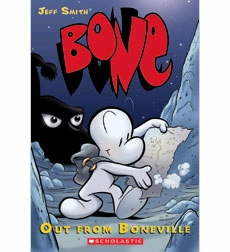
Book Review: Out from Boneville, by Jeff Smith (Scholastic edition, 2005)

Recommended for ages 11-13

Jeff Smith’s Bone was a popular comic book title in the ’90s, winning four Eisner Awards, and three Harvey Awards in 1994. Later on, the book caught on with kids as graphic novels gained more acceptance among educators. Scholastic has taken the 55-issue comic book series and repackaged them into a series of graphic novels. Out from Boneville is the first volume of this series, which follows the adventures of three cousins as they blunder into a fantasy world after being run out of their home, Boneville.

Phoncibile (Phoney for short) Bone is greedy and arrogant, which we are led to believe caused his ouster; Smiley Bone is the laid back one, and Fone Bone, our protagonist, is high-strung but an overall nice guy. Drawn as white humanoid shapes, the Bones resemble Casper with legs. The art is cartoon-like, very tween-friendly, and the banter is light and fun. Even the rat monsters who spend much of the novel trying to eat Fone Bone and seek out Phoney Bone for some dark reason are bumbling and goofy.

Out from Boneville sets up the entire Bone series, so  the storyline leaves a lot of questions unanswered by the end, but they are questions I am willing to pick up another volume to continue the journey.

 For teachers interested in working with graphic novels, Scholastic offers a guide for teachers and librarians (with mentions of Bone). Jeff Smith also maintains a Boneville web page with his touring schedule, his blog, and a section devoted to Bone.

Posted in Graphic Novels, Humor, Middle School, Tween Reads

Book Review: Amelia Rules! The Whole World’s Crazy, by by Jimmy Gownley (Renaissance Press, 2006)

Recommended for ages 9-12
 
Jimmy Gownley’s graphic novels about Amelia McBride and her group of friends remind me of Bugs Bunny cartoons – when you’re a child, they entertain you; when you’re a little older, you get the jokes.
 
In this first volume, we meet Amelia, age nine. Her parents have just divorced and she and her mom have moved from Manhattan to “the middle of nowhere, Pennsylvania”, where they live with her retired pop rock star Aunt Tanner. Tanner provides a ready ear and sometimes, shoulder, for Amelia when she needs to vent.
 
Amelia’s a wise-cracking tomboy, but she isn’t skin deep. We see the effect of her parents’ divorce on her, be it through the frustration and anger with her father for canceling plans for their weekend together because he has a last-minute work commitment or her discomfort in overhearing her mother berating her dad on the phone. She shakes it off, adapts her hard-as-nails persona, and moves on. We all know kids like Amelia;  maybe we have even been in Amelia’s place at one point, and this is what makes her so accessible to kids and grownups alike.
 
Speaking of grown-ups, there are plenty of in-jokes for mom and dad to catch. Amelia and her friends go to Joseph McCarthy Middle School (motto: “Weeding out the wrong element since 1952”). Ann Coulter garners a mention on one of Santa’s lists (hint: it ain’t the “nice” list). There are pop culture references aplenty. The dialogue is funny and smart; Gownley doesn’t talk down to his audience, nor does he shy away from sensitive topics.
 
Amelia’s friends are a mixed bag of personalities. Amelia’s friend Reggie is obsessed with being a superhero, to the point of starting his own league of heroes called GASP (Gathering of Awesome Super Pals). Pajamaman is the most popular kid in school, but never speaks, wears footie pajamas, and comes from a poor family. Rhonda, Amelia’s nemesis (and grudgingly, good friend), has a crush on Reggie and puts herself in competition with Amelia for his attention. The group deals with bullies and crazy teachers, unrequited love and poverty. It’s a group of kids that readers will see themselves reflected in.
 
The Amelia Rules! website offers even more to Amelia fans. There are book trailers, podcasts, a blog, and links to fan art and fan fiction. Visitors can listen to music in Tanner’s Garage and play games in the Ninja Lair.
Posted in Fantasy, Fiction, Graphic Novels, Tween Reads

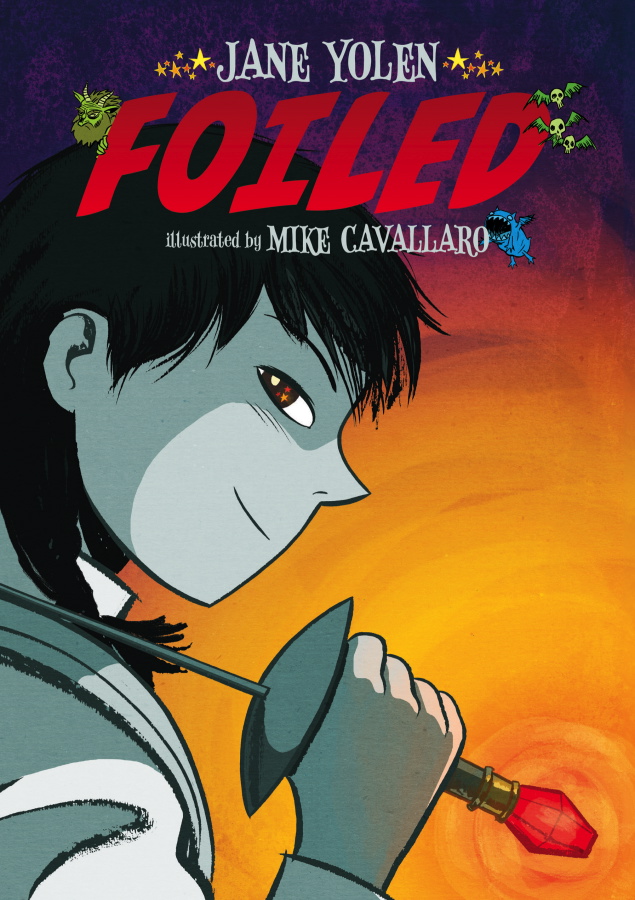
Book Review: Foiled, by Jane Yolen; illustrated by Mike Cavallaro (First Second, 2010)

Recommended for ages 12+

I love Jane Yolen’s books – her How Do Dinosaurs… series have a very special place on my bookshelf; they provided hours of cuddle time and giggles for my boys and I when they were younger. Her Commander Toad series was my older son’s logical next step after enjoying Frog and Toad’s adventures. As a former fencer, I was thrilled to see that Yolen made a teen female the hero of her graphic fantasy novel AND a fencer. Girl power!
 
High schooler Aliera Carstairs doesn’t fit in. She doesn’t fit in with the goths “(“I don’t look good in black”), the nerds (“my grades aren’t high enough”), or the jocks (“fencing doesn’t count”), but she’s dynamic on the fencing strip. Her coach, grooming her for nationals, advises Aliera to “always guard your heart”: advice she takes very seriously both on and off the strip. Aliera vists her wheelchair-bound cousin and best friend Caroline every week to play role-playing games.
 
Aliera’s mom, a compulsive bargain shopper, picks up a fencing foil at a garage sale; Aliera plans to use it as a practice foil once she shaves off a big, fake ruby that’s been glued to it. Around the same time she receives the foil, she meets a new boy in school, Avery Castle, who’s a little odd but has all the girls vying for his attention. He asks Aliera on a date and they agree to meet in Grand Central Station after fencing practice. Having never been on a date, she’s nervous but accepts.
 
In Grand Central Station, things take a Neil Gaiman-esque turn. There, Aliera stumbles on a fantasy world that connects her, Avery, and her unusual foil.

Foiled leaves the reader hungry for a second helping. Aliera, Avery and Caroline are all vibrant, interesting characters, and even when Aliera is at her most guarded, the reader wants to get behind her fencing armor and find out what makes her tick. Older ‘tween and young teen readers alike will enjoy the blending of fantasy into a reality-based setting, and teachers could use this novel in a fairy tale/mythology unit for older readers. The artwork never talks down to the book’s audience, portraying kids as kids rather than caricatures; the fantasy creatures are brightly colored and drawn straight from a vivid imagination and the fencing sketches are dynamic.

Jane Yolen’s website contains information for both students and teachers, an archive of awards the author has received, book trailers, and a link to her blog.