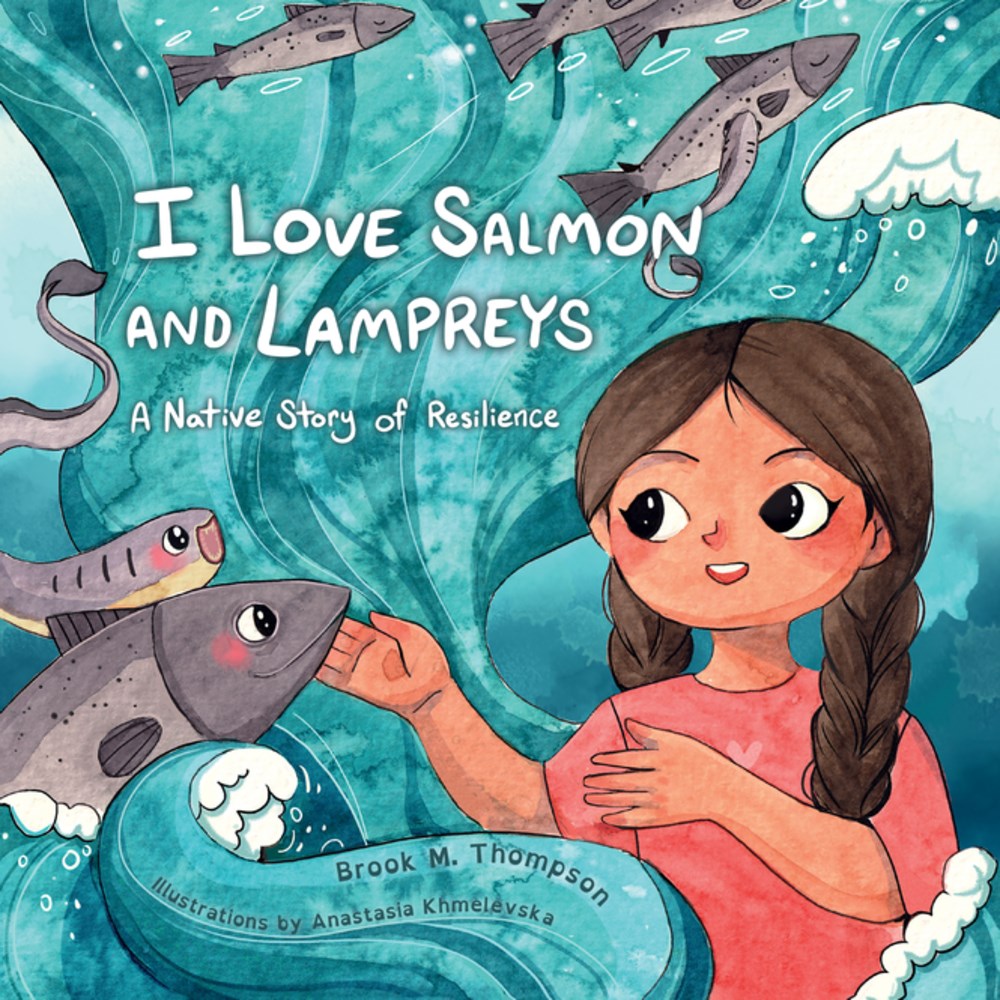
I Love Salmon and Lampreys: A Native Story of Resilience, by Brook S. Thompson/Illustrated by Anastasia Khmelevska, (Feb. 2025, Heyday), $20, ISBN: 9781597146685
Ages 4-8
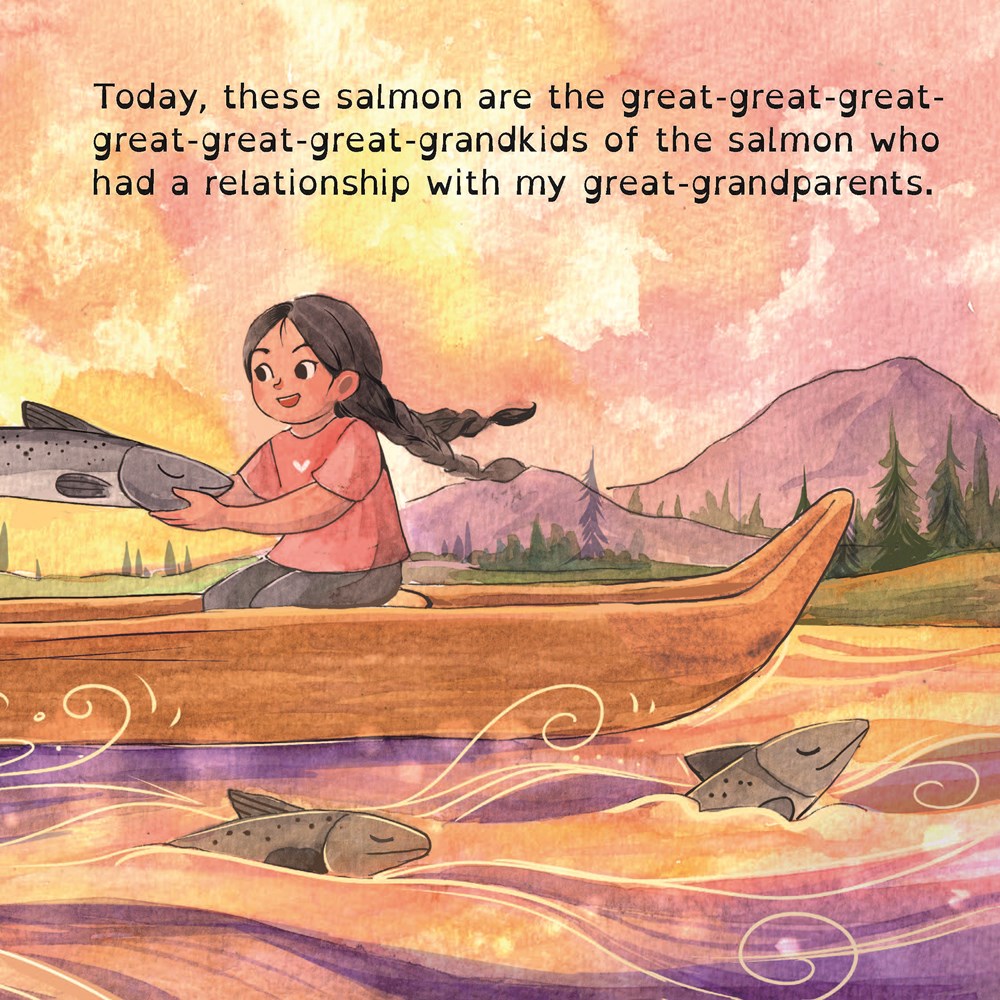
Growing up, Brook Thompson loved fishing with her family and hearing their stories; she also learned to care for the salmon and lampreys that sustained generations of her family. The dams along the Klamath River in Northern California endangered the fish, leaving the fish susceptible to “ich”, a parasite, that killed over 60,000 salmon. A member of the Yurok and Karuk Tribes, Thompson joined the tribal members and community that protested the dams until several were removed. Thompson’s story goes beyond the biographical to explain how the story of the fish mirrors her own journey to becoming a scientist and engineer; their pasts are rooted together in history, starting with the fish sustaining her ancestors. Like the salmon and lampreys, Thompson explored a life away from home, returning after receiving an education that will allow her to “take care of fish for people in the future, like my ancestors did for me in past years”. Khmelevska’s endearing artwork is rich with warm colors and expressive faces. A rendering of a grown-up Thompson wears a dress readers will recognize in an author photo from the back matter. Back matter includes fun facts, maps, and a note about the Klamath River dams. The book’s text utilizes a font called OpenDyslexic, making it easier for readers with dyslexia to enjoy. A good additional purchase for picture book biographies. Pair with We Are Water Protectors for Earth Day displays.
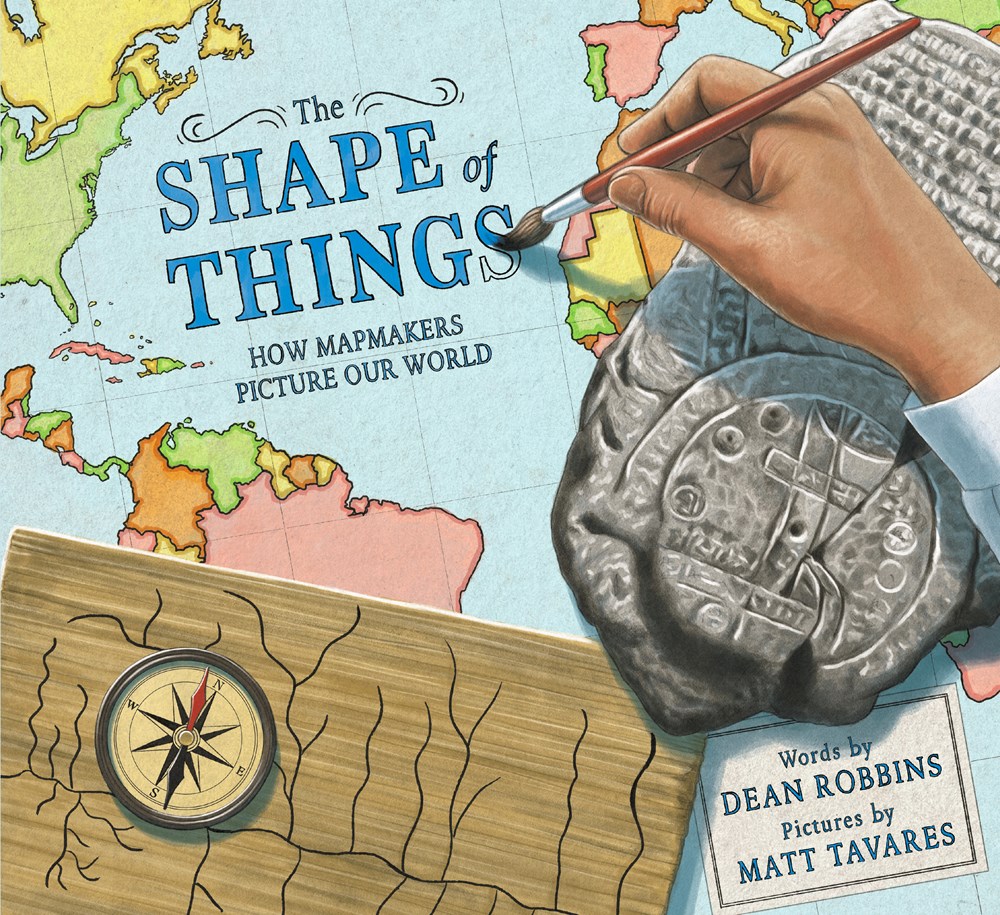
The Shape of Things: How Mapmakers Picture Our World, by Dean Robbins/Illustrated by Matt Tavares, (Aug. 2024, Knopf Books for Young Readers), $19.99, ISBN: 9780593479254
Ages 4-8
An extraordinary discussion on the development of maps, Robbins provides an insight into human history as Tavares illustrates how different eras created maps to make sense of their world. Beginning with the first cultures to make maps using cave drawings and mammoth tusks, Robbins describes how mapmaking developed with humans, going from rocks to papyrus and ink to digital technology; as humans explored the planet, maps became more detailed, including paths connecting cities, rivers, and oceans. Flat, one-dimensional maps gave way to globes and tools like the compass, Gunter’s chain, and satellites, and computers. Robbins skillfully explains how humanity came together with the goal to explore and define the world we share; Tavares’s digital illustrations show realistic depictions of people through different eras creating various maps, allowing readers to see the changes in landscape, cultures, and technology. The story of maps is the story of mankind, beautifully told here. Endpapers depict shards of an early map and a car-mounted smartphone GPS. Back matter includes an illustrated mapmaking timeline, a bibliography, and notes on mapmaking. Developing mapmakers will return to this book again and again.
“Map lovers and readers interested in the development of knowledge and technology will be drawn to Robbins’ look at how we, over millennia, have documented Earth’s shape.” —Booklist
Dean Robbins is a journalist and children’s book author. His previous books include, The Fastest Girl on Earth!, Two Friends; Susan B. Anthony and Frederick Douglass, Miss Paul and the President, and Margaret and the Moon. He lives in Madison, Wisconsin, with his family. To learn more, visit https://deanrobbins.net/
Matt Tavares is a New York Times bestselling author-illustrator of over twenty titles. His books have been featured in: ALA Notable, Parents’ Choice Gold Awards, and twelve were chosen for the Society of Illustrators Original Art exhibit. His artwork has been exhibited at the Brandywine River Museum, the Eric Carle Museum, and the Mazza Museum. Matt lives in Maine with his wife, Sarah, and their two daughters. Visit his website: matttavares.com
Club Microbe, by Elise Gravel, (Apr 2024, Drawn & Quarterly), $17.95, ISBN: 9781770467026
Ages 5+
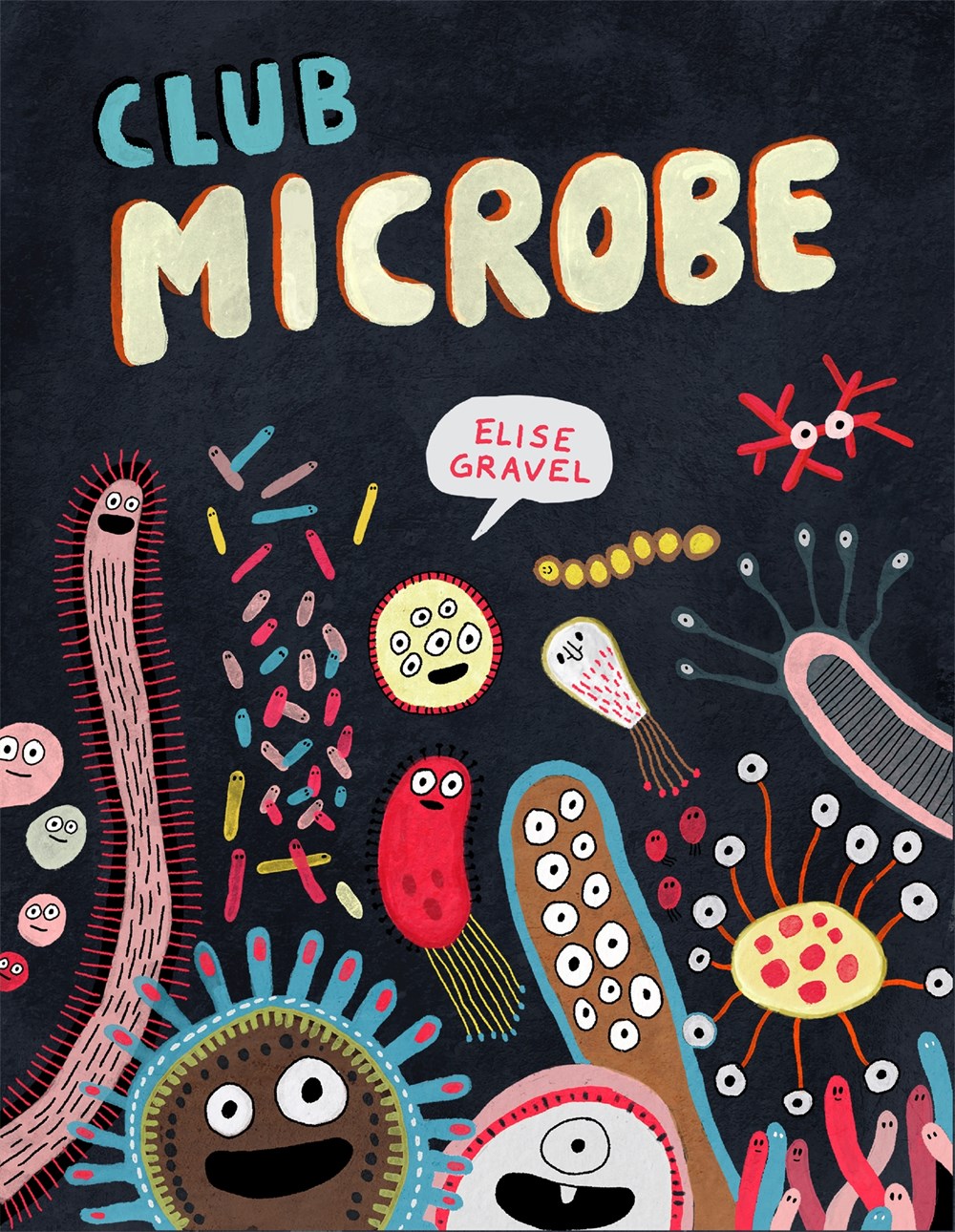
Elise Gravel makes some of the most fun science series: Club Microbe joins the ranks of Mushroom Fan Club and The Bug Club, making adorable cartoons out of subjects kids would normally scrunch their noses up at. Club Microbe is all about microorganisms: viruses, algae, bacteria, you name it, Gravel is fascinated with them. Gravel convinces readers that microbes get a bad rep because of a few creeps, like the coronavirus and rabies lyssavirus; there are loads of good microbes, like the bacteria that makes yogurt, or the germs that live in our intestines and help us digest our food (and make a little body music). There are microbes that help fight climate change, and microbes that help form snowflakes. Microbes are found everywhere on the planet – even volcanoes! – and without them, we’d be a dead planet. Gravel warms to her subject; her enthusiasm shines through, and her illustrations make expressive, brightly colored blobs of all sizes and shapes. A fun introduction that will delight any reader. Get a free virus printable and other science printables at Gravel’s author website.
Chef Edna, by Melvina Noel/Illustrated by Cozbi A. Cabrera, (Apr. 2023, Abrams), $18.99, ISBN: 9781951836399
Ages 5-8
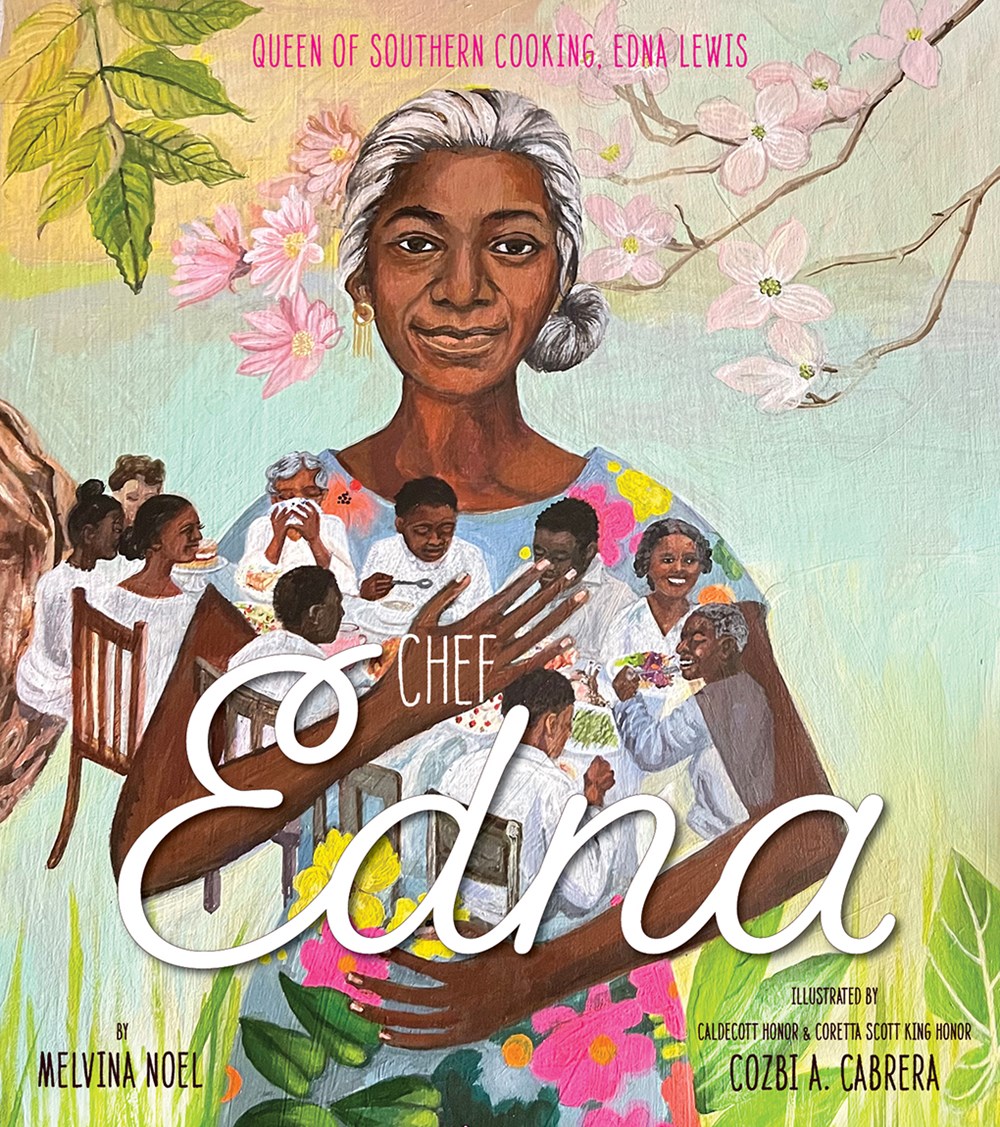
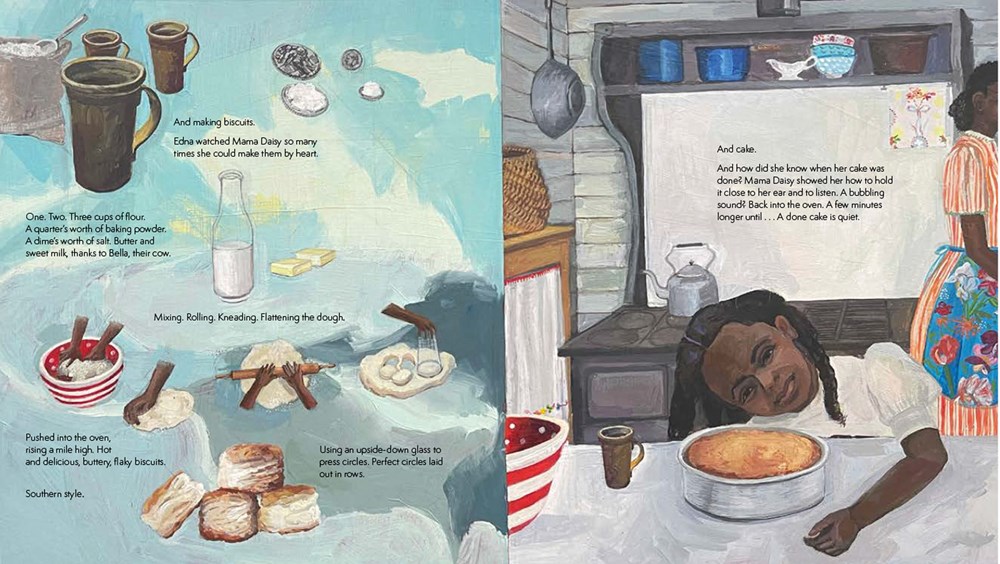
Have you ever heard of Chef Edna Lewis? You will now. Raised in Freetown, Virginia, in a town founded by her grandfather and other freed slaves, Chef Edna grew up on a farm and cooked with her mother, Mama Daisy, learning to measure out ingredients with coins: “A quarter’s worth of baking powder. A dime’s worth of salt”. She eyeballed, listened, and watched as her meals took shape; as her community gathered ’round to enjoy food together. But her parents passed, and Edna headed to New York to find work to help support her family; she took jobs answering phones and as a seamstress, making beautiful clothes for movie stars, but her real talent lay in creating food to bring people together, just like her life in Freetown. Eventually, that is exactly what she did: beginning with dinner parties and catered events, word spread and Edna’s Southern meals generated buzz and gained popularity, and Miss Edna eventually became Chef Edna, co-owner of an Upper East Side restaurant in Manhattan, where luminaries of all stripes came to eat Southern food. Caldecott and Coretta Scott King Honoree Cabrera creates gorgeous spreads with deep colors to evoke the clean feeling of a country kitchen and the warmth of a family gathering. A spread showing Chef Edna’s Manhattan clientele reveals some familiar faces, including Salvador Dalí and Eleanor Roosevelt; older readers who recognize certain celebrities will enjoy the secret reveal and can clue younger readers in. Back matter includes an author’s note, a biscuit recipe, and further sources for more reading. The cover is a beautiful illustration of Chef Ednea holding a table full of people in her arms, illustrating the connection between food and community. Endpapers bookend her life, showing a farm and a woman wearing a colorful floral dress, holding a bag of fresh food and flowers, crossing a street in the city. A wonderful celebration of a life well-lived, Chef Edna is an excellent add to picture book biographies.
Visit the Edna Lewis Foundation for more information about Chef Edna, her books, and a scholarship in her name that funds study for young, upcoming Black chefs.
The Fire of Stars: The Life and Brilliance of the Woman Who Discovered What Stars Are Made Of, by Kirsten W. Larson/Illustrated by Katherine Roy, (Feb. 2023, Chronicle Books), $18.99, ISBN: 9781452172873
Ages 6-9
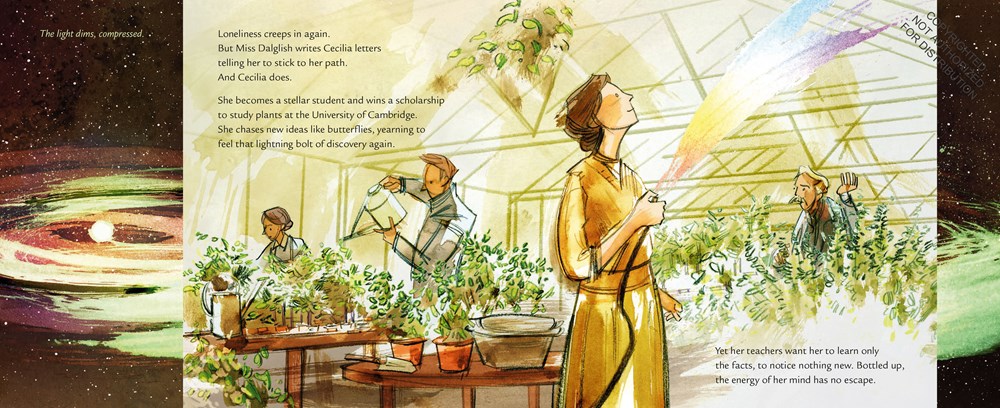
This picture book biography on astronomer and astrophycsicist Cecelia Payne charts the birth of a star with Payne’s rise – also the birth of a star, albeit in the astrophysics and astronomy fields. Born in the English countryside and moved to London at an early age, Cecelia Payne is fascinated with nature and science. Pencil and ink illustrations, digitally colored, show Payne as she grows from curious child to focused, science-mined young woman, alongside the celestial creation of a star; the descriptive text mapping to moments in Payne’s life. After graduating Cambridge, Payne traveled to America, where she ultimately discovered that stars are composed mostly of hydrogen and helium. Back matter includes more about Payne and being a woman in the sciences and a deeper dive into the panels illustrating a star’s creation. There is also a timeline of Payne’s life and a bibliography. It’s a beautifully illustrated book that marries its subject with the phenomenon she helped further define. An excellent selection for STEAM and STEM collections and biography collections.
The Queen of Chess: How Judit Polgár Changed the Game, by Laurie Wallmark/Illustrated by Stevie Lewis, (July 2023, Little Bee Books), $18.99, ISBN: 9781499813067
Ages 6-9
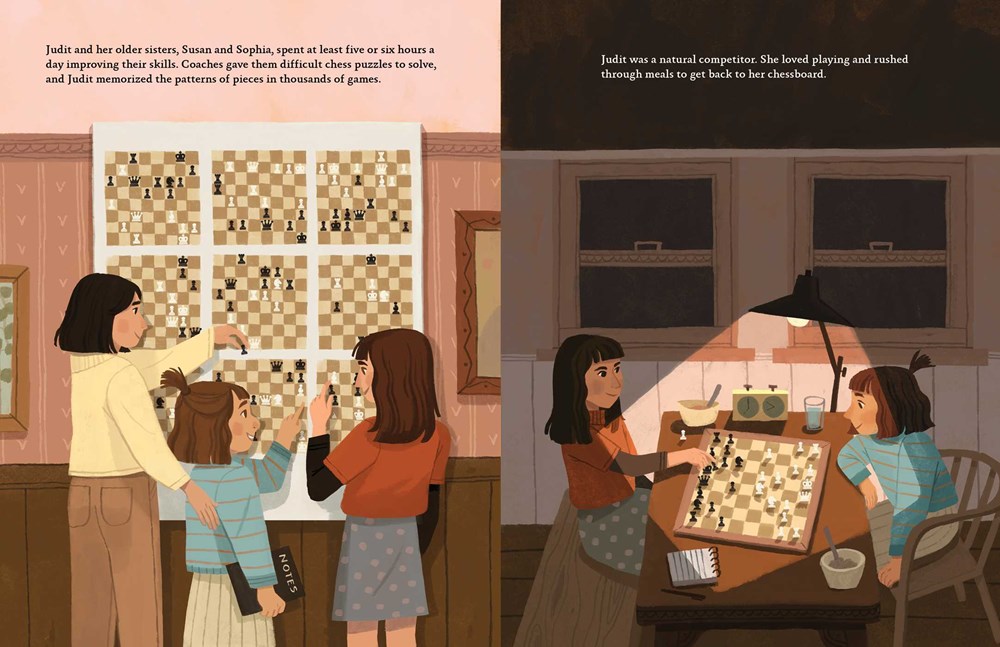
As a child, Judit Polgár watched her parents teach her older siblings to play chess; at the age of five, it was her turn to learn. The Queen of Chess, the picture book biography of chess prodigy Polgár, chronicles her rise and dedication to the game. Stevie Lewis beautifully communicates Polgár’s intensity, beginning with the cover illustration, where Polgár stares intensely at a chessboard – and possibly, the reader? – hands folded in concentration. The Queen of Chess is a love letter to chess without necessitating knowledge of the game. Wallmark tells the story of Polgár’s passion for the game and determination to attain the rank of grandmaster; Lewis creates illustrations that communicate both Polgár’s intensity and her joy: she smiles as she and her sister go over patterns and play “blind chess”, where they sat back to back, announcing their moves to one another. Wallmark writes of Polgár’s “ferocious” and “fearless” game while noting that checkmating her opponents made her giggle and smile. Lewis captures a moment where Polgár lies on her bed, holding a book on chess positions, smiling with her eyes closed. Polgár wrote copious notes on her opponents and is well aware of the mental game involved in chess. Her determination won her medals and championships and made her the youngest grandmaster in history at the age of 15. The Queen of Chess will inspire and excite readers, possibly introducing another generation to the game. Back matter includes a timeline of Polgár’s life and a note on the mathematics of chess. An excellent choice for biography collections.
Visit the Judit Polgár Chess Foundation for more information on supporting chess programs for children. Judit Polgár’s website includes fun facts, photos, and appearances. ChessKid is a site that includes teaching materials for children who want to learn chess.
To celebrate the release of Destiny Finds Her Way by Newbery Honor winner Margarita Engle, blogs across the web are hosting guest posts from Margarita as well as the book’s photographer, Sam Trull, who is also the co-founder and Executive Director of the Sloth Institute — a sloth rescue organization based in Costa Rica. Join us for a journey behind the scenes of how these two amazingly talented women teamed up to bring this inspiring, true story to readers everywhere and learn more about sloths and the work being done to protect them.
Rewilding Means Survival
by Margarita Engle
As a botanist, I have visited Costa Rica and other tropical rain forest regions at various times, beginning in the 1980s. As a Cuban American, I have loved tropical forests since my childhood visits to the island during the 1950s and early ‘60s, with many return trips since 1991.
There is no substitute for the protection of forests and planting of additional native trees. Every breath we inhale has passed through a green leaf. Every living species is dependent on the balance between oxygen and carbon dioxide. Tropical forests are one of the essential sources of global balance. By protecting trees, we can slow climate change and avoid catastrophe.
Costa Rica has protected so much of its forest that it can be viewed as a role model for the rest of the world. Along with trees, wildlife survives. Sloths, monkeys, tapirs, jaguars, toucans, macaws, and other amazing species all benefit from rewilding. What is rewilding? It’s simply the return to a natural state. In other words, a forest or other habitat is restored by protecting existing trees from logging, and by replanting trees on previously logged areas. In a truly rewilded habitat, all the native animals are protected too. Orphaned and injured ones are rescued, healed, and returned to the wild. Balance is restored, and species survive.
Destiny is just one inspiring example of the work accomplished by scientists dedicated to preserving biodiversity.
(ages 4-8, Hardcover Picture Book, National Geographic Kids Books)
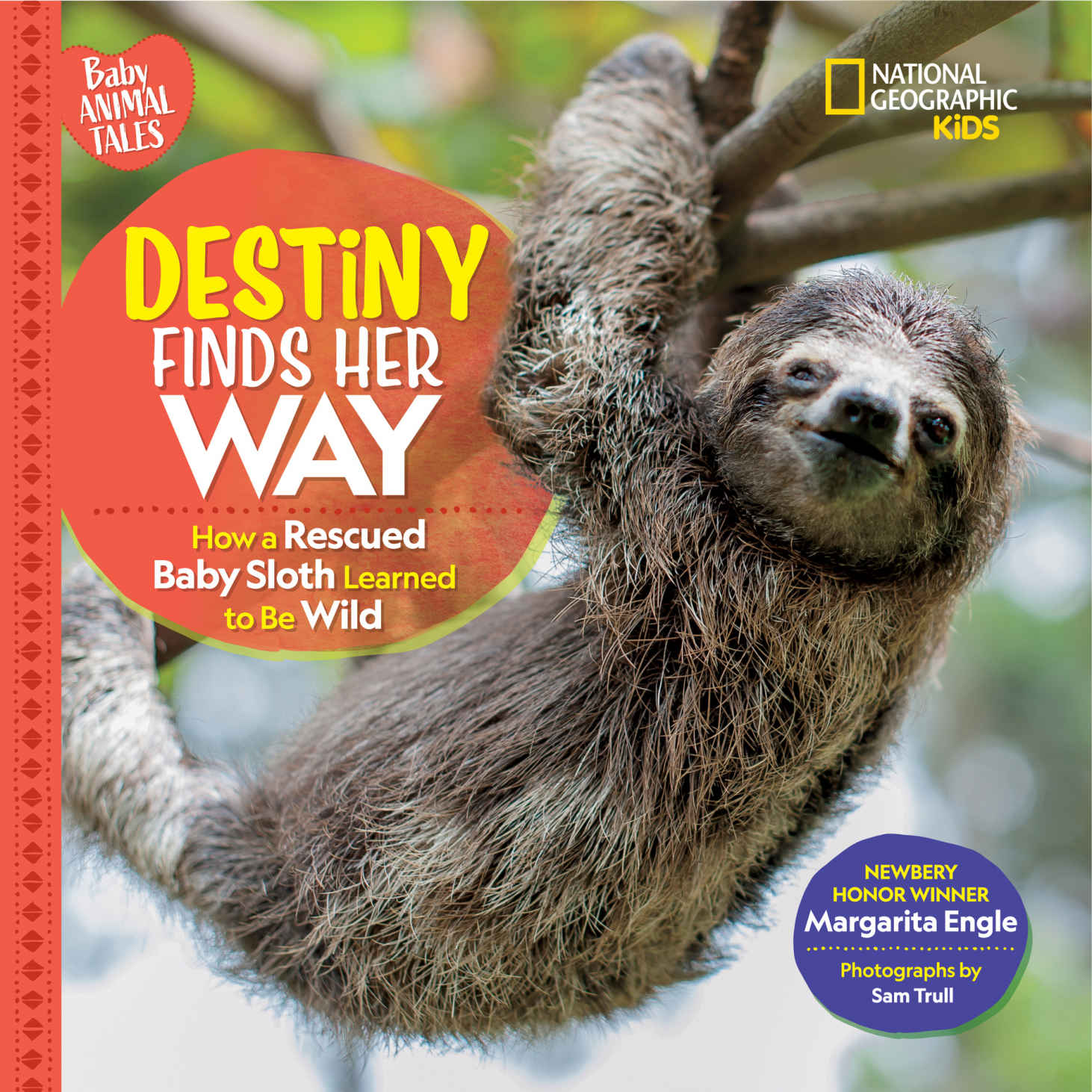
Newbery Honor winner Margarita Engle and photographer and Sloth Institute Executive Director Sam Trull team up to bring the inspiring and true story to life of how Destiny, a motherless baby sloth, sightless in one eye and rescued by Sam in the Costa Rican rain forest, defies the odds, overcomes her obstacles of limited sight and learns the skills she will need to return to her wild, forest home.
Without her mother to protect her or teach her, Destiny is found and taken to a rescue center in Costa Rica. The little sloth soon befriends other orphaned sloths. Her poor eyesight, however, makes it hard for her to keep her balance. Eventually Destiny begins to use all of her senses to explore the world around her. But can she learn to climb? Can she master the other skills she needs to survive on her own? And will Destiny be brave enough to return to her wild, forest home?
In addition to learning about Destiny and her journey, readers are immersed in the world of sloths and sloth rescue in this uplifting story about overcoming obstacles and believing in yourself.
About the Author:
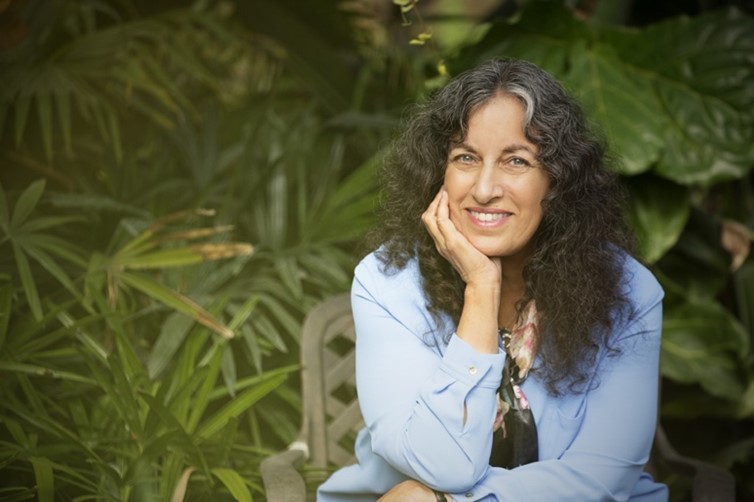
Margarita Engle is the Cuban-American author of many verse novels, memoirs, and picture books, including The Surrender Tree, Enchanted Air, Drum Dream Girl, and Dancing Hands. Awards include a Newbery Honor, Pura Belpré, Golden Kite, Walter, Jane Addams, PEN U.S.A., and NSK Neustadt, among others. Margarita served as the national 2017-2019 Young People’s Poet Laureate. She is a three-time U.S. nominee for the Astrid Lindgren Book Award. Her most recent books are Rima’s Rebellion, Singing With Elephants, and Destiny Finds Her Way. Her next young adult verse novel is Wings in the Wild, and her next picture book is Water Day.
Margarita was born in Los Angeles, but developed a deep attachment to her mother’s homeland during childhood summers with relatives on the island. She studied agronomy and botany along with creative writing, and now lives in central California with her husband.
Sam Trull has been a photographer and a wildlife biologist for decades. After many expeditions to Madagascar, West Africa, and Central America, in January 2013, she settled in Costa Rica, where she co-founded and is the executive director of the Sloth Institute. Her first photo book, Slothlove, was published in April 2016.
The Sloth Institute (TSI) is a nonprofit organization located in Costa Rica with the mission to enhance and expand the welfare and conservation of sloths through rescue, rehabilitation, release, research, and education. In addition, TSI works on targeted conservation projects to improve the safety and quality of sloth habitats and teaches other rescue centers how to better care for and release their sloths. TSI believes that all sloths were born to be wild and deserve that second chance at freedom.
NatGeo Kids once again rocks my nonfiction section with a new series for younger readers. So Cool/So Cute is perfect for preschoolers through first graders who love animals, whether they’re cool, like dinosaurs, or cute, like puppies. Filled with facts, amusing side commentary, and color artwork and photos, they’re a great add to displays and small enough to fit inside a backpack or Mom’s bag.
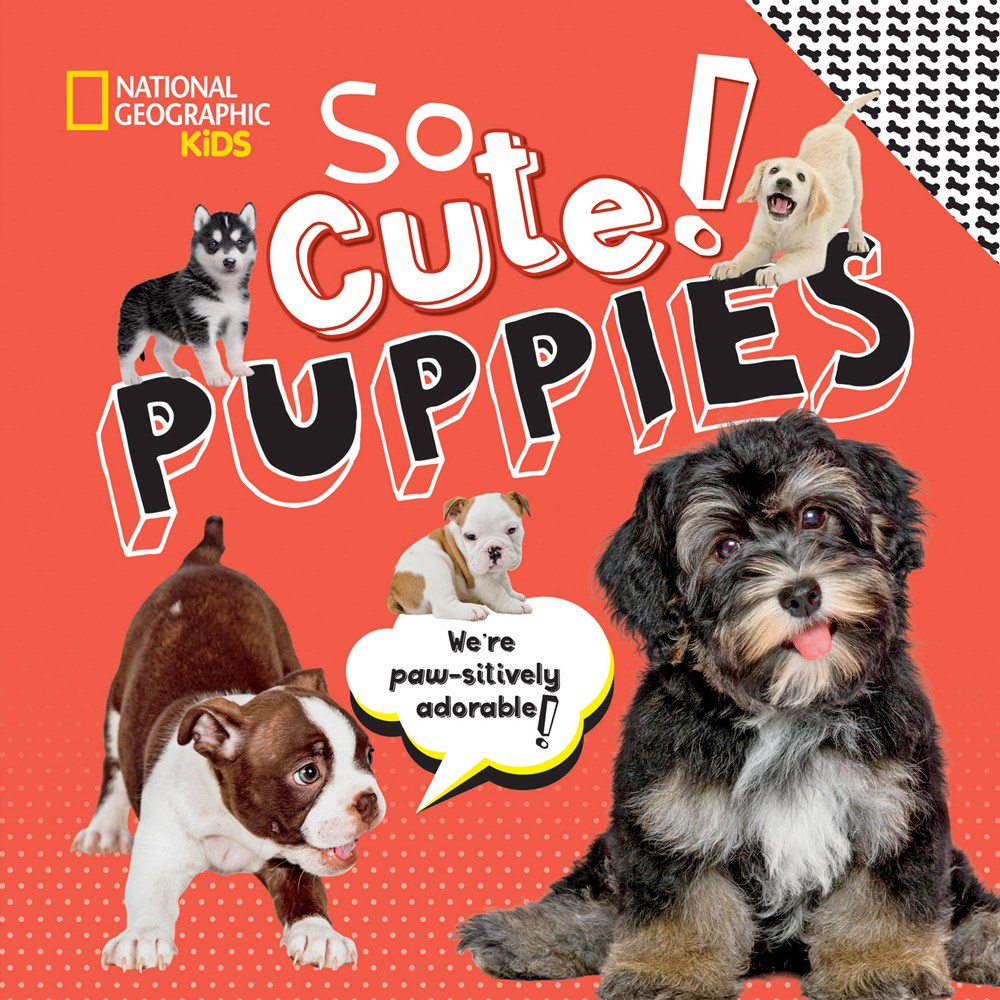
So Cute! Puppies, by National Geographic Kids, (Feb. 2022, National Geographic Kids), $6.99, ISBN: 9781426339066
Ages 3-5
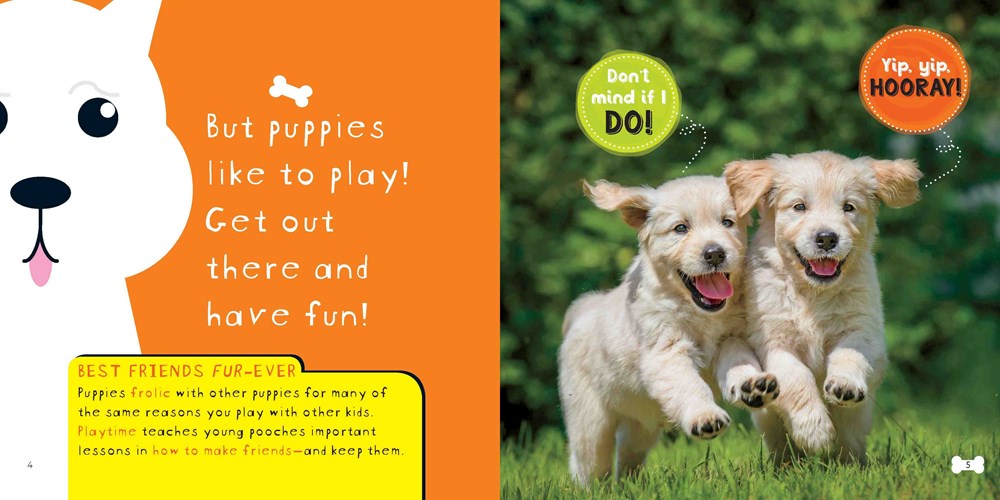
Readers who love puppies will love this adorable collection of puppy facts and photos. They’ll come away with fun facts: did you know that playtime is just as important for puppies as it is for kids? It is! Playtime “teaches young pooches important lessons in how to make friends – and keep them”. They’ll learn a little bit about some of the over 400 dog breeds out and about, and how some puppies look very different at birth, like the Dalmatian, born without spots. Clearly labeled photos introduce kids to different dog breeds, and fun word bubbles give the puppies a say in the dialogue-based text. A perfect Dad joke ends this volume and will give readers a giggle.
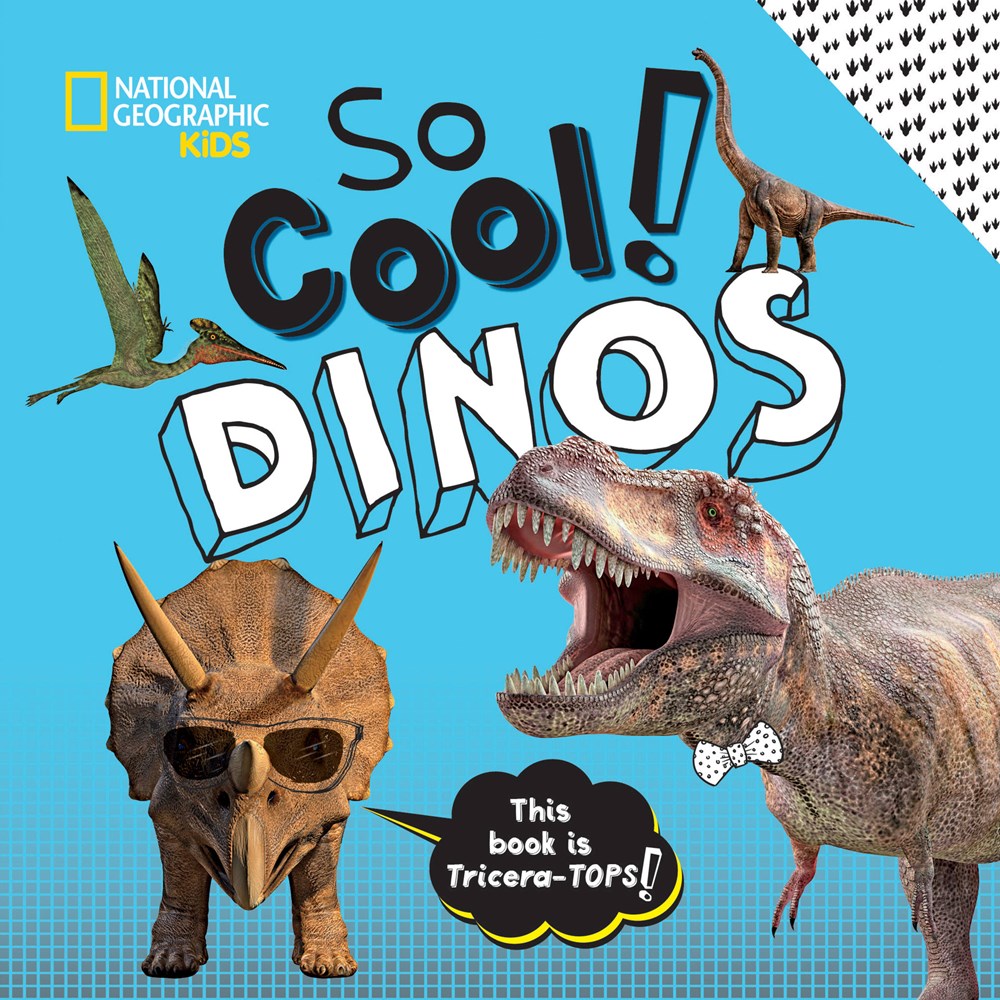
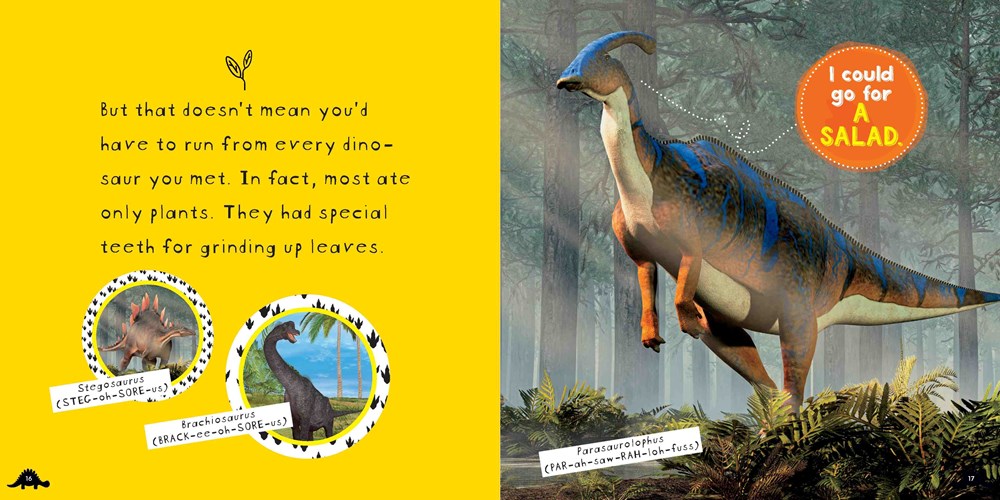
So Cool! Dinos, by National Geographic Kids, (Feb. 2022, National Geographic Kids), $6.99, ISBN: 9781426339042
Ages 3-5
Puppies are so cute, but dinosaurs? They are SO COOL. This little book is filled with dino facts and colorful artwork, with humorous commentary to keep kids laughing while they learn. An armored Ankylosaurus warns readers, “You wouldn’t want to mess with this”, while a peevish Pterosaur gripes that they wouldn’t “want to be a dinosaur anyway”. Readers will find out ways that scientists learn more about dinosaurs, and yes, there is a mention of dinosaur poop (coprolite), to keep them entertained. There’s information about dinosaur descendants that live in our world today, dino babies, and different-sized dinos. Clearly labeled pictures also offer phonetic pronunciation, making dino researchers out of every reader. The ever-present Dad joke closes this volume.
I’ve got two fun books for dinosaur fans: one fiction, one non-fiction, both adorable.
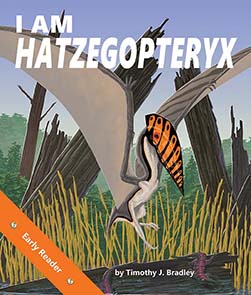
I Am Hatzetgopteryx (I Am Preshistoric), by Timothy J. Bradley, (Nov. 2021, Arbordale Publishing), $10.95, ISBN: 9781643518213
Ages 3-7
Look at that brilliant beak! Look at that impressive wingspan! I Am Hatzetgopteryx introduces readers to a pterosaur they may not have heard of – yet. Everyone knows pterodactyls, but Hatzegopteryx is a more recent discovery (2002). I Am Hatzetgopteryx is an early reader that uses repetition and simple, factual sentences to teach readers about this pteranodon. A Hatzegopteryx chick hatches and goes through life, flapping and leaping, dodging and chasing, giving readers a glimpse into the prehistoric world. Artwork is colorful and the Hatzegopteryx’s bright orange and black beak jumps off the page, as does the pteranodon’s often colorful prey.
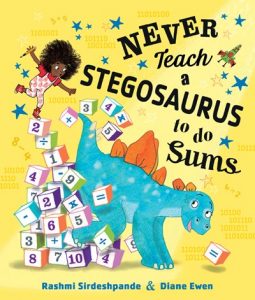
Never Teach a Stegosaur to Do Sums, by Rashmi Sirdeshpande & Diane Ewen, (Jan. 2022, Kane Miller), $12.99, ISBN: 9781684643424
Ages 3-7
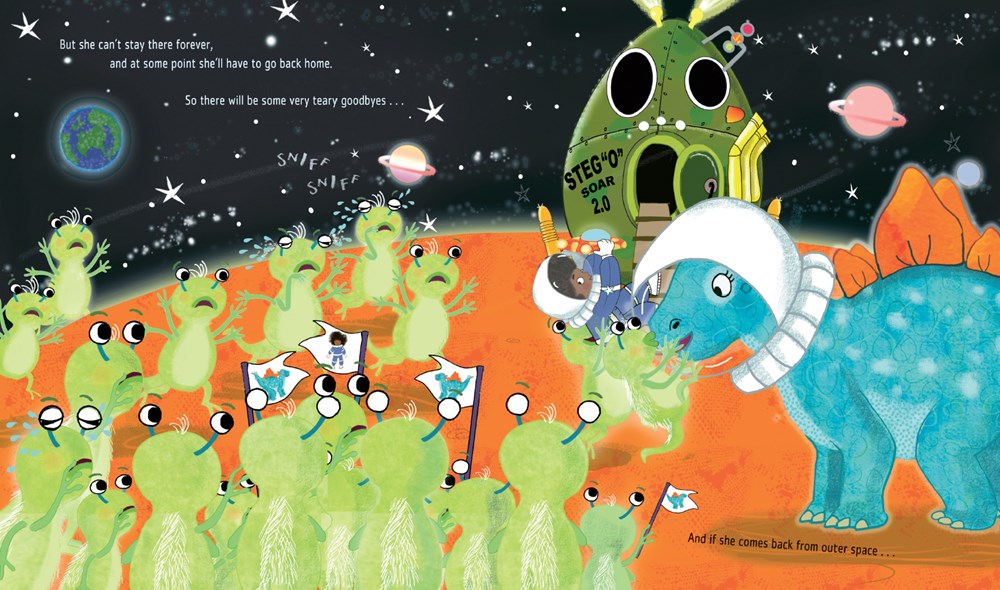
Imagine what would happen if you could teach a dinosaur to do math? The little girl who almost caused a dinosaur uprising by teaching a T. Rex to read is back with a new dinosaur friend in a companion book to Never Show a T. Rex a Book (2021). Here, she teaches a stegosaurus to do math, leading to delicious baked goods, coding, even building a rocket ship to go to the moon! But wait! What happens when you can do math so well that you accidentally create a possible robot uprising? Never Teach a Stegosaur to Do Sums is a celebration of all things mathematics, with fun illustration details including cameos from our T. Rex friend and his storybook. The cartoon artwork portrays a young girl of color exploring all the things math lets you do, with exciting moments like opening a book and unleashing a whirlwind of numbers, pie charts, and bar graphs; unlocking codes and recipes; engineering bridges, and building rockets and robots. A poster of NASA mathematician Katherine Johnson graces the girl’s bedroom wall, and rocket ship curtains frame her window; a dinosaur blanket covers her bed. The light, fun storytelling inspires kids to love math by illustrating its presence in our everyday lives. Pair with its companion book or with another fun dinosaur, like my old friend Dexter T. Rexter, for a fun dinosaur storytime: and don’t forget the Laurie Berkner soundtrack (and book)!
Niki Nakayama: A Chef’s Tale in 13 Bites, by Jamie Michalak & Debbi Michiko Florence/Illustrated by Yuko Jones, (Sept. 2021, Farrar, Straus & Giroux), $18.99, ISBN: 9780374313876
Ages 4-8
Niki Nakayama, the master chef behind the California restaurant n/Naka, shares her story in this lovely picture book biography from children’s book authors Jamie Michalak, Debbi Michiko Florence, and illustrator Yuko Jones. Beginning with Ms. Nakayama’s childhood in California, the story gives us 13 “bites”: 13 defining moments in the chef’s life, to parallel her 13 course menus at n/naka. The Japanese-American chef developed a love of global cuisine as a child; her mother blended Japanese and American foods and flavors together to make meals like meatloaf with soy sauce, or teriyaki turkey for Thanksgiving dinner. Ms. Nakayama began creating her own recipes as a child, eventually traveling the world to sample cuisines from different cultures. When she returned to the United States, she apprenticed as a sushi chef, ultimately opening her own restaurant, n/naka, where she now creates 13-course tasting “storytelling” menus. Back matter includes a timeline of Niki Nakayama’s life, an explanation of terms used in the story, and the chef’s own childhood wonton pizza recipe. The story flows from moment to moment in the chef’s life, touching on frustrations like having her family dote on her brother, and having her family agree to finance her first restaurant, but agree to give up her dream if it was not successful. Spreads show Nakayama and her family gathering at their own table, and families gathering to eat at n/naka, illustrating the power of community that eating together brings. Spreads show colorful foods from all over the world sprawl across pages, and diners speaking different languages as they enjoy a creative master chef’s food.
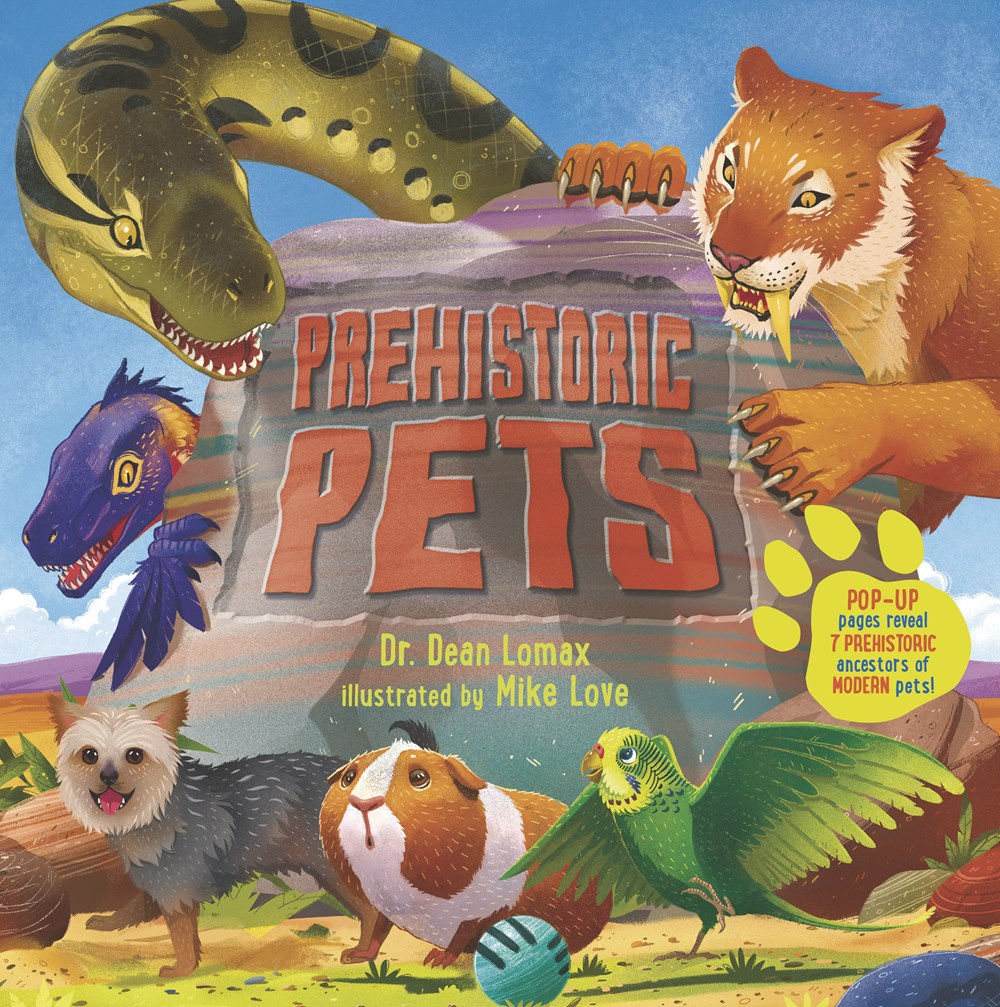
Prehistoric Pets, by Dr. Dean Lomax/Illustrated by Mike Love, (Sept. 2021, Templar), $17.99, ISBN: 9781536217148
Ages 5-9
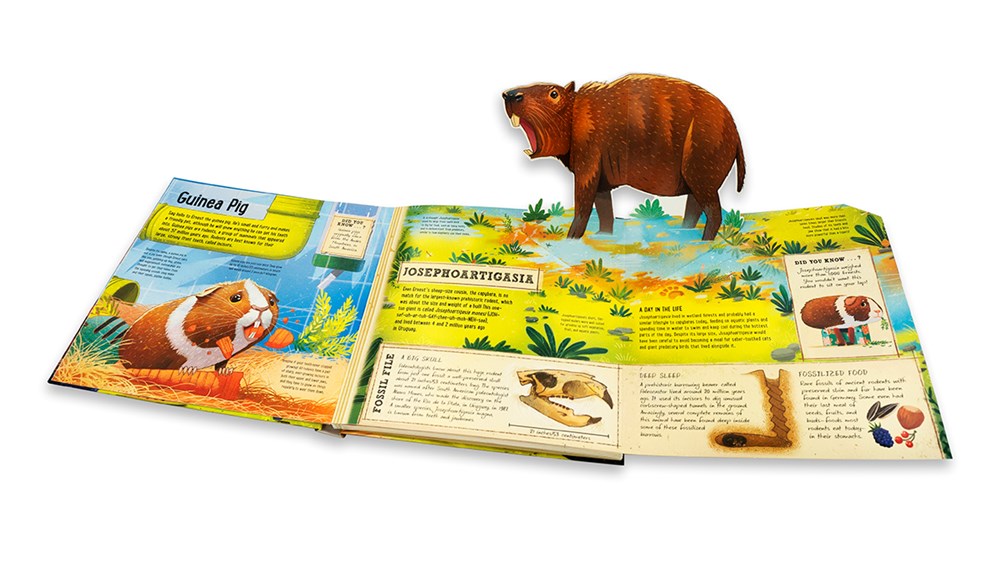
Cat people all know that our little furballs think of themselves as savage, saber-toothed tigers on the hunt, whether they’re stalking a daydreaming dinosaur or a dust bunny. But did you ever imagine what your guinea pig’s ancestors may have looked like? Paleontologist Dr. Dean Lomax has you covered. Prehistoric Pets looks at the evolution of seven favorite kinds of pets: guinea pigs, parakeets, corn snakes, cats, goldfish, dogs, and horses. Using the fossil record to trace each pet’s lineage, Dr. Lomax goes back through the family trees of each of these popular pets to give us an idea of their prehistoric parentage. That chatty parrot likely descended from the Velociraptor; your corn snake can trace its heritage back to the giant Titanoboa. Each spread folds out into a pop-up gatefold, with the prehistoric beast rising up from the pages. Loaded with facts about both the modern animal and its primeval counterpart, and filled with colorful artwork, this is a home run for your prehistory collections. Display and talk up with one of my favorite read-alouds, Steve Jenkins’s Prehistoric Actual Size. The pop-ups are going to seal the deal for readers on this book – get a couple if your budget permits.
When I got back to my library just under two months ago, I discovered some bookmail waiting for me: two books in Spanish, courtesy of Peachtree Publishing! They’ve been wonderful about keeping me updated on their bilingual and Spanish nonfiction books, and I’ve loved the “About…” series they’ve sent me so far, so I wanted to make sure I gave these two books the love they deserve (and a place on my Spanish collection shelves).
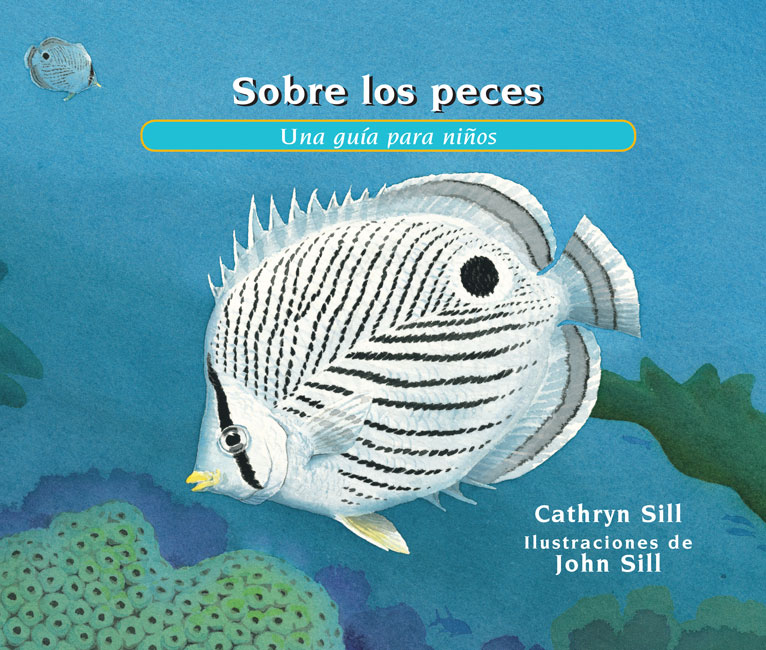
Sobre los peces, by Cathryn Sill/Illustrated by John Sill, (Feb. 2020, Peachtree Publishers), $8.99, ISBN: 978-1-68263-154-6
Ages 3-7
Great early reader nonfiction. Sobre los peces is entirely in Spanish, and offers readers a look at the basics of fish: where they live, how they adapt to their environment, what they eat, how they reproduce. The text is written in easy-to-read, easy-to-understand, simple sentences, and each spread includes colorful, realistic paintings of different fish throughout. The text is presented in bold, black font against a white background, not competing for the reader’s attention; each painting includes the name of the fish, to increase understanding and forward the fact that there are a LOT of fish out there! Back matter includes more information about each spread: did you know that tropical fish are usually more vibrantly colored than fish from cold waters? It helps them camouflage better in their surroundings! A glossary and bibliography offer more resources for curious readers.
Sobre los insectos, by Cathryn Sill/Illustrated by John Sill, (Feb. 2020, Peachtree Publishers), $8.99, ISBN: 978-1-68263-155-3
Ages 3-7
More great books in translation from Peachtree! About Insects is translated entirely into Spanish, with easy-to-read, easy-to-understand sentences introducing readers to the basics about insects: how many legs they have (it’s 6, not 8!), their hard exoskeletons, how they change forms as they get older, what they eat and how they eat, and how they are helpful to us humans (and how some are just plain pests). Colorful paintings by John Sill are realistic and detailed, making a naturalist out of every reader; the environments are textured, often lush, and there’s always something to draw your eye, from the movement of water as a trout jumps to catch a fleeing mayfly to the shadowy leaves in the background as a katydid leaps. Details on each painting, a glossary, and bibliography make up the back matter.
 I Love Salmon and Lampreys: A Native Story of Resilience, by Brook S. Thompson/Illustrated by Anastasia Khmelevska, (Feb. 2025, Heyday), $20, ISBN: 9781597146685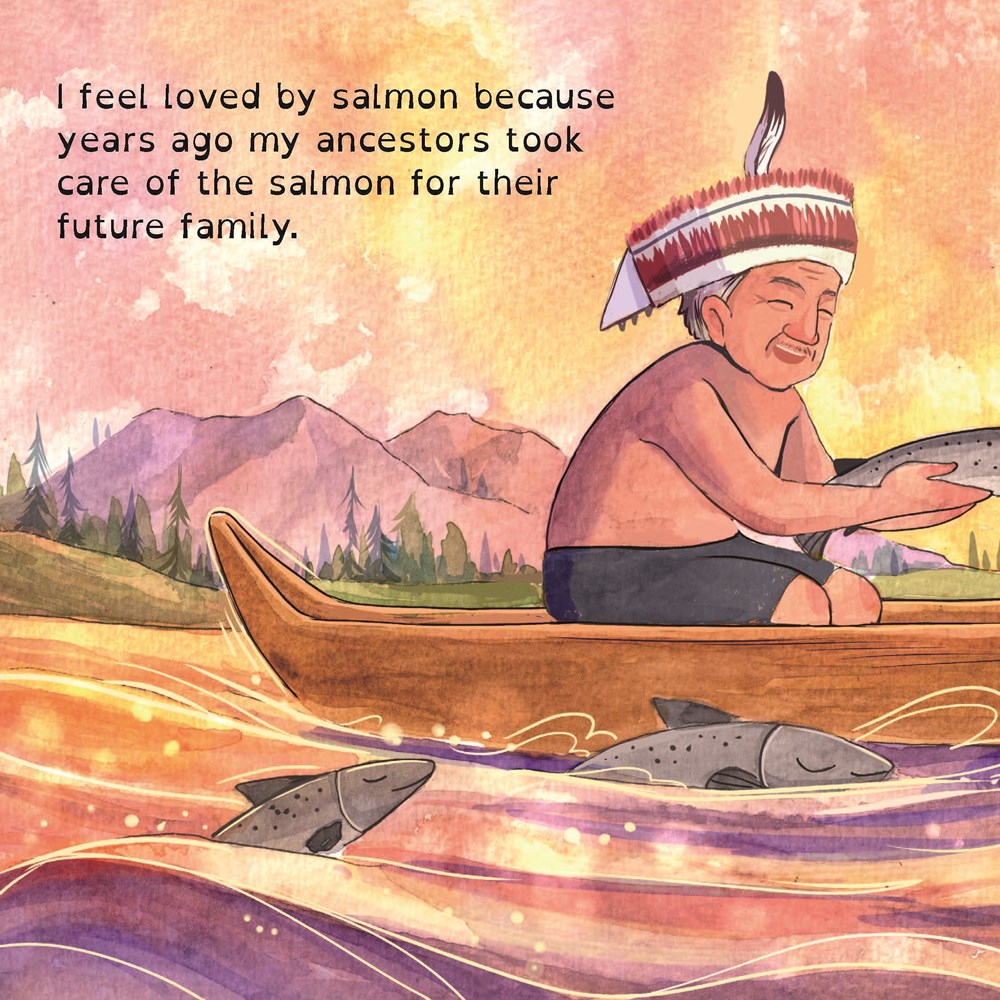









 Mom Read It