Posted in Early Reader, Fantasy, Fiction, Fiction, Intermediate

An overscheduled princess takes a day off: Princess Cora and the Crocodile

Princess Cora and the Crocodile, by Laura Amy Schlitz/Illustrated by Brian Floca, (March 2017, Candlewick Press), $16.99, ISBN: 978-0-7636-4822-0

Recommended for readers 4-8

A king and queen have a baby that they coo and marvel over – until they realize that she’s clearly not ready to run an entire kingdom. From that moment on, Princess Cora’s life is a nonstop schedule of lessons, physical training, and nonstop bathing (seriously, her nanny’s got a bit of a complex). Cora writes to her fairy godmother in desperation, and the response, while not necessarily what Cora expected, is exactly what she needs. A crocodile shows up to take Cora’s place for a day; while Cora takes a day off to enjoy being a kid, the crocodile sets to teaching the king, queen, and nanny a thing or two.

Newbery Medalist Laura Amy Schlitz and Caldecott Medalist Brian Floca have joined their considerable forces to create a book that parents need to read (cough, cough, and education administrators, cough, cough) as much as their children do. Princess Cora and the Crocodile is all about the stresses our kids face today: the lack of time to enjoy being a kid, doing kid things. The king and queen are so stressed out about what Cora’s not ready for, they strip the joy not only from Cora’s childhood, but rob themselves of the chance to enjoy watching Cora grow up; of playing on the floor with her as an infant, climbing trees and running around their considerable lands with her, of reveling in the carefree fun that parents should embrace.

When Cora’s fairy godmother sends a crocodile to her family, the croc immediately – if a bit roughly – sets to whipping Cora’s family into shape, with hilarious results. While the croc wreaks havoc at home, Cora spends the day picking strawberries, climbing trees, even stepping in a cow pie, and enjoying every moment of it. Every. Unscheduled. Moment. Brian Floca’s ink, watercoor, and gouache artwork is fun, hilarious, and every bit as free and joyful as the story’s text.
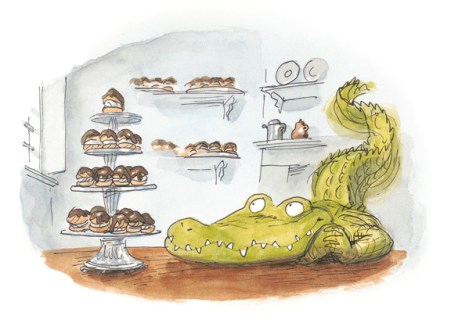
Image courtesy of Brian Floca

Parents, read this one. Please. It’s as much for us as it is for our kids. Schlitz and Floca created this fairy tale to let kids know that it’s okay to be a kid, but the message here is for us adults, because we’re the ones who can make the changes kids need to be happy – to be kids – again.

Princess Cora and the Crocodile received starred reviews from School Library Journal, Booklist, and Publisher’s Weekly.

Illustrator Brian Floca has a fantastic webpage, with lots of online extras, information about school visits, and upcoming events.
Posted in Early Reader, Fiction, Preschool Reads

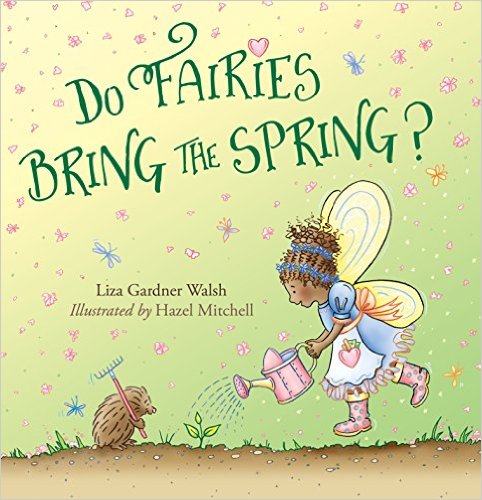
Do Fairies Bring the Spring? Let’s find out!

Do Fairies Bring the Spring?, by Liza Gardner Walsh/Illustrated by Hazel Mitchell, (Feb. 2017, Down East Books), $16.95, ISBN: 978-1-60893-633-5

Recommended for readers 3-7

Do fairies bring the spring? This adorable picture book poses the question while infusing nature with a little bit of magic, as Liza Gardner Walsh’s rhyming text suggests that fairies are behind the scenes, working to bring spring to the world. Suggestions for attracting fairies to your own gardens in the spring, at the end of the book, encourage you to dig into nature with your little ones and take care of your little corner of the world.

Hazel Mitchell’s illustrations of diverse, adorable little fairies and their woodland friends infuse this Spring story with all the charm and wonder that makes a preschool/Kindergartner story a success.

Invite some magic into your life this spring with this sweet springtime story! Little ones will love the soothing rhyme and the adorable pictures. Encourage parents to get outside with their little ones and enjoy nature while respecting it –  no littering, please! This is a great story to read and follow up with a planting activity, whether it’s going out in the yard with your little one, or planting some seeds in recyclable egg cartons and bringing them home to start a container garden. Hand out fairy coloring sheets, or print small fairy pictures out on card stock, let the kids color them in, and mount them on popsicle sticks to give your new  plants extra fairy protection!

Liza Gardner Walsh is a former librarian (whoo hoo!) and has a companion book, Where Do Fairies Go When It Snows? (2015). Her website, Moss & Grove, encourages parents and kids to get outside and embrace nature. See more of illustrator Hazel Mitchell’s work at her website.

Posted in Early Reader, Fiction, Preschool Reads

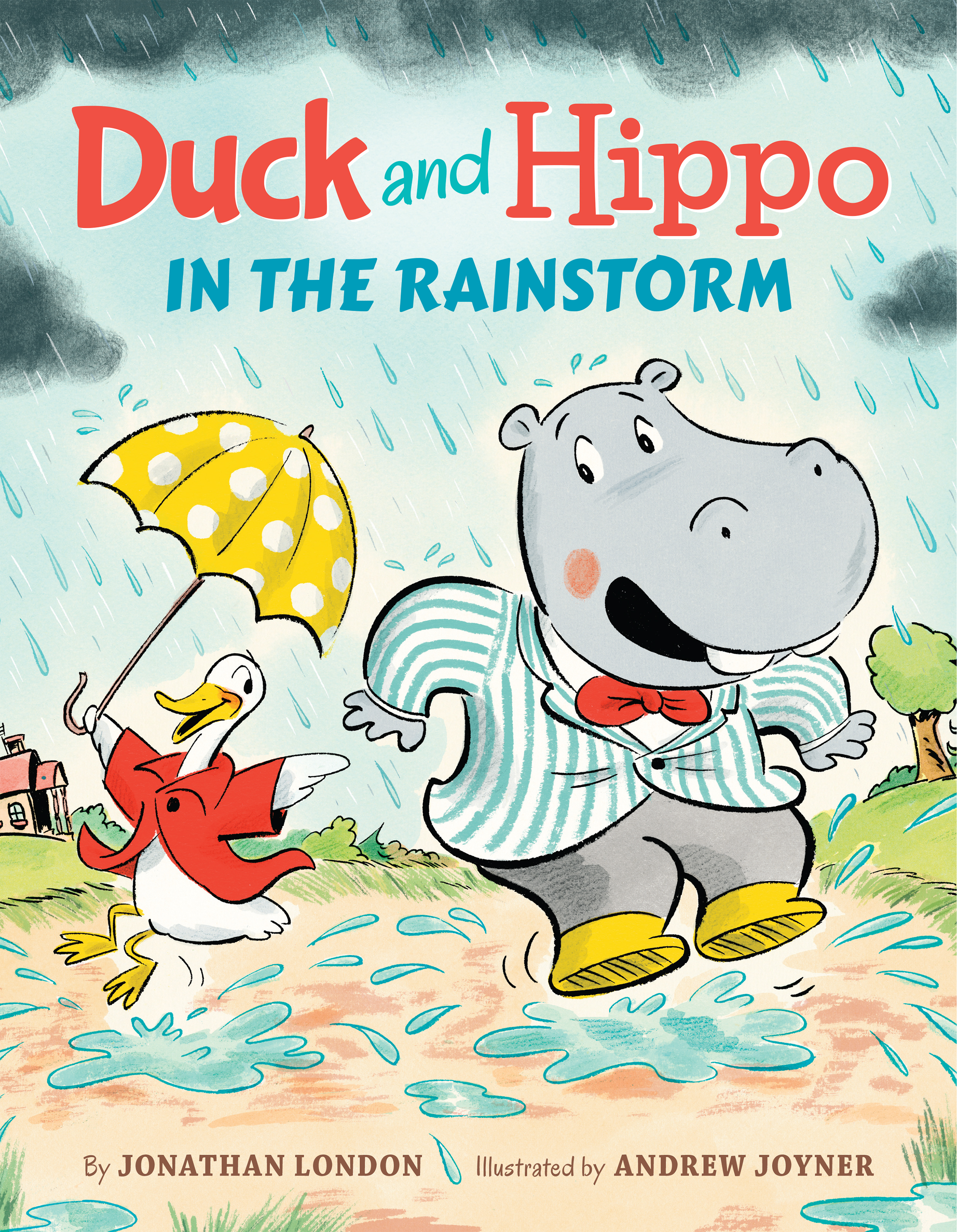
Duck and Hippo brave the rain together!

Duck and Hippo In the Rainstorm, by Jonathan London/Illustrated by Andrew Joyner, (March 2017, Two Lions/Amazon), $17.99, ISBN: 978-1-5039-3723-9

Duck and Hippo are the best of friends, and want to go for a walk in the rain. But the umbrella isn’t big enough for them both! Luckily, the two friends find a solution and go off on a rainy day walk, filled with adventures, until a strong gust of wind sends one of them up in the air!

Jonathan London is best known for his Froggy series, most of which end up on my library kids’ summer reading lists every year. Booktalking Duck and Hippo will be a breeze – the author already has a tremendous fanbase. Then, we have Andrew Joyner’s brush and ink illustration, with wash and pencil, then digitally colored; which it makes me happy just looking at it. It’s classic illustration; hearkening to timeless books like Frog and Toad and Danny and the Dinosaur. colors are soothing with bright touches, like Duck’s red jacket and yellow umbrella, which matches Hippo’s yellow rain boots. The definitive outlines make each piece, each character, step off the page. Sound effects are in playful font sizes and colors, swirling along like the water in a creek or coming down with the rain.

This book is a fun read-aloud about friendship and sharing. Read and display with Frog and Toad, James Marshall’s George and Martha, or Sue Gallion’s Pug Meets Pig. Hand out a Duck and Hippo coloring sheet, courtesy of Andrew Joyner’s website – and give your bigger readers Joyner’s How to Draw Duck and Hippo instructions!

About the Author and Illustrator

Jonathan London is the author of more than one hundred children’s books, including the bestselling Froggy series, illustrated by Frank Remkiewicz. Many of his books explore nature, among them Flamingo Sunset, illustrated by Kristina Rodanas, and Little Penguin: The Emperor of Antarctica, illustrated by Julie Olson. He is currently writing a middle-grade series, which started with Desolation Canyon, illustrated by his son Sean London. Jonathan lives in Graton, California. Learn more online at www.jonathan-london.net.

Andrew Joyner is an illustrator, author, and cartoonist based in South Australia. He has illustrated a number of picture books, and he wrote and illustrated a chapter book series about a warthog named Boris. He has also illustrated for newspapers and magazines, including the Wall Street Journal, Reader’s Digest, and Rolling Stone magazine, among others. Learn more online at www.andrewjoyner.com.au.

Enter this Rafflecopter giveaway for a chance to win your own copy of Duck and Hippo in the Rainstorm!

Posted in Early Reader, Fiction, Preschool Reads, Toddler Reads

See the animal mommies, count the baby animals!

Count the Baby Animals, by Guido van Genechten, (March 2017, Clavis Publishing), $17.95, ISBN: 978-1605-37324-9

Recommended for readers 2-5

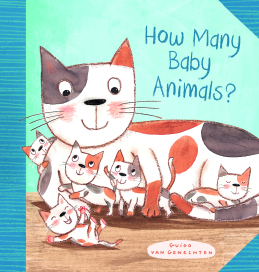
This fun die-cut book shows a pregnant animal mommy; with a flip of the page, she’s surrounded by her babies! Sweet rhyming text throughout invites readers to count each group of animals while offering descriptive details.

This is an adorable book to introduce to toddlers, who can point to and name animals as you read along. Encourage them to make animals sounds for each one to extend the fun. There are oodles of fun animal coloring sheets and activities available online; matching games with moms and babies would be a great choice for older toddlers and early preschoolers. You can pair this with books like P.D. Eastman’s classic, Are You My Mother?, or Nancy Tafuri’s All Kinds of Kisses (one of my personal faves).

Originally published in 2016, this is the English translation of Guido van Genechten’s original Dutch. His artwork is child-friendly, with gentle, cartoony faces and smiles. Endpapers with frolicking baby animals bring the reader right into the fun, and the sturdy paper stock will hold up to exploring little hands, who will love turning the half pages back and forth to see each mommy animal with a round belly, and later, surrounded by her babies.

How Many Baby Animals is a fun addition to toddler bookshelves and would make a fun sibling-to-be gift, too.

Posted in Early Reader, Fiction, Preschool Reads, Realistic Fiction

Fun with Phonics: Phoebe Sounds It Out

Phoebe Sounds It Out, by Julie Zwillich, (Apr. 2017, Owl Kids), $16.95, ISBN: 978-1-77147-164-0

Recommended for readers 3-7

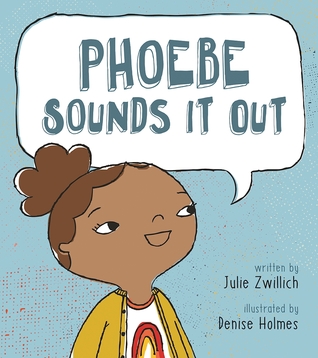
Phoebe’s teacher announces that the children are going to learn to write their names today. All they have to do is sound it out. Phoebe doesn’t quite agree. First of all, Mama sewed her name on her school bag, and she’s convinced that she made a mistake: Phoebe’s name begins with a P, but that’s not the sound her name makes! She dawdles as the teacher encourages the class to sound it out, and finally, she gives it a shot. Her encouraging teacher tells her that it’s a great start – she did sound it out, after all!

I enjoyed so much about this book. I love that there’s a child of color main character and the diversity reflected in the classroom. One of the two teachers is also a person of color, and there is diversity in the classroom, including a classmate in a wheelchair. I enjoyed Phoebe’s thought process while the rest of the class works on their assignment: she fidgets, she goofs off, she “borrows” a letter from a classmate’s name to jazz up her name as she sounded it out. Kids will recognize themselves in Phoebe.

I’ve seen comments questioning whether a teacher would let Phoebe’s misspelling stand. I tend to say yes, especially for this first attempt. The point of the story is to sound out a word, and Phoebe does just that. When my older kids were in elementary school, the practice for teachers was not to correct spelling errors on similar assignments; the kids were expected to catch on eventually, and they did, through vocabulary words, spelling tests, and reading and being read to.

Denise Holmes’ art is rendered in ink and colored using Photoshop, and it’s very cute. There are bright colors and fun patterns, and sweet touches, like the children’s pictures on their cubby spaces and the handwritten children’s work.

This book presents a fun chance for a similar Sound It Out activity, complete with glitter glue to finish up your kids’ work. Let them sound out their names, or other fun words around them.

Julie Zwillich is a television personality with shows on Food Network Canada. You can see more of Denise Holmes’ illustration at her website.

c

Posted in Early Reader, Fiction, Preschool Reads

Little Blue Chair: the power of sharing, the power of home

Little Blue Chair, by Cary Fagan/Illustrated by Madeline Kloepper, (Jan. 2017, Tundra Books), $16.99, ISBN: 978-1-77049-755-9

Recommended for readers 3-7

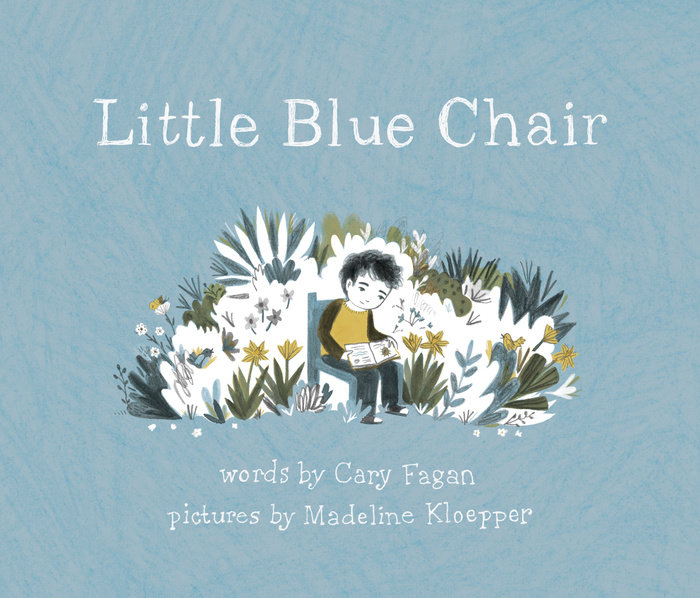
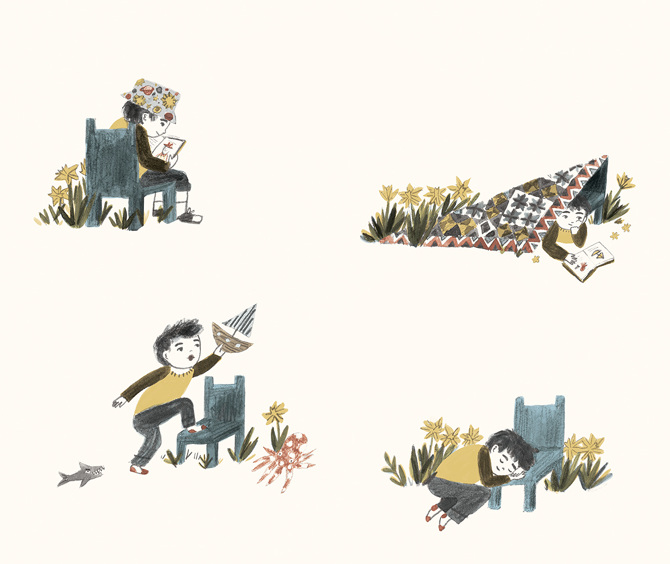
A little boy outgrows his favorite blue chair, so his mother puts it on the curb with a sign reading, “Please take me”. From there, Little Blue Chair follows the chair as it’s passed from hand to hand: it’s used as a replacement seat on a plant stand; a ferris wheel; a bird feeder; a throne, and a chair for elephant rides. It travels to amusement parks, houseboats, and beaches, ultimately coming full-circle as it arrives back where it began. It’s a sweet story about a favorite belonging – it could easily be a toy, as in Kate DiCamillo’s The Mysterious Journey of Edward Tulane – and the power of home, but it’s also a story about the permanence of objects. The chair is never thrown in the trash; it’s used again and again, serving different purposes for different people, all of whom love the chair while they have it. It’s a journey home.

Madeline Kloepper’s ink and pencil illustrations, finished digitally, a soft and gentle, calming to the reader. The palette of opaque greens, reds, dark yellows, and gray-blues gives the story almost dreamlike feel; a child’s imagination realized, from one boy using the chair as a tent, to another using it as a throne, his stuffed toys as subjects. Everything in this world has a story; everything has a value. Read this with your little ones and talk about the stories their toys hold. If you’re in a school, talk about the desks: what stories could they tell?

courtesy of Madeline Kloepper’s website

I’d love to pair this with Mirielle Messier’s The Branch and compare the two stories. They’re both books about reusing and repurposing; one, a child’s chair; the other, a branch from a favorite tree.

Cary Fagan is an award-winning children’s author. See more of Madeline Kloepper’s illustration at her website.

Posted in Early Reader, Fiction, Fiction, Graphic Novels, Humor, Intermediate

Noodleheads See the Future… Is there cake?

Noodleheads See the Future, by Tedd Arnold, Martha Hamilton, & Mitch Weiss/Illustrated by Tedd Arnold, (Jan. 2017, Holiday House), $15.95, ISBN: 9780823436736

Recommended for readers 6-10

Noodlehead brothers Mac and Mac return for a second round of goofy fun in Noodleheads See the Future. The empty-headed brothers (no, really, they’ll show you their hollow pasta heads) are a bit gullible, which leaves them open to pranks by their cousin, Meatball. The Noodleheads head to the woods to get firewood for their mother so she can bake them a cake; where Meatball tricks them and steals their firewood. The joke’s on Meatball, though; the Noodleheads still manage to get the job done for Mom, who bakes them a cake!

Think of the Noodleheads as a first step toward Amelia Bedelia. The brothers take everything literally, like looking up when being told, “heads up”. This is a fun graphic novel to give to emerging independent readers; the text is brief and bold, the panels show events in sequence, and the three chapters are short enough to keep a reader’s attention. Plus, the illustrator and one of the authors is Tedd Arnold, whose Fly Guy series is an Easy Reader favorite. An explanation of the myths inspiring the stories told in Noodleheads of the Future will interest kids and grownups.

This is the second Noodleheads book. The first, Noodlehead Nightmares, was released in 2016. The series is a Guided Reading level L, according to the publisher’s website, and received starred reviews from School Library Journal and Kirkus.


Posted in Animal Fiction, Early Reader, Fiction, Preschool Reads

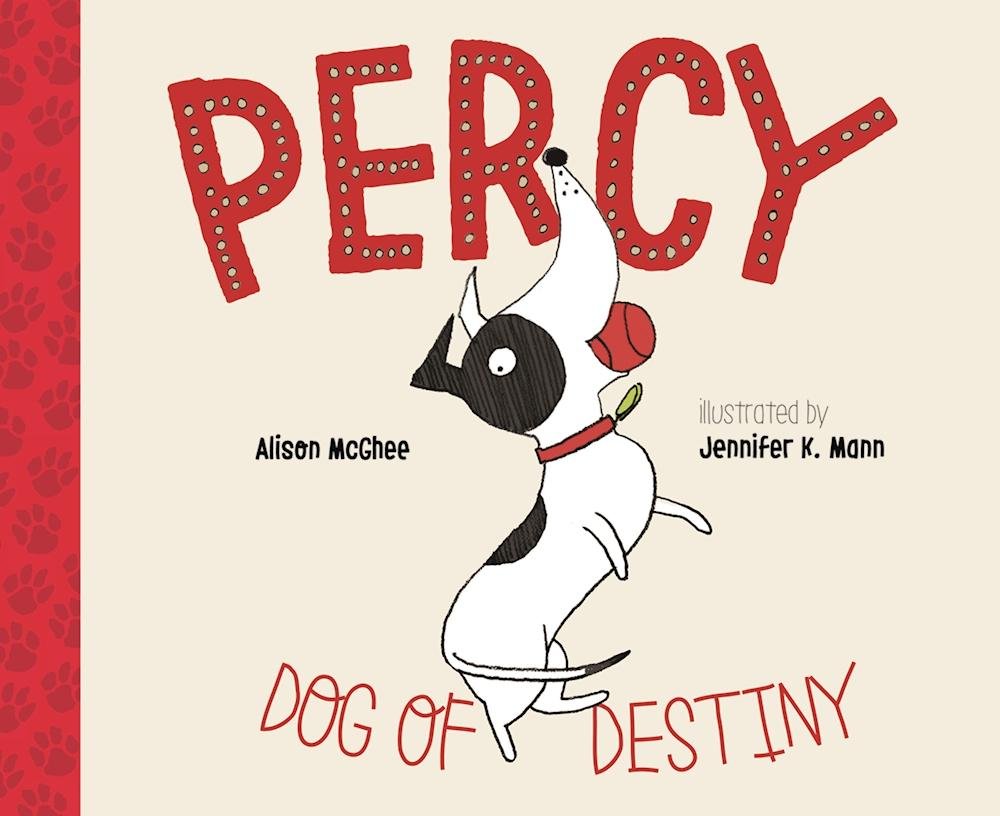
Percy, Dog of Destiny – What Ho!

percyPercy, Dog of Destiny, by Alison McGhee,/Illustrated by Jennifer K. Mann, (March 2017, Boyds Mill Press), $16.95, ISBN: 978-1-59078-984-1

Recommended for readers 3-6

Percy is so excited for his trip to the park. After finding his special ball, he and his human head out, meeting his friends along the way. Molly, the poodle, has her ladylike kerchief; dachshund Oatmeal Raisin Cookie has her frisbee, and giant Fluffy has his bone. With a hearty “What ho!”, the friends run to the park and play. While the group acts as one: racing along the fence, digging holes, peeing on the tree, Fluffy marches to the beat of his own drummer, garnering an “Oh, Fluffy”, from Percy. After a run-in with some squirrels puts Percy’s ball at risk, Fluffy shows just what he’s made of.

I picked this advanced reader copy up at ALA Midwinter because Percy looks like my doggie, Chester. When I opened it, and saw that “What ho!” was the second sentence in the book, I knew I needed to read this. This book is laugh-out-loud hilarious and works perfectly as a read-aloud. I read this with my little guy, and we took turns shaking our heads and saying, “Ohhhhh, Fluffy”, each more dramatic than the last. Surround yourself with fun stuffed doggies and let the kids mimic Percy and his friends, and hand out dog coloring sheets to finish up a fun storytime. What ho!

Alison McGhee is an award-winning author whose book Someday will bring any parent to tears. Jennifer K. Mann is an author and illustrator; you can see more of her artwork at her site.

Posted in Early Reader, Fiction, Preschool Reads

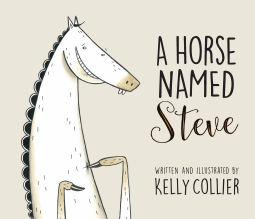
A Horse Named Steve is exceptional!

steveA Horse Named Steve, by Kelly Collier, (April 2017, Kids Can Press), $16.95, ISBN: 9781771387361

Recommended for readers 4-8

Steve is a horse that’s just fine as he is, but he thinks he can be better. He wants to be exceptional. He finds a beautiful gold horn lying on the ground in the forest, and that’s it: he’s found the pass to being exceptional! He ties the horn on his head and showboats to all of his woodland friends, who are so taken, they find items to tie on their own heads: sticks, rocks, anything they can find. But Steve accidentally loses his horn – oh no! What’s an exceptional horse to do when he loses his exceptional horn?

A Horse Named Steve is hilarious in its side commentary (notes throughout the book explain words like devastated: “that means really, really bummed”, or refer to his moods: “Mr. Mopeypants”) and its execution of an image-obsessed horse, but kids will get it: it’s not what you wear, or how you look. The commentary adds a little wink, wink, nudge, nudge humor to kids, bringing them in on the joke, and the raccoon that isn’t quite as enamored of Steve gives kids an entry point to a discussion: why doesn’t he think Steve’s so great? Do you think Steve is treating his friends with respect? What really makes our friends special?

Kelly Collier’s two-color ink and watercolor art, finished in Photoshop, is adorable and fun. Steve’s physicality plays up his ego for laughs, and there are visual jokes aplenty, especially when his golden horn slips from on top of his head to under his chin. Playing with fonts brings more humor to the page by emphasizing different words and making Steve’s very name a standout with curlicues and bolding.

You can have a lot of storytime fun with this book: make horns with your readers! For older readers, pair this one with Dr. Seuss’ The Sneetches for a good discussion on the value we place on appearances.

Posted in Animal Fiction, Early Reader, Fiction, Preschool Reads, Toddler Reads

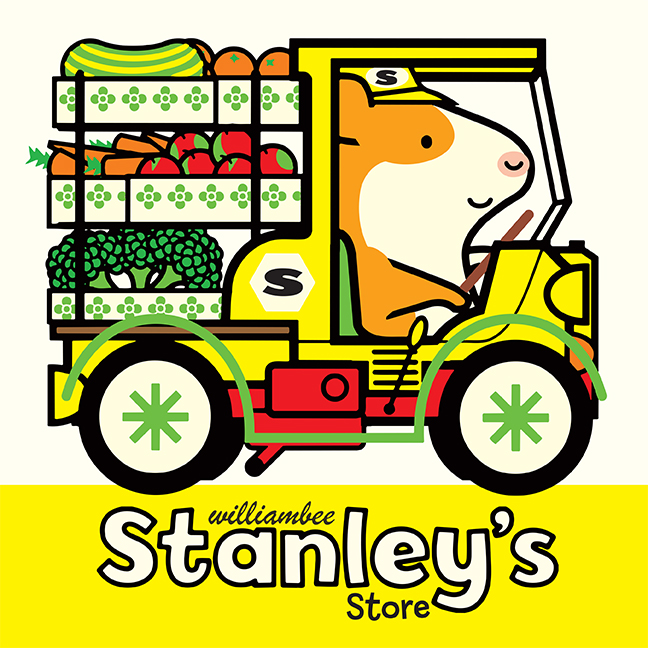
Stanley’s Store Blog Tour!

The hardest working hamster in town is back in his sixth book, Stanley’s Store (by William Bee, March 2017, Peachtree Publishers, $14.95, ISBN: 978-1-56145-868-4) . It’s a busy day at Stanley’s Store: Stanley’s got to unload fresh fruits and vegetables; Mattie helps customers pick out cheese, and there’s some excitement when Charlie doesn’t know how to control his shopping cart! Stanley’s always there to help, though, and at the end of a busy day, it’s time for him to go home.

stanley

My colleague LOVES Stanley. When we opened this library, she made darned sure we had the full line of Stanley books ready for the kids, so when I told her there was a new book coming out, she was thrilled! I sat down and read the first five books, and they’re adorable. They introduce kids to different careers (builders, business owners – stores and diners, farmers, mechanics, and mailmen) that shape their world, and provide a little look into the events of each job’s day. Stanley’s Store is a good book to read with your child and talk about your experiences at the grocery store; it’s also a good opportunity to point out safety and paying attention, illustrated by Charlie’s mishap. I love Shamus and Little Woo, a father and son duo, whose cart mysteriously fills up with cookies and sweets when Shamus’ back is turned. The story also slips in shape and color awareness, making this a great book for toddler and pre-k audiences.

Play store! Save some packaging and let your kiddos “shop” and create displays! Plastic food is huge with the kids in my library (and with my own kiddos, when they were younger) and is available everywhere. Talk about shapes and colors and talk about what foods are good for you. This could be paired with a fun flannel board activity and there are many food-related songs available to put together a fun storytime and playtime.