If the kids are reading it, chances are I have, too.
Author: Rosemary Kiladitis
I'm a mom, a children's librarian, bibliophile, and obsessive knitter. I'm a pop culture junkie and a proud nerd, and favorite reads usually fall into Sci-Fi/Fantasy. I review comics and graphic novels at WhatchaReading (http://whatchareading.com).
I'm also the co-founder of On Wednesdays We Wear Capes (http://www.onwednesdays.net/), where I discuss pop culture and geek fandom from a female point of view.
Radical, by E.M. Kokie, (Sept. 2016, Candlewick), $17.99, ISBN: 9780763669621
Recommended for ages 14+
Bex is in a constant state of readiness. She just knows the Big Thing is coming – worldwide crisis, breakdown of society, whatever you want to call it – it’s coming, and she’s going to be ready. She trains, she preps, she plans. She’s the only one in her family that seems to have her eyes open, after all. Until her older brother Mark discovers Clearview, a new group that seems to take survival as seriously as she does. She’s not sure how she feels about a stationery place, at first; she feels like she’d do best on the move, in a smaller group, but she’s drawn in by the group, who seem to welcome her. They don’t appear to be like most survivalist camps – they don’t have a problem with Black members, for starters, and no one seems to care that she doesn’t look like most girls should – at least, according to what her mother thinks a girl should look like.
Bex is training and working at her uncle’s gas station when she meets Lucy – Lucy, who doesn’t have a problem holding her hand in public or with kissing another girl. While Bex lets herself get lost in Lucy, her brother, Mark, is falling in with some more extreme members at Clearview. He’s becoming more hostile and more secretive. Bex knows she should say something, but she’s used to her parents choosing Mark over her. There will come a time where Bex has to draw the line, though: can she save herself, even if it comes at the cost of her family?
Radical is a different kind of novel on several levels. Bex is a brilliant, breakout character, for starters. She’s a butch lesbian, a character we don’t normally see in LGBTQ YA fiction. She’s comfortable with herself, and frustrated with the discomfort of everyone around her: most notably, her mother, who constantly compares her to her more feminine, average teen cousin. Her father shares some of Bex’s survivalist interests, but treads between loving Bex for who she is and trying to smooth things between Bex and her mother; sadly, both parents fail her where their son is concerned. Her Uncle Skip is a strong supporting character and is the parental figure Bex needs: concerned and loving, he knows to give Bex her space while communicating his concerns about Clearview.
The novel has elements of YA romance in it, to be sure, but it’s not a YA romance. It’s a gritty, taut work of realistic fiction that takes readers into the mind of a teenage survivalist who finds herself questioning everything she’s understood to be true: who to trust, what to believe, and whether or not family is forever. Radical is a strong entry into YA fiction and breaks new ground in LGBTQ fiction. Add this to your LGBTQ collections and booktalk this as the breakout work it is.
Author E.M. Kokie’s website has information about all of her books, links to social media, her blog, and an events calendar.
Pug Meets Pig, by Sue Lowell Gallion/Illustrated by Joyce Wan, (Sept. 2016, Simon & Schuster), $17.99, ISBN: 9781481420662
Recommended for ages 3-7
Pug is a happy-go-lucky pup, living the good life. He’s got his own house, his yard work, his food bowl, and his doghouse. When Pig joins the family, though, Pug is not thrilled. His routine is completely thrown off, because Pig is in all of his business; Pig’s eating his food, hanging out with his friends, and sleeping in his doghouse! What’s a Pug to do? Can Pug and Pig work it out so they can live in the same space happily?
This is the sweetest story about change, learning to share, and welcoming a new friend (or family member). Kids will recognize Pug’s feelings, especially kids that may be starting school and meeting new kids (and having to share supplies and toys) for the first time, or even closer to home, welcoming a new sibling or family member to their home. Pug’s reaction to sharing his toys, yard, and bed is spot-on for toddlers and preschoolers learning to share. Ultimately, the good-hearted Pug and eager to please Pig come together to share, and kids will, too.
The fun begins with the book’s endpapers, where readers follow along on Pug’s very busy day (and later, Pug’s and Pig’s day). I am in love with Joyce Wan’s adorable art. Her board books, You Are My Cupcake and We Belong Together are in heavy rotation at my storytimes (and in my home). Her Kawaii-inspired art never, EVER ceases to make me squeal, and Pug Meets Pig brings on the cute attack thousandfold. I almost passed out from cute overload. True story.
Adorable art plus a fun, sweet story that kids will love? Pug Meets Pig has it all. Add this one to your storytime collections, and put it in cuddle time storytime rotation. My little guy can’t get enough of this book, and neither can I. We’re getting a Pug & Pig Trick or Treat book in 2017, so watch this space for more of my incoherent squealing over this series.
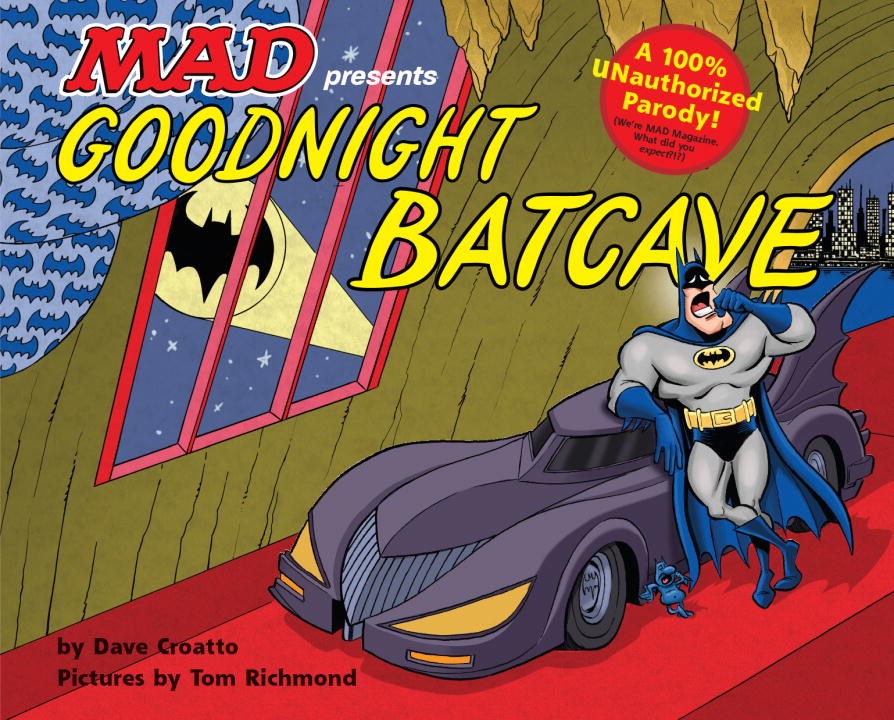
Goodnight Batcave, by Dave Croatto/Illustrated by Tom Richmond, (Oct. 2016, MAD Magazine), $14.99, ISBN: 9781401270100
Recommended for ages 5+
“In the great gray cave, there were a lot of bats, and souvenirs saved…”
Margaret Wise Brown could never have seen this coming: her sweet bedtime story has been turned into seemingly countless tongue-in-cheek retellings, including Goodnight iPad and Goodnight Goon. Goodnight Batcave is MAD Magazine’s take on the sleepytime classic and takes readers inside Batman’s inner sanctum, The Batcave. Batman’s wiped out and ready for bed, but his rogues gallery – including both fan favorites and old reliables, from Joker to Bane – just won’t behave and decide to attack the Batcave, maybe in the hopes of catching Bats unawares for the night? Using Goodnight Moon‘s familiar rhythm, Dave Croatto hilariously inserts Batman references that any fan worth their Bat-insignia pajamas will love. Bats flips and whips, knocks out knaves and bowls Penguins down the stairs. At the end of the night, Alfred is there, as always, to send Master Bruce off to sleep.
Tom Richmond’s art is classic MAD style, with exaggerated facial expressions and a superhero chin that you could land a Bat-Plane on. There are fantastic little references and Easter eggs for fans, including a nice showing by Ace, the Bat-Hound, and a quietly, ever-present Bat-mite, who snuggles up to Bats when their shift is finally over. The giant penny and T-Rex are there, and – this isMAD, after all – Alfred E. Neuman makes a cameo.
Younger Bat-fans will get a kick out of the fun take on a Bat-time story, and grown-up Batfans will love having this one on their bookshelves alongside favorite graphic novels and trade paperbacks.
Monson profiles 12 pioneer women who lived life on the frontier as America expanded into the West. From a freed slave who watched her husband and children sold in front of her to a woman who rescued Chinese girls from human trafficking, every woman profiled in this book withstood hardships, overcame obstacles, and thumbed their noses at nay-sayers to change the world. There are entrepreneurs, doctors, politicans, and activists, all here to inform and inspire a new generation.
Frontier Grit gives us a new batch of women in history that many of us would otherwise never have heard of; while the research is well done and comprehensive, the writing is simplified, more for a middle school audience than the 18+ age group suggested by the publisher. An author summary at end of each profile relates what each woman personally means to the author, detracting from the scholarship of the overall book and relegating it to the territory of history report. Each woman’s impact could more effectively be communicated by making it less personal, more definitive; the lasting impact of each woman on all women.
Each profile includes photos (or drawings, where applicable), notes and sources. A reasonable purchase if you need additional women’s biographies, particularly as they relate to the American frontier or women’s suffrage.
Gertie’s Leap to Greatness, by Kate Beasley/Illustrated by Jillian Tamaki, (Oct. 2016, Macmillan), $16.99, ISBN: 9780374302610
Recommended for ages 8-12
Gertie Reece Foy is a fifth grader on a mission. She lives in Alabama with her dad, who works on an oil rig, and her great-aunt, who loves her to pieces. But Gertie’s on a mission to be the GREATEST fifth grader: she’s got quite a few plans. See, she wants to go up to her absentee mother – who lives in the same town – and let her know that she didn’t need her after all. Only one thing is standing in Gertie’s way, and that’s the new girl, Mary Sue Spivey. Mary Sue has a Hollywood director daddy and seems to have the world on a string, and she and Gertie do not hit it off at all.
This is a quick read that middle graders will enjoy. Caldecott Honor artist Jillian Tamaki’s (This One Summer) illustrations really bring a gentle life to the characters, particularly the headstrong Gertie, who takes a little bit to love, no lie. Like most middle grade protagonists, she can get a bit caught up in herself, especially considering her circumstances. Her mom abandoned her family when Gertie was just a baby, yet lives in the same town. Gertie passes her mother’s house on the bus route to school every day, and by some crazy happenstance, she and Aunt Rae only bumped into her mother once while grocery shopping at the Piggly Wiggly. I was confused as to why someone would abandon her husband and child, yet stay in the same neighborhood to continue on with her life.
Gertie becomes much more sympathetic when Mary Sue’s mean girl act kicks into high gear. Mary Sue is a truly awful mean girl. The author tried to soften her and make her more human at the end, but I wasn’t having it, nor was I having what appeared, to me, her mother sanctioning Mary Sue and her new mean girl clique’s behavior in targeting Gertie via a “Clean Earth Club” (Gertie’s dad works on an oil rig, and Mary Sue’s mom is an environmental lobbyist.) There’s some good diversity in the book, as you’ll see in the illustrations and the descriptions of some characters.
Entertainment Weekly is calling Gertie the “next Ramona Quimby”, and that’s a great starting point for display and booktalk/readalikes. Gertie’s Leap to Greatness is a good middle grade addition to collections where realistic fiction is popular. A story thread about oil rigs and the environment provides some good discussion topics.
There’s a Gertie webpage that offers some of Gertie’s Tips for Greatness, and illustrator Jillian Tamaki’s webpage has more artwork to enjoy.
Some pages from Gertie’s Leap to Greatness, courtesy of Macmillan:
The Bear Who Wasn’t There and the Fabulous Forest, by Oren Lavie/Illustrated by Wolf Erlbruch, (Oct. 2016, Black Sheep/Akashic), $17.95, ISBN: 9781617754906
Recommended for ages 4-8
A bear searches for himself, using clues he’s discovered scrawled on a note in his pocket: 1) I am a very nice bear; 2) I am a happy bear; and 3) Very handsome too. As he searches, he discovers more about the world around him, seeing things with a childlike sense of wonder that all readers will enjoy. Originally published in Germany, The Bear Who Wasn’t There is a debut picture book by composer and playwright Oren Lavie and illustrated by German illustrator Wolf Erlbruch, both renowned for their crafts.
I adore this bear. He’s perpetually upbeat, excited to learn more about himself and ready to explore the world around him. He’s drawn with huge, wide eyes, eager to take in everything he sees, and his mouth is curved into big, happy red smile. He wanders through the Fabulous Forest and meets other creatures who help him on his quest for self-discovery: the Convenience Cow and the Lazy Lizard; the Penultimate Penguin, and the Turtle Taxi, all of whom guide him in some way. Bear is thrilled with everyone he meets; even the snappish Penguin. Lavie’s words are lyrical, beautifully curling themselves around the characters. I love the bantering between Bear and each character; it’s sweet and gentle, and shows kids how to respond to others, as is the case with the standoffish Penguin. Bear never loses his idealism, best seen when he counts flowers, deciding that the number is “beautiful”. When he’s told that “beautiful” isn’t a number, Bear has already moved on, thinking to himself, that it’s better to smell flowers than count them, and that “Flowers are more Beautiful than they are thirty-eight.”
This is such a happy, sweet book to read to younger kids and to older, school-age kids. Kids see things in a different way; a more inspiring, upbeat way. Books like The Bear Who Wasn’t There are a great reminder to kids and adults that sometimes, it really is better to smell flowers than to count them.
Add this one to collections where animal books are popular. The Bear Who Wasn’t There has received a starred review from Publishers Weekly.
The Worst Breakfast, by China Miéville/Illustrated by Zak Smith, (Oct. 2016, Black Sheep/Akashic), $16.95, ISBN: 978-1617754869
Recommended for ages 3-8
Two sisters sit down one morning to talk about the worst breakfast they’ve ever had. It gets progressively worse, from burnt toast, to unbaked, uncooked, unclean baked beans, a steaming, slick tomato hill oozing into rancid swill. Can it get worse? It has to get better… doesn’t it?
This book is just too much fun to read by yourself or a room full of kids, who will squeal with awful glee as the awful breakfast the two sisters describe gets grosser and grosser. Award-winning author China Miéville, best known for his fantasy and science fiction tales, is brilliant as he constructs a hilarious, rhyming tale, told as a conversation between two sisters remembering the worst breakfast ever made. Building on each other’s memory, the sisters one-upping each other and – illustrated in full repulsive glory by Zak Smith – create a mountain of food so terrifying and awful that you have no choice but to squeal and giggle uncontrollably at memories of terrible meals past. And then… a glimmer of hope? Maybe breakfast can be saved, after all.
I love this book. I hope Miéville and Smith have more stories to tell, because this will be a storytime mainstay for me. This would be great for a food storytime. Pair this one with Kate McMullan’s I Stink!, where a garbage truck narrates a stomach-churning alphabet of the “food” he eats on his shift. I’d also pair this with Maurice Sendak’s In the Night Kitchen for a surrealist story session; I was reminded of Sendak’s book often as I read The Worst Breakfast. I enjoyed the back and forth between the sisters, and the different British-American references, like the differences in the pronunciation of words like tomato and bravado: “You can’t rhyme TOMATO and BRAVADO!” “I can if we’re English. Almost. Tu-MAH-toe, bruh-VAH-doe.” I love the pictures that Miéville paints with his words and Zak Smith’s wild interpretations that give the words life on the page.
This is a fun tale that’s sure to get the kids interacting during a storytime. If you’ve got readers who enjoy gross humor – and who doesn’t? – this will build their vocabularies and make them howl with disgusted delight. The Worst Breakfast has received a starred review from Kirkus.
One great thing about being able to have my own little corner of the blogosphere is discovering all these great, smaller publishers I may never have discovered before. I hope that by sharing these books, authors, and publishers with you,that you enjoy discovering them, too.
Everton Miles is Stranger Than Me is the sequel to 2014’s The Strange Gift of GwendolynGolden. It’s the continuing story of a teenage girl who discovers that she’s got an incredible gift – but there are always strings attached, and being able to fly comes with some pretty big strings. It’s a fun tale of magical realism, family, and friendship, and you don’t need to have read the first one to pick up the second; the book fills you in on the basics that you need to know to enjoy the story. I enjoyed visiting Gwendolyn, Everton and their friends; they’re characters you genuinely like and want to see good things happen for them. The supporting characters are all strong and empathetic; I especially love Gwendolyn’s headstrong younger sister, Christine.
If you’ve got readers who enjoy a little bit of magic in their daily lives – Rebecca Stead’s When You Reach Me is a great read-alike here – add the Night Flyers series to your bookshelves.
Everton Miles is Stranger Than Me, by Philippa Dowding, (Oct. 2016, Dundurn Press), $9.99, ISBN: 9781459735286
Recommended for ages 10-14
I was lucky enough to have author Philippa Dowding put together a fun Q&A for this post. Read and enjoy!
The 5 Questions No One Has Asked Me About This Book – Yet!, by Philippa Dowding
1. What’s your new book about? Everton Miles is Stranger than Me (Dundurn Press), is a sequel to my 2014 title, The Strange Gift of Gwendolyn Golden, which was nominated for the OLA Red Maple award in 2015. In the first book, Gwendolyn, my 14-year-old protagonist, wakes up one morning on the ceiling of her bedroom, which is odd, but doesn’t particularly shock her. Floating around is just another weird thing that seems to be happening to her during puberty. As the story develops, however, she realizes she’s part of a larger community of Night Flyers, and that her dead father was a Night Flyer, too.
In the new sequel, I pick up where we left off: Gwendolyn has one year to decide whether or not she will become a Night Flyer forever. As she enters grade nine, she has all the problems of a regular teenager, PLUS she’s also part of this magical community of Night Flyers, which imbues everything with a sense of wonder, and a little darkness too, frankly. Everton Miles shows up at the beginning of school, a grade older, much cooler than her, and surprise, surprise … he’s a Night Flyer, too! The two mismatched teenagers are thrown together, and as Gwendolyn discovers more about the death of her father, she and Everton have to face Abilith, a fallen Rogue Spirit Flyer, kidnap, and the unspeakable horror of the Shade, together. Gwen discovers that with the help of Everton Miles, her community, and The Night Flyer’s Handbook, she might actually survive grade nine!
2. The series is called The Night Flyer’s Handbook. Why did you choose that as a series name?
Part of the new story is built around an 800-page book, The Night Flyer’s Handbook, that Gwendolyn’s mentor, Mrs. Forest, hands her. It’s quite hilariously the exact opposite of the flimsy 3-page brochure for the Less-than-Willing-Reader that Gwen received in book 1, (which ended up being entirely unhelpful). The much larger Handbook is intended to help her understand her new life as a Night Flyer, if she chooses to become one forever. Gwen isn’t a great reader, and finds the book daunting just to look at, but she does slowly read it, as the story progresses.
I’ve been both an academic and a copywriter in my life, and have written probably thousands of brochures, as well as a few academic papers in university. I thought it would be fun to introduce a tiny taste of academic-style writing into the story, since it couldn’t be more different from the useless 3-page brochure Gwen gets in book one. The Handbook has hilariously earnest chapter headings, like “Enemies and Entities,” or “History and Hysteria.”
Here’s a sample: “There appears to have been spirited rejection of the medieval European Night Flyer population, and as Professor Gertrude L. Lisquith (N.F., PhD, Oxford), concludes in her lengthy and definitive 1963 study, The Dialectic Presented by the Earliest Records of Night Flying/Non-Witch Identified Populations in Medieval England, France, Germany and Belgium, (Oxford University Press, pp. 816–865), although Night Flyers most likely existed before 1437, we have virtually no written record of them…”
Gwen finds it mystifying, but she doesn’t give up. The Handbook also has illustrations by a mythical 15th century illustrator, “T. Bosch,” who is a fictional, lesser-known relative to Hieronymus Bosch. As Gwen’s story progresses, and she eventually finishes the enormous Handbook, she realizes that it actually does help her, and is a valuable tome about her Night Flyer community. The message? You can still find the answers to life’s questions in books!
3. The teenagers in the story build a beautiful bottle garden with thousands of recycled glass bottles. Where did you get the idea for a bottle garden?
I was reading an article about wind catchers. There’s a low-tech wind-maker people create, using plastic bottles with the ends cut off, poked neck-first into plywood, which catches the breeze. This led to more reading about what to do with bottles, and I was astonished to discover the beauty of glass bottle garden sculptures.
One of the characters in both books, Mr. McGillies, is an old bottle collector. He has a fairly large role in Everton Miles is Stranger than Me, so I wanted to do something useful with all the bottles he hoarded on his property, plus I wanted to show that teenagers are remarkably resourceful, and beauty can pop up in the most unusual ways. I also wanted a tip of the hat to recycling.
Search “glass bottle sculpture” on the web, you’ll be amazed!
4. You HAVE to choose a favourite character from the book. Who is it, and why?
Abilith the Rogue, hands down. He was fascinating to write, and who doesn’t love creating a brilliant, powerful, menacing sociopathic antagonist, a fallen outcast from a race of immortals? For more about Abilith the Rogue, you can follow my blog tour this week, the schedule is on my blog: http://www.phdowding.blogspot.ca
5. What are you publishing next?
I have a middle-grade series with Dundurn Press called Weird Stories Gone Wrong, so I am currently expanding on those three books, hopefully there will be two more in the next year. I’m also considering a third book in The Night Flyer’s Handbook series, so stay tuned on that!
Enjoy a book trailer for The Strange Gift of Gwendolyn Golden right here!
My First Puppy, by Dr. Lisa Chimes/Illustrated by Tina Burke, (2016, Kane Miller), $9.99, ISBN: 978-1610675161
My First Kitten, by by Dr. Lisa Chimes/Illustrated by Tina Burke, (2016, Kane Miller), $9.99, ISBN: 978-1610675178
Recommended for ages 4-8
Getting a pet is so exciting! Most kids love the soft purr of a new kitten, or the excited kisses from a new puppy, and this new picture book duo, written by veterinarian, Dr. Lisa Chimes, is great for younger kids – and their parents – who are about to embark on pet parenthood.
My First Puppy and My First Kitten follow two kids – Sam and Fran – as they adopt their new pets. Each family takes this very seriously, looking into what breeds of dogs and cats would fit well with their respective families; what each pet needs when they first join the family (bowls for food and water, places to sleep, toys); and the importance of veterinary care, including great checklists of things to watch out for or talk to your vet about during a routine pet checkup.
What I love most about the My First books? Dr. Chimes having her characters explore shelters and veterinarian offices for pets that need homes, rather than having the families to buy a cat or dog at a pet store. I loved that she drew attention to these great options, where families can find their newest member and really provide a loving home to a pet who needs it.
The art is sweet and loving, realistically rendered and brightly colored to attract a reader’s attention. Each cover stars the adopted pet and its loving new human on the cover, with little paw prints set into the background. While most of my pet books tend to run a little older, a good picture book series like this (will we be getting books for fish, birds, and lizards, too?) is great for my younger readers. Encourage families to read this one together, and pair it with books like Dr. Seuss’ What Pet Should I Get?, Mo Willems’ The Pigeon Wants a Puppy!, and Alexandra Day’s Carl series. I also love Emma Jackson’s A Home for Dixie, the true story of a rescue dog.