Posted in Preschool Reads, Toddler Reads

Book Review: Moo, Baa, La La La by Sandra Boynton (Little Simon, 1984)

moobaalalalaRecommended for ages 0-4

Children learn about animal sounds through fun rhymes with author and illustrator Sandra Boynton in Moo, Baa La La La! Ms. Boynton uses her popular cartoon-style animals and lettering to draw both children and adults in to her story about the silly sounds animals make, including rhinoceroses snorting and snuffing, and horses neighing. Illustrations are drawn in lighter colors featured on pastel backgrounds, soothing to babies who are learning to make sounds and toddlers who are relating animal sounds with the animals that make them.

The book would make for a fun read-aloud, encouraging children and parents/guardians to chime in and call out the animal sounds. The book ends with the author asking the audience what they say, which is a perfect time to get story time participants to say hello and wave or cheer. Story time can be animal-related, with photocopies of animal pictures to color. Songs and fingerplays could include animal-related songs like Old McDonald, which also teaches children about animal sounds.

Posted in Preschool Reads, Toddler Reads

Book Review: What Does Baby Do? by Martin Larranaga (Begin Smart, 2008)

whatdoesbabydoRecommended for ages 0-4

Using lift-the-flaps to teach babies the concept of object permanence, What Does Baby Do? presents cartoon children in different situations and asks the question, “What does baby do?” Each flap reveals how baby handles a new situation: petting a cat, blowing kisses to grandma and grandpa, and waving good-bye to Daddy. Each action is physical, allowing for parents and guardians to interact with their children by asking them the question, “What does baby do?”, and acting out the answers. The book features multi-ethnic families and its artwork is cartoon style with bright colors and pastels and a bold, childlike font. Flaps are oversized for small fingers that are just learning to grasp. A note to parents in the book provides information on object permanence in infants and offers ideas on using the book.

This is a participatory book, so a story time allows the audience to take an active role, repeating the question on each page and acting out the answers. Story time leaders can also teach object permanence games like Peek-a-Boo to parents and guardians, and provide handouts from parenting websites with more information.

Posted in Preschool Reads, Toddler Reads

Book Review: Shake it Up, Baby! by Karen Katz (Little Simon, 2009)

shake it up babyRecommended for ages 1-4

Shake It Up, Baby! is an interactive board book that will get parents and toddlers moving together. The book, which contains a rattle in its spine, leads readers through a dance, encouraging them to “touch your nose, rub your tummy, [and] shake your rattle”. As with Katz’s other books, the featured babies are multiethnic and have big, round heads with cheerful facial expressions. Katz’s artwork uses pastels with her trademark heavy outlines, varicolored backgrounds, and bright colors with bold fonts. Dotted curves depict movement.

The book includes a link to SimonSaysKids.com, the publisher’s children’s division, where parents and guardians can read a parenting guide and discover more Karen Katz activities.

As the book is the activity, a story time using this book gives parents, guardians and toddlers the chance to get up and dance with the book. Story time can include other songs and dances, like the Hokey Pokey and fingerplays like Tommy Thumbs.

Posted in Preschool Reads, Toddler Reads

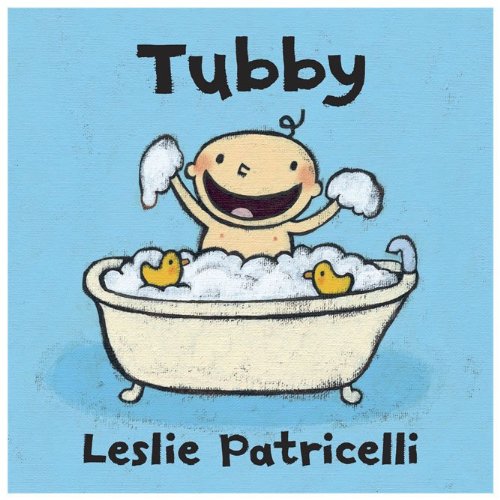
Book Review: Tubby, by Leslie Patricelli (Candlewick Press, 2010)

tubbyRecommended for ages 0-4

In Leslie Patricielli’s book, Tubby, a toddler’s bath time is fun time! Patricelli takes readers through the ritual of bath time from a toddler’s point of view. The toddler begins with the joy of running around naked; after getting into the bath, he plays with the bubbles and gets soap in his eyes – which Mommy makes all better. After getting rinsed off, dried and diapered, baby is all clean and ready to play. The book, illustrated by Patricelli, uses bright acrylic illustrations and bold, simple text to create a fun story that communicates the excitement of bath time and gives parents and guardians the opportunity to incorporate the story into a bath time ritual.

Patricelli’s book Tubby is the companion book to Potty, featuring the same happy toddler who needs to “go potty” and goes on his own adventure to figure it out.  Patricelli also uses acrylic illustrations and bold, simple text to tell this story.

A fun story time activity could incorporate bath time rhymes, like Rub-a-Dub-Dub, that parents could share with their children at home. Librarians can also purchase small rubber ducks from catalogs like Oriental Trading and hand them out at story time.

Posted in Preschool Reads, Toddler Reads, Uncategorized

Book Review: Baby in Car, by Monica Wellington (Dutton Books, 1995)

baby in a carRecommended for ages 0-4

Monica Wellington’s Baby in a Car begins with the question, “What does baby see?” and answers by taking a toddler on a road trip filled with fun things to see from the car. This brightly colored board book is filled with bold, bright illustrations that toddlers will easily recognize, from traffic lights and taxis to flags and umbrellas.  The cartoon style illustration uses gouache collage to provide texture, including the blades on a helicopter, leaves on an apple tree, and the moon’s shading. Young readers will be attracted to the bright pictures of easily identifiable objects, and the childlike lettering further communicates a young, happy tone. Parents and guardians can use the book on car rides, whether to the grocery store or a longer family trip, to keep children happy and begin conversations about their surroundings.

Baby in a Car is part of a series by Wellington that includes Baby in a Buggy, Baby at Home, and Baby Goes Shopping.

Story time activities could include traveling rhymes and fingerplays including Wheels on the Bus and Over the Mountain. The book can be used in a participatory fashion, with the reader asking, “What does baby see?” and allowing parents and children to respond with each picture. 

Posted in Preschool Reads

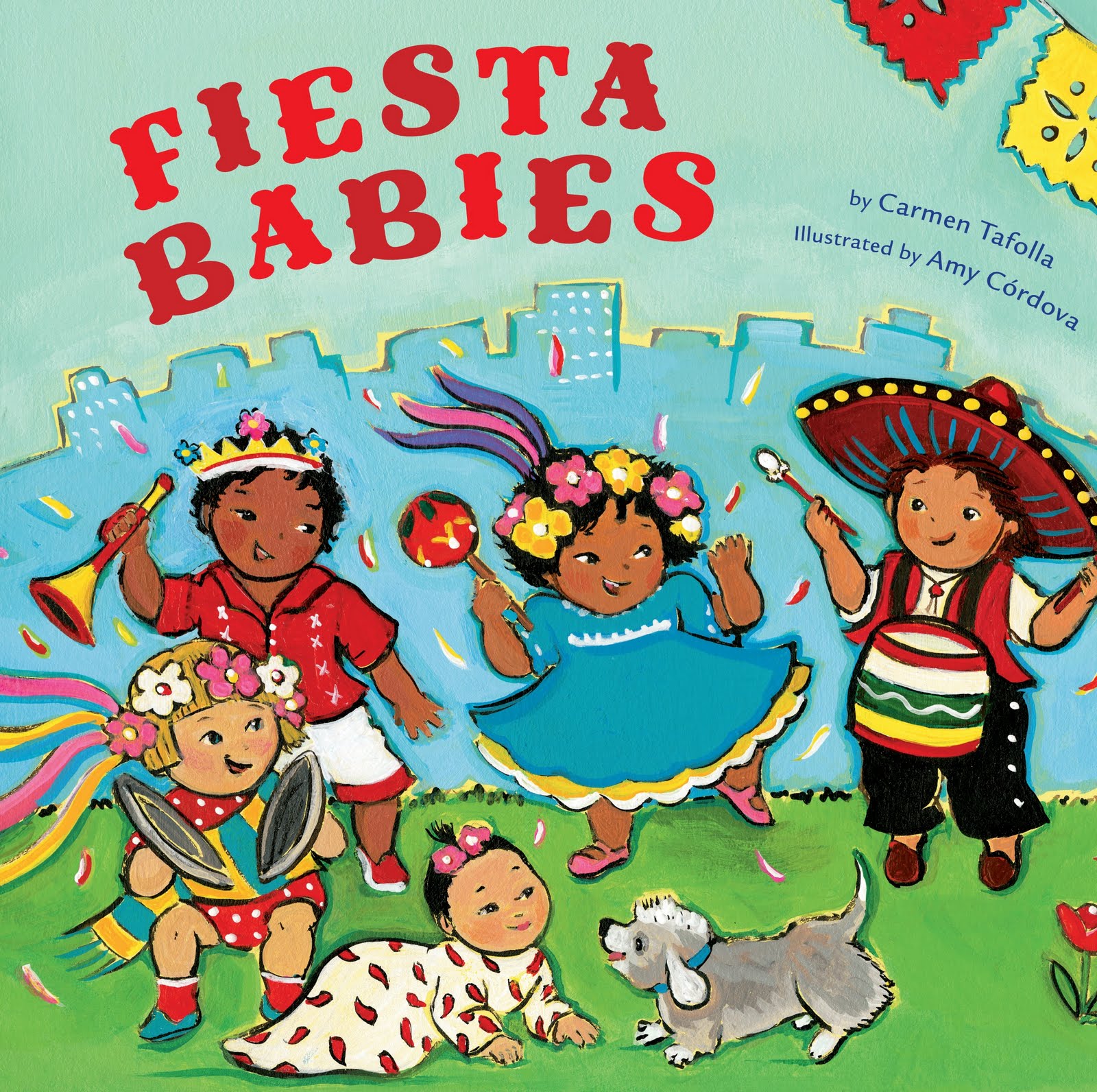
Book Review: Fiesta Babies, by Amy Cordova (Tricycle Press, 2010)

fiesta babiesRecommended for ages 2-5

A multicultural group of babies and their families take part in a cultural celebration, complete with colorful hats, dresses, foods, and dancing. The story, told in rhyme, uses English and Spanish words to bring babies of all ethnicities together in a celebration of Mexican heritage. Amy Cordova received 2011 Pura Belpre Illustration Honors for her bold acrylic colors and brushstroke paintings that bring Ms. Tafolla’s text to life. There are sombreros, serapes, salsa, and happy babies and grownups from diverse backgrounds together to celebrate a grand fiesta. The faces of the participants are joyfully expressive, spreading good feelings. A short glossary at the end of the book defines the Spanish words in simple-to-understand language for young audiences.

The book is a great read-aloud choice. The rhyming text will draw in young listeners, as will the bright colors and exciting new words, for those non-Spanish speakers. There can be a glossary handout for parents and guardians to practice the new words with children after the story time. Fiesta Babies, like Dora the Explorer, can teach children simple Spanish words; some preschoolers may recognize some of the words from Dora episodes. This would be a great multicultural language read-aloud with books like Linda Sue Park and Julia Durango’s Yum! Yuck! A Foldout Book of People Sounds, where children learn common words and phrases in a multitude of languages. There are several websites that offer Spanish language fingerplays and songs and can easily be slotted in to a bilingual story time.

Posted in Uncategorized

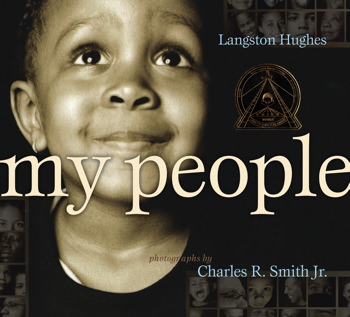
Book Review: My People, by Langston Hughes/illus. by Charles R. Smith Jr. (Ginee Seo books/Atheneum Books for Young Readers, 2009)

my peopleRecommended for ages 3-8

Langston Hughes’ 1923 poem is brought to life with images by illustrator Charles R. Smith in this 2010 Coretta Scott King Illustrator Award-winning book. The book brings together the 33 words of Hughes’ beautiful ode to beauty and sepia-toned photographs of African-Americans of all ages. The photos are close-up, happy, expressive faces against a black background, with additional photos of faces running down the margins of the pages; these are lighter sepia so as not to distract from the main photos and words on the page. The faces appear to emerge from the shadows, and Smith often juxtaposes young and old together, creating a perfect harmony on each spread. The font is large and bold, alternating white and sepia. The endpapers offer a collage of faces in the overexposed, faded sepia we see on the page margins inside.

This is an excellent story time choice for young audiences. The faces will appeal to babies, toddlers and preschoolers alike, and at 33 words, the reader can take his or her time, allowing listeners to enjoy the faces and allow the words to sink in. This would make an excellent Black History Month reading, but can be a reading done at any time. It would be a good addition to a multicultural story time in diverse neighborhoods, which could include fingerplays and songs from other cultures. Participants can be invited to contribute their own nursery rhymes, songs and fingerplays.