Posted in History, Non-Fiction, Tween Reads

Book Review: Chasing Lincoln’s Killer, by James L. Swanson (Scholastic Press, 2008)

Recommended for ages 12+

Chasing Lincoln’s Killer is the story of the plot to kill President Abraham Lincoln, the assassination and ensuing manhunt for John Wilkes Booth and his fellow conspirators. Author James L. Swanson based this YA version on his previous book, Manhunt: The 12-Day Chase for Lincoln’s Killer (William Morrrow, 2006).

A lifelong Lincoln aficionado who shares the 16th President’s birthday, the author wanted to bring his story to a younger audience. He never dumbs down the narrative to reach this audience; rather, he makes it more accessible by featuring over 70 photos of artifacts, newspapers and photos taken from various archives; he summarizes trial manuscripts and interviews, and moves the events along at a pace that younger, less patient readers will enjoy and stick with.

Scholastic’s website offers free teaching resources to use with the book including an audio book excerpt, video interview with the author, and printable Wanted! poster for Booth.

Manhunt received an Edgar Award for the best true crime book of the year in 2007; Chasing Lincoln’s Killer has received recognition as a Young Adult Library Services Association (YALSA) Best Book for Young Adults. Mr. Swanson holds a seat on the advisory council of the Ford’s Theatre Society. He has collected books and artifacts on President Lincoln since he was 10 years old and has written a photographic history, Lincoln’s Assassins: Their Trial and Execution.

Posted in Post-apocalyptic/Dystopian, Science Fiction, Tween Reads

Book Review: The Hunger Games, by Suzanne Collins (Scholastic, 2008)

Recommended for ages 12+
Welcome to Panem, the post-apocalyptic United States of America, divided into the Capitol and 12 districts. Every year, two “tributes” between the ages of 12 and 18 are selected from each district to take part in a brutal contest called The Hunger Games, where they fight to the death. There is only one winner. Sixteen-year old Katniss volunteers to her district’s tribute after her 12-year old sister’s name is drawn.

The Hunger Games is the brutal version of a reality game show – think of Stephen King’s (written as Richard Bachman) novel, The Running Man and you’ll have a good frame of reference. The tributes are given mentors – former winners, condemned to preparing future tributes for the games – and stylists to make them look good. The contestants have to project personality in the week of interviews and preparation so that they have a chance at receiving help from sponsors, who can send food, medicine, and supplies to their contestants during the games. The games are televised for all the districts to watch. Katniss struggles to keep her humanity in the midst of the game and rails against being the Capitol’s pawn.

The book moves at a breathtaking pace with an intensity that starts mere pages in and doesn’t let up until the book’s end. The main characters have a good base for character development that will likely continue in the two following books in the series, Catching Fire and Mockingjay; the others are as developed as they need to be in order to further the story and keep the pace. Ms. Collins makes her point about valuing bloodsport over humanity as eloquently as she is brutal in several key scenes in the book. With a strong mix of violence and compassion, boys and girls have both seized on this series and catapulted it to the top of their reading lists. Katniss emerges as a heroine not only for her strength but her ability to retain her sense of self in the middle of the games. She is a complex, conflicted heroine who resonates with ‘tweens and teens alike.

The Hunger Games has won multiple awards and honors. It is a New York Times and Wall Street Journal besteller, and was one of Kirkus and School Library Journal‘s Best Books of 2008. It is an Americna Library Association (ALA) Notable Children’s Book and one of the Young Adult Library Services Association’s (YALSA) Teens Top Ten for 2009. Lionsgate Studios will release a movie based on the book in March of 2012.

A comprehensive wiki exists for the series and the author’s website offers author and book information. There are many teacher’s resources for teaching the series available on the Web, including Scholastic’s and Hunger Games Lessons.

Posted in Adventure, Fantasy, mythology, Tween Reads

Book Review: Percy Jackson and the Olympians, Book One: The Lightning Thief, by Rick Riordan (Miramax, 2005)

Recommended for ages 10-13

The first book in the Percy Jackson & The Olympians series, The Lightning Thief introduces readers to Percy Jackson, demigod son of Poseidon, and his friends at Camp Half-Blood.

Percy, a sixth grader who’s been kicked out of several schools, suffers from dyslexia and ADHD; he’s never met his real father; and his mother, whom he adores, is married to a jerk who verbally abuses Percy and his mother. When monsters start coming after Percy and he discovers that his best friend isn’t exactly what he seems, his mother helps him escape to Camp Half-Blood in Long Island, where he finds out the missing information about his past and a great deal more. The Greek gods exist, and they have a lot of children populating the earth; Camp Half-Blood is a safe haven for them. Because he is the son Poseidon, of one of the “Big Three” – Zeus, Poseidon and Hades – he is hunted even more than the children of the other gods and goddess. He also learns that someone has stolen Zeus’ master lightning bolt and Zeus think it’s him.

 Charged with finding the bolt and returning it to Mount Olympus in just 10 days, Percy heads out on his quest with his best friend, the faun Grover and Annabeth, daughter of Athena. Getting the lightning bolt back is just part of the puzzle: Percy must also learn who was really behind the theft, and in doing so, will uncover a plot to bring down Mount Olympus.
 
The Percy Jackson series was hugely popular with middle grade readers with good reason: it’s a well-written, exciting series with plenty of monsters, mythology and quests to keep boys and girls alike turning pages. There are well-fleshed, strong male and female characters alike throughout the series and familiar monsters like Medusa and the minotaur make appearances throughout. Bringing mythology to life is a great way to make these stories accessible to a new generation, and giving these demigods learning disabilities like ADHD and dyslexia makes them relatable to a wider audience of readers who may be coping with these issues and rarely get to read about characters who also deal with them.
 
The Lightning Thief is the first of five books in the Percy Jackson & The Olympians series. Riordan’s newest series, The Heroes of Olympus, follows new heroes from Camp Half-Blood but has references to the original Percy Jackson characters.
 
The Lightning Thief received several honors, including designations as a New York Times Notable Book of 2005, School Library Journal Best Book of the Year, and VOYA Top Shelf Fiction List for 2005. It was made into a movie in 2010. The author’s website offers information about all of his books, a link to his blog, and extras including a map of the Underworld and a Greek mythology guide. A Camp Half-Blood wikia offers exhaustive information created by Mr. Riordan’s fan community on all of his books, his characters, and the mythology that breathes life into his series.
Posted in Historical Fiction, Tween Reads

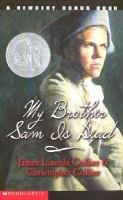
Book Review: My Brother Sam is Dead, by James Lincoln Collier & Christopher Collier (Scholastic, 1974)

Recommended for ages 12+

My Brother Sam is Dead is a look at the Revolutionary War that readers don’t normally get: like the Civil War, this war divided families. We also see a side of the American soldiers that we don’t usually hear about in History class – “our” soldiers weren’t always acting like the good guys, especially to their own countrymen if they weren’t supporters of the cause.

We hear about the Tories and they are demonized. We laugh at stories of them being tarred and feathered, but what My Brother Sam brings home is that Tories were the same Americans that the Revolutionaries were, but they just believed in a different ideal. To the Tories, there was no reason to split with Mother England, who provided for them and protected them. Taxes were a fact of life. Quartering soldiers was a fact of life. To rebel was treason and it was just wrong. When looking at the acts of the Revolutionaries – stealing from, kidnapping and murdering fellow Americans who were Tories – it is difficult to say anyone involved was 100 percent right or wrong. We learn that the Revolution was a black and white issue; My Brother Sam goes beyond that thinking and shows readers that the War was made up of many, many shades of grey.

Tim Meeker is the son of a Connecticut tavern owner whose older brother, Sam, joins the Revolutionary Army under Benedict Arnold while away at college. The relationship between Sam and their father appears to have been conflicted to begin with, as both are stubborn men with strong opinions, and this act leads to a schism within the family that leaves Tim wondering who’s right and who’s wrong Torn between his love for his brother and his love and loyalty to his family, he finds himself stuck in the middle of a far larger conflict when he’s asked to keep secrets about Sam and when his battalion is in the area. Tim sees firsthand the brutality of the American soldiers to his Tory neighbors and he sees the cruelty of the British soldiers. Is there a right or wrong?

My Brother Sam is Dead won the 1975 Newbery Honor and was nominated for a National Book Award that same year. It has also been designated as an ALA Notable Children’s book and was the twelfth most frequently challenged book from 1990-2000 (ALA).

The History of Redding website has extensive information about the novel; Redding, Connecticut is the setting for the story. A 2005 Scholastic edition of the book has an AfterWords bonus feature which includes an interview with the authors, where they compare their story to fellow Newbery winner and Revolutionary War story Johnny Tremain, and discuss parallels between their work, written after the VietNam conflict, and Johnny Tremain, written after World War II.

Posted in Fantasy, Fiction, Tween Reads

Book Review: Alex and the Ironic Gentleman, by Adrienne Kress (Miramax, 2007)

Recommended for ages 10-13

Alex Morningside is a 10 1/2 year old girl who’s often mistaken for a boy; she wears her hair short and is something of a tomboy. Orphaned at a young age, she lives with her uncle in their home above his doorknob shop. When Mr. Underwood, a new teacher, shows up in her sixth grade classroom at the prestigious Wigpowder-Steele Academy, Alex finds herself finally liking school. Mr. Underwood has a good sense of humor and is fun to talk with.

Mr. Underwood also has a family secret – he’s the descendant of a famous pirate family. When he’s kidnapped by a rival pirate family over a long-secret buried treasure, Alex is the only one who can help him. She goes on a journey that will take her through strange places, where she meets equally strange people and one Extremely Ginormous Octopus.

 The book is a fun adventure for young ‘tweens, with enough interesting characters and plot twists to keep a reader’s interest. The only problem for me is in the occasional plodding of the storyline, which bogs down the story and may bore less patient or committed readers. The main characters – Alex and Mr. Underwood, to a degree – are fairly well-developed, and the supporting players don’t really need to be: they aren’t part of the story for long enough to necessitate it.
 
The book has won several awards in the UK and Canada, including the Heart of Hawick Children’s Book Award in 2009. It was shortlisted for the Red Cedar Award in 2009/2010.
 
The author’s website offers the usual biography, FAQ, book and appearance information. Extras include Alex and the Ironic Gentleman desktop wallpaper.